









How the holidays have broken the promise of TNVS

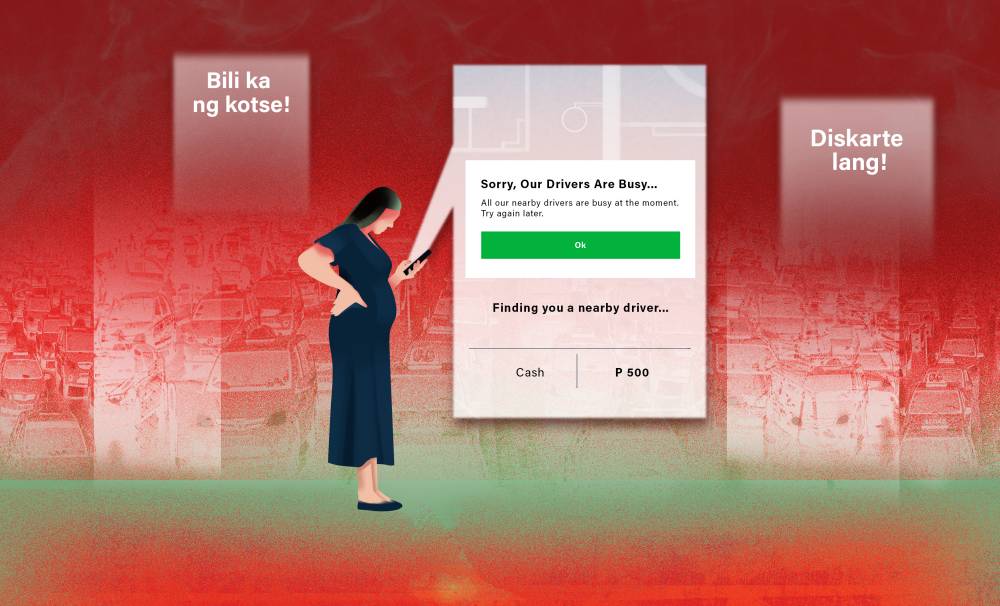
A couple of weeks ago, a seven-months-pregnant woman from Valenzuela posted a rant on Facebook, dressing down one of the multiple ridesharing services available in Manila. This service had an app that showed nearby drivers seemingly ready to take passengers, but because they had the power to choose their fare, they all passed on her bid for a ride.
The soon-to-be mother railed against the injustice of this service’s system and the heartlessness of the drivers for conveniently ignoring someone so clearly in need.
The worst part, I saw, was not that the drivers wouldn’t take her. That’s disgustingly normal these days. No, the worst part is the droves of Filipinos who were insensitive at best and cruel at worst—people who would callously tell her to buy her own car if she wanted a guaranteed ride all the time, even though she was willing to pay for a service that was already expensive.
Around the same time, I saw how a planned transport strike would get in the way of students’ commutes to a particular college in Manila. The school refused to suspend classes, arguing that students should be able to find alternative (read: more expensive for students’ budgets) methods of transportation to school.
Again, more callous and insensitive comments from people on social media, basically telling students on a budget to buckle down and pay more for transportation.
Greed begets greed
As I write this, it is the middle of December, where the holiday rush and slightly uncharacteristic rainy weather have essentially sodomized the ridesharing and private transportation game. Over the past few days, I’ve been unable to book any of my usual rides, even during hours one would normally consider “off-peak,” and even with the tips turned all the way up to the maximum. It’s really become unconscionable.
At the same time, the LTFRB has declared a 19-day cap on Transportation Network Vehicle Service (TNVS) surge pricing, and as expected, drivers are already crying foul. They’re feeling that they’ll be leaving a lot of money on the table in a time of ridiculous demand, and honestly, I totally get that.
It’s easy to call them greedy—and in a lot of ways, greed is a real factor in this mess—but we’re also in this position because of terrible living conditions and unbelievably high standards of living in the Philippines today.
Basically, it’s still greed, but it’s not just the drivers’ and operators’ greed.
A failed system
A decade ago, I wrote about the much-welcome rise of Grab (then GrabTaxi) and Uber that appeared to solve the terrible problem of choosy and rude taxi drivers. It seems easy to clown my then-naive self for thinking that things would always stay rosy when it came to the then-new ride-sharing services, but as it was unprecedented at the time, we also had no idea just how greedy both the system and its players would become.
Ten years later, not only did we not solve the taxi problem at all, but the TNVSs also joined the dark side. As a young Obi-Wan Kenobi once famously cried, they were supposed to defeat the [enemy], not join them. We championed this, so it seems like we’re supposed to live with it, even if this isn’t what we really signed up for.
Every now and then, a new player will rise to try and challenge the status quo, but they always end up joining it. Much in the same way the ride-sharing cars and taxis were supposed to be cool, the motorcycle taxis were supposed to disrupt the system, and now they’re also part of the problem.
Today’s cool new addition is the brand-new EV taxis, and I’m already expecting them to be extremely difficult and expensive to book by this time next year.
The rise of traitorous bootlickers
But again, choosy TNVS drivers aren’t the worst problem. At the end of the day, they are also still pawns in a broken society, and their behavior can still be traced to the roots of survival in a capitalist dystopia.

No, the worst thing about all this is the Filipinos whose spirits have been pretty much broken and battered by the aforementioned dystopia. I’ve already written about how we have turned mean and cruel because of our collective trauma, and that definitely covers the way some of us tell people they aren’t deserving of compassion and kindness unless we have money, and lots of it.
The worst of us have been conditioned to believe that we (as in all of us) deserve our current transport woes, and someone disadvantaged like a seven-months-pregnant woman doesn’t even deserve the comfort and dignity of a proper ride—all because drivers have the absolute freedom to choose their passengers, all in the name of chasing the almighty peso.
They’ve been conditioned to think that the only real and viable solution is to throw lots of cash at a car, as though everyone deserves to sit behind the wheel of one, as though everyone in the Philippines suddenly owning a car wouldn’t push traffic to apocalyptic levels beyond the holiday season—like it wasn’t already.
Bringing out the worst in people
If it wasn’t yet clear what I’m trying to get at: the lack of empathy and consideration from Filipinos is a disease that’s making our broken systems even worse, and it’s what’s letting our corrupt elite get away with what they’re getting away with.
But the real worst part is that we’ll just be all worn down sitting in traffic, too beaten and battered to really do something about it. Some of us will get paid enough to be able to pay for the expensive rides, while the rest will deal with the inhumanity of public transportation. Most of us will just wait for the holidays to be over, consequences of surge fares and long trips be damned.
In the meantime, while the drivers don’t take my bookings this December, I’ve rediscovered public transportation. It’s still not perfect, yes, but at least I’m not paying half a thousand to sit hopelessly in traffic, and they’ve never given me the illusion of a chance at a decent ride.