









How to invest when the world feels increasingly unstable

Early in his career, Tonichi Bonoan realized that working hard alone wasn’t enough to keep up with rising costs, especially housing in the Philippines.
“I was already working my ass off,” he shares. “Even if I saved super aggressively, like let’s say I was making six figures and I saved half of my income, I’d still have to save for 10 years to actually buy something meaningful. And it would probably just be a studio apartment.”
That’s when he turned to investing in stocks, crypto, and other opportunities as a more practical, accelerated path to building wealth. He notes that many young people today are coming to the same conclusion, that traditional saving often can’t match the pace of modern costs.
Which is why it was a pleasant surprise to suddenly see him posting daily financial advice online, which my husband and I have been following religiously. And I was all the more shocked to learn that he’s left Manila and voluntarily sequestered himself in Dumaguete to focus wholly on investing and creating content for his page, @justtonch, every day.
In the span of a month, his content, formatted as short, direct explainers about money, has steadily gathered an audience. His TikTok and Facebook following have passed 15,000. Each time my husband and I check his Instagram, there are a few hundred more followers. Much of his advice is delivered casually, often in Taglish, which makes topics like investing and market volatility feel far less intimidating.
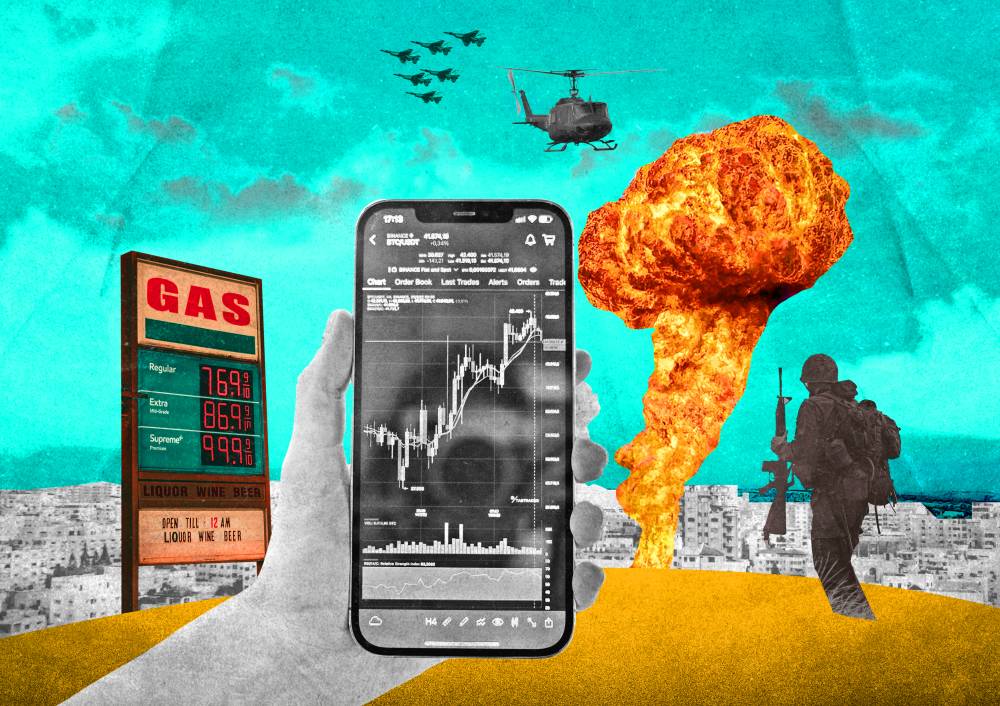
The timing couldn’t be more apt with escalating tensions between Iran, the United States, and Israel, oil prices rising, and everyday people tightening expenses. With all this, many people are wondering the same thing: Where should we actually put our money if the economy slows down, or even crashes?
For Bonoan, the answer is in the fundamentals.
First, build an emergency fund
Before thinking about investing at all, Bonoan says people should secure their financial footing. “Before anyone invests, they should first have an emergency fund,” he says.
But where that money sits matters too, as traditional savings accounts, he notes, often earn almost nothing. “Big banks sometimes give something like 0.06 percent interest, which doesn’t even keep up with inflation.”
Instead, he suggests placing emergency funds in high-yield digital savings accounts, such as those offered by fintech banks like Maya or CIMB, which can offer closer to three to four percent annually. “It’s not life-changing money,” he says, “but at least your cash isn’t losing value while it sits there.”
In uncertain times, protect your cash flow
Don’t buy that P200 coffee. During economic slowdowns, liquidity becomes important. That means trimming unnecessary spending, especially lifestyle expenses that add up.
“Cut the unnecessary expenses,” Bonoan advises. “GrabFood, Shopee, Lazada—those things add up during a recession.” I clutch my pearls and glance nervously at my delivery history.
The goal, he explains, is to preserve cash so that you have the flexibility to invest when opportunities appear.
Conflicts like the current tensions involving Iran with Israel and the United States also don’t just affect oil prices, but ripple through the entire global economy. These include increased market volatility as investors become nervous, disruption of global shipping routes and supply chains, all creating uncertainty. The effects can show up in everyday life through higher prices for groceries or imported goods.
The best buying opportunities often come from fear
One of the more counterintuitive ideas in investing is that the moments people feel most afraid are often when assets become cheapest. “When fear is high, everyone is panic selling,” Bonoan reveals. “Historically, those are the most attractive prices.”
He points out that markets have endured wars, recessions, and financial crises, referencing the pandemic as the most recent occasion. Yet over long stretches of time, they have continued to recover and grow.
“If we look at the world today, we’re seeing progress in technology, renewable energy, global connectivity, SpaceX… These innovations create new industries, jobs, and opportunities that literally never existed a decade ago. “If you zoom out, the long-term direction of human progress has always been up.”
This said, for Bonoan, current geopolitical tensions represent short-term volatility rather than permanent decline.
Don’t try to time the market
Instead of trying to predict the perfect moment to invest, Bonoan recommends a simpler strategy known as dollar-cost averaging.
“Buy slowly, at regular intervals,” he explains. “Maybe once a month, regardless of price.” This approach spreads investments over time, reducing the risk of buying everything at a market peak.
“Don’t try to time the bottom,” he says. “No one really knows when the bottom is.”
Bonoan suggests that young Filipinos start investing using accessible platforms like GoTrade, which allow small, regular investments in stocks, ETFs, and other assets. He notes that the fees have gone up slightly, but it’s still a simple way for beginners to access global markets.
Why younger investors can afford more risk
Age, Bonoan argues, should influence investment strategy. For people in their 20s or early 30s, he believes portfolios can lean toward higher-growth assets, with an aggressive or semi-aggressive approach to investing.
“Younger investors have time to recover from downturns,” he explains. “So I would focus more on high-growth assets.” These might include global stock market ETFs, technology-focused funds, or cryptocurrencies.

Older investors, especially those with families or mortgages, often prioritize stability instead. “As you get older, the focus shifts toward protecting wealth,” he says. That’s where assets like bonds, savings accounts, or gold typically play a larger role.
Still, he believes even conservative portfolios should include some growth exposure. “High-growth assets should still be part of the portfolio,” he says, “just in smaller percentages.”
Looking beyond the Philippine market
Another point Bonoan raises, one that may be controversial, is that he personally invests more heavily in global markets than local ones.
“The Philippine stock market’s returns over the last decade have been extremely low compared to global markets,” he says.
Instead, he favors diversified global exchange-traded funds that track large groups of companies for his portfolio. Among the ones he personally holds, he looks at the VOO, an ETF tracking the S&P 500. Another global ETF called VXUS invests in international companies outside the United States. He also has investments in the NASDAQ 500, through an ETF called QQQM, which tracks the top Nasdaq technology companies.
He calls it “buying a basket” or “buying the entire haystack rather than trying to find the needle in the haystack.”
Bonoan also shares that he’s long been a buyer of Bitcoin, as well as other lesser known blockchains and NFTs. But then again, he’s an expert.
Ultimately, stay positive
Bonoan’s advice seems to emphasize a balance of staying safe and practical while still seizing opportunities, especially as a young investor.
Even in volatile times, he believes in long-term growth as markets recover, innovation continues, and opportunities arise for those ready to act thoughtfully. In such crazy times, patience, prudence, and a long-term mindset are our allies, as fear is temporary, but the progress of humanity is permanent.
******
Get real-time news updates: inqnews.net/inqviber