








Into the wild

“So what do you think?” a friend asked me some years back, holding up an impressionistic painting of exuberant flowers in blues, yellows, and pinks. Pretty as it was, the painting seemed like an unusually bland addition to his collection.
“Look closer,” he urged. And then I understood why he had been drawn to this piece. Each petal, each sepal, each stem was constructed from sinuous letters that curved and compressed and stretched to form words and phrases that were shockingly irreverent, even salacious.
The unexpectedly subversive nature of the painting was quite a revelation, and I had to admire the artist’s twisted sense of humor.
How beauty and ugliness coexist
The audacious manipulation of text and language as both commentary and exploration of modern life, our obsessions, what we hold as sacred, and what we hold as profane, was the artist Tsang Kin-wah’s signature. The painting I’d seen was merely the briefest of glimpses of his oeuvre; he would later become known for his massive text-based multimedia installations.
He would go on to represent Hong Kong at the Venice Biennale in 2015 with a solo exhibition entitled “The Infinite Nothing,” consisting of video projections of words embodying philosophical ideas, inspired by Nietzsche’s existentialist philosophy.
I’d never forgotten the genius of that one flower painting, how Tsang had taken one of nature’s most beautiful creations and challenged our own assumptions of beauty and its association with purity and incorruptibility. But could it be that the rot is always lurking underneath, that beauty and ugliness have always coexisted within the same being?
In biological terms, of course, this is true. Flowers bloom, then they fade and wilt away. We live, and then we die. Such is the incontrovertible cycle of life. But Tsang’s interrogations are of a more philosophical, if sometimes insolent, nature—so to speak.
An allegory of violence and sexuality
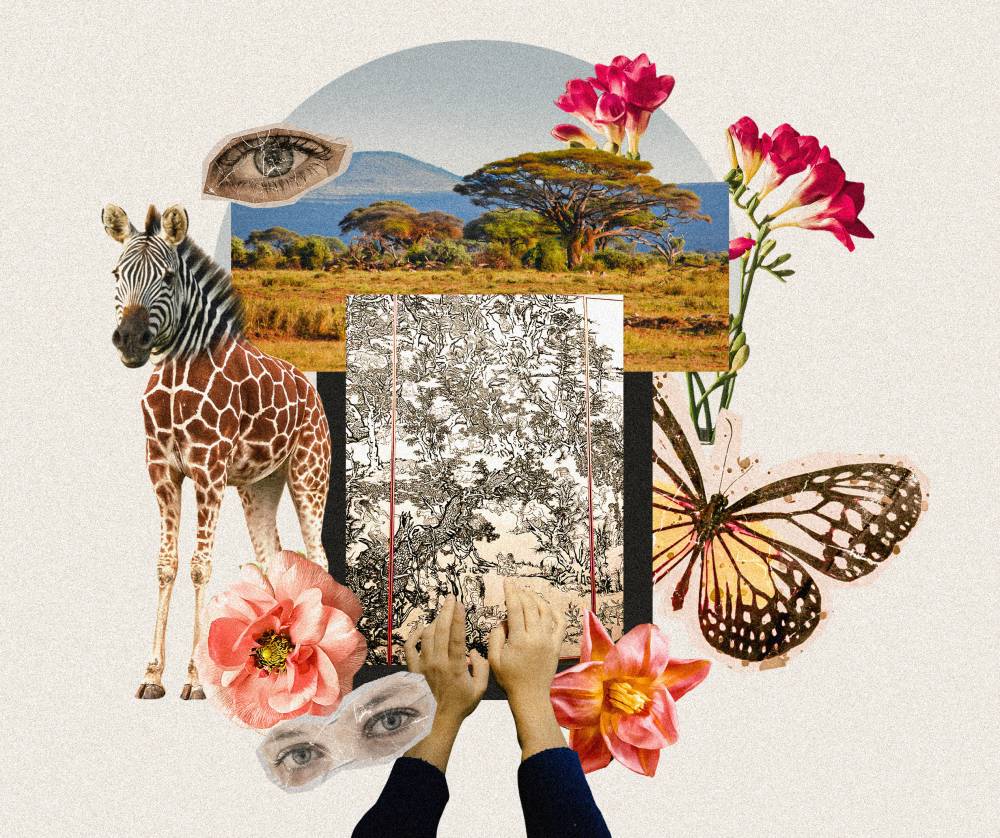
I was reminded of such subversions of nature last week when I chanced upon “Black & White Mustard Seed Garden,” a massive landscape by the Chinese artist Yang Jiechang, rendered in ink on silk and mounted on canvas at M+ Museum in Hong Kong.
What looks like, at first glance, a conventional artwork in the classical Chinese tradition, anintricately detailed and technically superbly executed tableau of nature, turns out to be, on closer inspection, a panorama of animals gone wild, species, both human and animal, cavorting with each other—some in openly sexual contortions, others in playful poses, and yet others clearly stalking their prey.
Fascination morphs into revulsion into disbelief into bemusement as zebras shed their stripes for the giraffe’s spots, antelopes take on the hide of a leopard, a rhino teases a rat, an elephant and a horse perform a mating ritual, while a woman is being devoured—sexually, that is—by a lion.
And that’s just the first panel.
One is simultaneously marveling at Yang’s fine draftsmanship and reeling from the unsettling scenes he’s created. Though I suppose on the one hand, it’s an allegory of the violence inherent in nature, with sexuality itself being an expression of violence, particularly through the lens of miscegenation or the transmutation of species.
On the other hand, it could be a statement about the inevitability of hybridization as the antidote to an increasingly polarized, racist, and anti-immigration world.
Perhaps there’s a clue in there as to why so many MAGA (make America great again) men, those hyper-macho, trad wife-loving but critical thinking-challenged species of sheep, tend to choose to marry immigrant women from disadvantaged countries. Who knows?
A scene without boundaries
Meanwhile, the Los Angeles-based artists The Haas Brothers have long lived in their own wild, witty, and woolly menagerie of imagined beasts. These fanciful creatures take surreal and voluptuous shape in their sculptures, lighting, and furniture as well as their wallpaper. In 2014, they debuted a handmade, limited-edition wallpaper design they created for Flavor Paper.
Like Tsang Kin-wah’s flowers and Yang Jiechang’s garden, the wallpaper was insane and provocative, funny in parts but also discomfiting.
The twin brothers, Simon and Nikolai, showed me a sample on their iPad over lunch in New York one day that spring. There was a cartoonish quality to their interpretation of the Garden of Eden that immediately made me smile.
When I looked closer, however, I found that these animals were not the picture of bucolic innocence; some were in a drunken stupor, others were mid-coitus, while a few were flying across the sky in a drug-induced haze. Like Yang’s landscape, it is a scene without boundaries: predators alongside prey, cheetahs next to elephants, and all that. The surreality of it all was heightened by the paper’s glow-in-the-dark effect at night when the lights were turned off, complete with twinkling stars.
The brothers explained to me how they had been inspired by a 1976 movie called “Animals Are Beautiful People,” which portrayed animals in the wild in southern Africa through a comedic lens. So Simon and Nikolai transposed that humor and subverted it even more so that the animals attained a degree of anthropomorphism that makes one think, “Hang on a second, I’ll have what they’re having.”
Unfortunately, what the animals were on was the juice of the marula fruit, which has a narcotic effect, but does nothing at all for humans.
Hybridization has its limits, I guess.