









Is ‘Heated Rivalry’ the thing to change attitudes about gay pro athletes?

Twelve years ago, the NBA was rocked to its very core—not by a trade, an injury, or a free agent signing, but by a journeyman player named Jason Collins coming out as gay. It was a huge deal for those who weren’t around or aware enough at the time. Remember, we were in the early 2010s, and millennial culture had only just begun shaping the world and pissing off hardened boomers and Gen Xers.
In a world that was being governed by Barack Obama and the liberals, Collins felt it was perfectly safe to come out. And while Collins’ coming out didn’t really inspire droves of closeted athletes to start living their authentic lives, there were a few who followed Collins’ lead, such as NFL players Michael Sam and Carl Nassib.
But fast forward to 2025, and here comes “Heated Rivalry.”
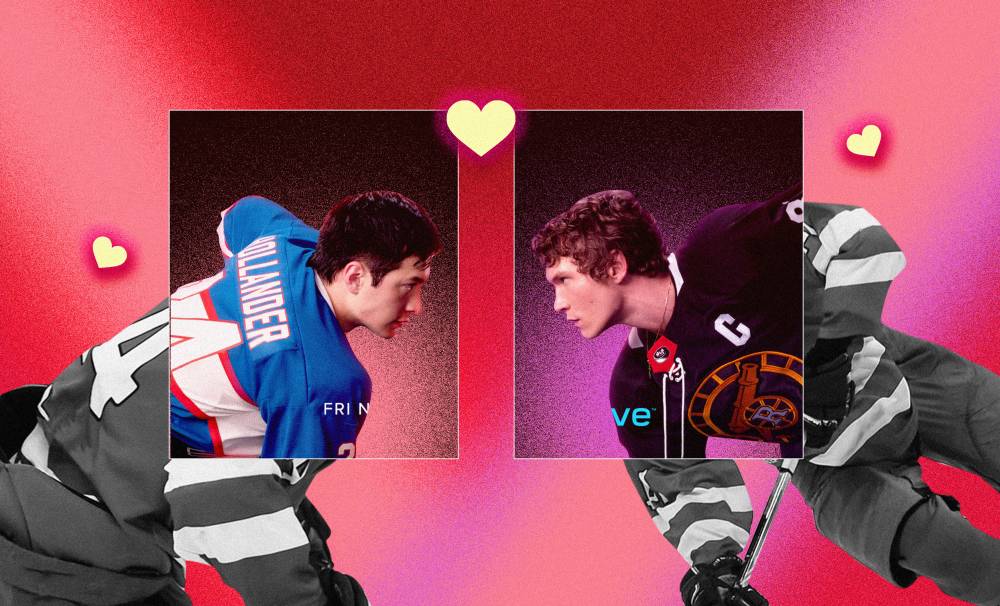
I don’t think I still need to explain to you what it is and why it’s gotten the culture in such a chokehold. The SparkNotes summary is that it’s about two ice hockey players falling in love and lust with one another. First, it was a steamy book released back in 2019, and now, it’s a steamy drama series you can watch on HBO Max.
Thawing a sport that’s cold to queerness
And, dear reader, the impact the series has had on real-life hockey culture is pretty notable.
First, former hockey player Jesse Kortuem publicly came out via his Instagram account. While Kortuem didn’t play for the NHL during his career, he’s still a pro, and he directly credits the show for giving him the courage to share his truth. Hudson Williams, who plays Shane Hollander on the show, even came to “The Drew Barrymore Show” to congratulate him.
Another player, Matt Kenny, said the series gave him a “five-day panic attack” because of his own feelings about being gay in hockey. The sport’s highly toxic masculine culture, evidenced by players’ and fans’ traditionally conservative leanings (the NHL itself had banned the expression of LGBTQIA+ support on the ice), made him feel “unsafe” enough that he chose to walk away from the sport he loved.
And a third athlete, but this time a Gaelic football player named Kevin Penrose, also came out—specifically citing how “Heated Rivalry” has made masculine queers more visible and mainstream. For him, “Heated Rivalry” was moving enough to get him to come out on Instagram, but the internalized chauvinism was enough to make him panic again after his public post.
While these may be only three men, Williams has also shared that multiple professional athletes still in the closet have privately reached out to him, thanking him for how the series is helping and allowing them to navigate their own sexualities and relationships.
When I was discussing this story with my editor, we thought that one or two men might have been a coincidence with the timing of “Heated Rivalry’s” release, but it’s pretty clear now that the show has thawed a lot of the ice.
The power of very real writing and representation
It’s not just your imagination: The writing on “Heated Rivalry” is powerful, accurate, and effective enough to cause these effects on athletes. The experts actually agree. “The series refuses to strip its characters of masculinity or competitiveness to make queerness palatable,” says clinical and sports psychologist Tess M. Kilwein, Ph.D., ABPP, CMPC, in an article for Psychology Today. “They are strong, dominant, high-performing athletes. That matters, as research has consistently shown that rigid stereotypes linking athleticism with heterosexuality remain a core barrier to inclusion in sport environments.”
“It is a legit claim that the last closet for men is sports, especially in the North American context,” says Charlene Weaving, a professor of gender studies at St. Francis Xavier University, in an interview for the Uncloseted Media Substack, which explains that there are no active gay athletes in the major sports leagues despite queerness being tolerated more by the current generation.
“If you look at sports, it’s as if what’s happening in society is amplified. Sports is the worst place for sexism and homophobia. There’s so much pressure to adhere to a heterosexual persona,” Weaving adds.
“Hockey remains one of the most hypermasculine sport cultures, with no openly gay or bisexual players at the highest professional levels,” Kilwein adds. “Visibility is politicized through bans on pride jerseys and stick tape. It is no surprise that silence is seen as safer. Gay athletes frequently report that acceptance is conditional, tied to performance, discretion, and not disrupting the status quo.”

“[The players told me] it doesn’t matter if you’re gay, or concussed, or you’ve been sexually abused or have mental health issues—none of those are okay because you are a distraction,” says Cheryl MacDonald, former co-chair of the western Canadian board of You Can Play, a group that promotes LGBTQIA+ inclusion in sports, in an interview with The Guardian.
Kilwein goes on to emphasize the power of representation in popular, visible media—something that conservatives and bigots tend to discourage and fight back against because of the challenges to their traditional worldview. Ice hockey is especially a fertile ground for stories like these because of the sport’s hypermasculine culture.
“It is not just about seeing queer athletes exist,” explains Kilwein. “It is about seeing their lived realities understood. The compromises. The isolation. The exhaustion of adapting to systems that reward performance while punishing authenticity.”
“Queer athletes are never just queer,” she adds. “Clinical and performance work that ignores intersecting identities misses the full psychological picture.”
So remember, the next time you see some insensitive Neanderthal question why this or that character has to be gay or queer or a person of color or a woman—or anything other than the default white male—and why they are “political,” it’s because straight maleness (and whiteness, as the case may be) was never the default. Diversity exists and is unforced because the world is diverse.
Works like “Heated Rivalry” is not insistence—it’s one reflection of the reality around us. And the more we get things like this, the more we are able to remake people’s perception and make the ashamed feel seen, little by little.
Maybe, despite the noise, we could still get to that better, kinder world after all.