








Les Misérables finds new power in the troubled times of 2026

I grew up listening to “Les Misérables,” the Cameron Mackintosh-produced musical by Alain Boublil and Claude-Michel Schonberg that is based on the novel by Victor Hugo. The music of Schonberg and the lyrics of Herbert Kretzmer (from the original text of Alain Boublil and Jean Marc Natel) are large in scale, both in sound and in emotion. A little kid could really eat that up for the big-ness that it has.
Later, I was “indoctrinated” by my father to heavier, more complex and nuanced musicals—Sondheim, Kander & Ebb, Yeston, Ahrens and Flaherty, and so many more—but every time I hear a song from “Les Misérables,” my ears would perk up, and I would start singing along.
Growing up as a pretentious musical theater kid, I would casually state that “Les Misérables” was a “pop musical” in comparison to my favorites, but know this: When “One Day More” would play, I’d try to sing all the voices—even if I can’t sing.
But growing up (and growing older) with this musical, you kind of forget what it is about. Yes, there’s a revolution and one man’s journey, Jean Valjean, towards some manner of goodness, despite all the ways the world will test you to stray. But when you hear those songs as a kid, you kind of sing along and forget what the musical is really about.
I’ve never seen the show live. I’ve seen some songs performed on YouTube, and I’ve the concert performances on video—the 10th anniversary concert with Lea Salonga as Eponine and the 25th anniversary concert with Lea Salonga as Fantine—but never got to see the show live. It has always escaped me until now.
The power of live theater
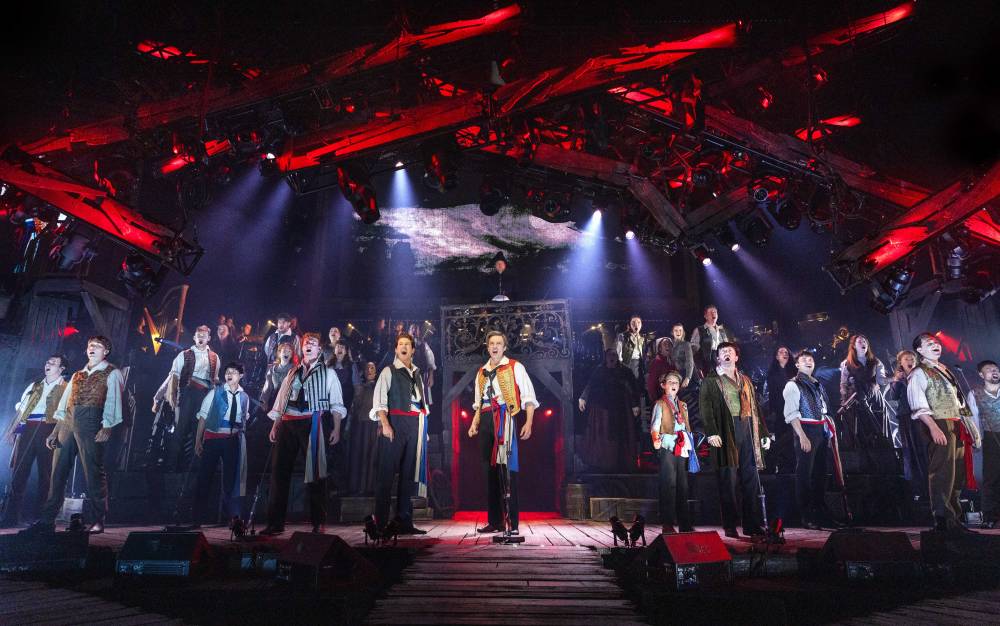
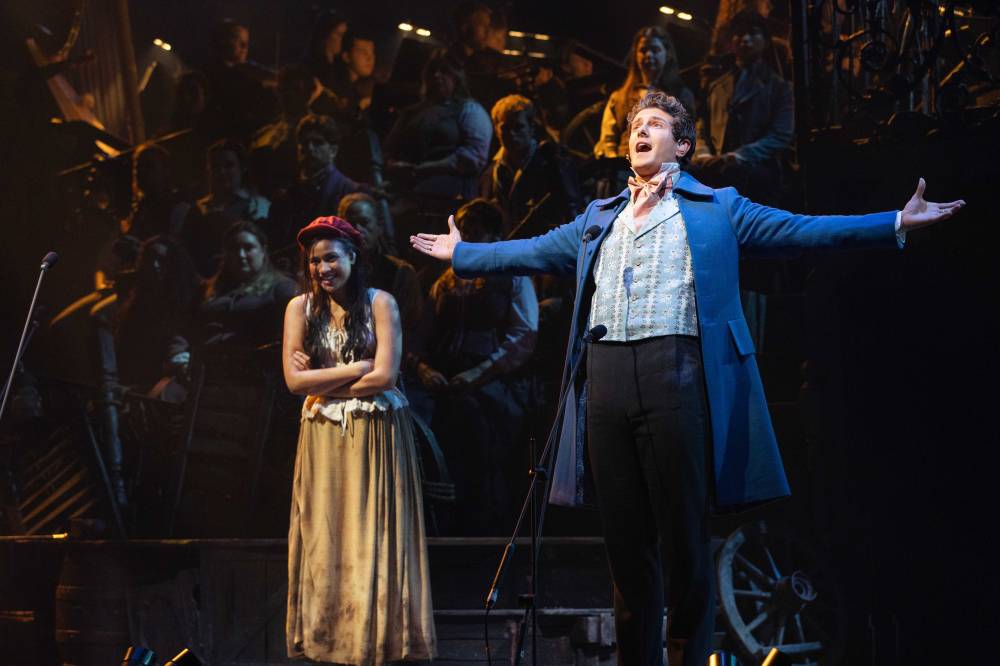
Last Jan. 20, Cameron Mackintosh, along with Nick Grace Management and GMG Productions, opened “Les Misérables: the World Tour Spectacular” at the Theater Solaire. It’s not the show in itself, but a concert staging.
There is a lavish set design by Matt Kinley and costumes by Andreane Neofitou. The set includes a moving bridge and a barricade that is lifted in and out of the stage for full effect. The costumes are bright and arresting, allowing you to focus on the players as they stand in front of the mics and sing—some more than singing but really performing the piece—with the direction of James Powell and Jean-Pierre Van der Spuy. It’s a concert, but “Les Misérables” is practically a musical that is sung-through.
And much like the movie, no dialogue is needed. It’s all sung, so a concert is almost like the next best thing.
Sitting in the theater and watching this musical unfold, I was struck by all the things I never picked up about the play when I saw the concerts on video or listened to the songs over and over again. Maybe it’s because I’m older; maybe because of the times we live in—this is probably a major factor—but I’d also like to think that the power of “Les Misérables” comes from the power of the music, the songs, and the visuals all coming together right in front of your face.
The energy of the songs—and that magnificent orchestration (more on this later)—amplify the narrative’s core, and I realized how relevant this musical is now more than ever.
There is so much injustice in the world
The whole story of “Les Misérables” is centered on the injustices of this world—the harshness of the laws that protect the rich and not the poor—and the way that many of the characters react to these injustices. The revolutionaries—like Marius and Enjolras—fight against it even when they are sorely outmatched. Jean Valjean focuses on his own redemption, fighting tooth and nail to protect his young ward, Cosette. The Thenardiers use the chaos to enrich themselves. Javert wholeheartedly enforces the law, almost stripping him of his own humanity.
Despite the melodrama—all the worst things that could happen to these characters do happen in this musical—the message rings loud and clear, and it couldn’t be a simpler one: There’s so much injustice in this world. We have to stand up and fight it.
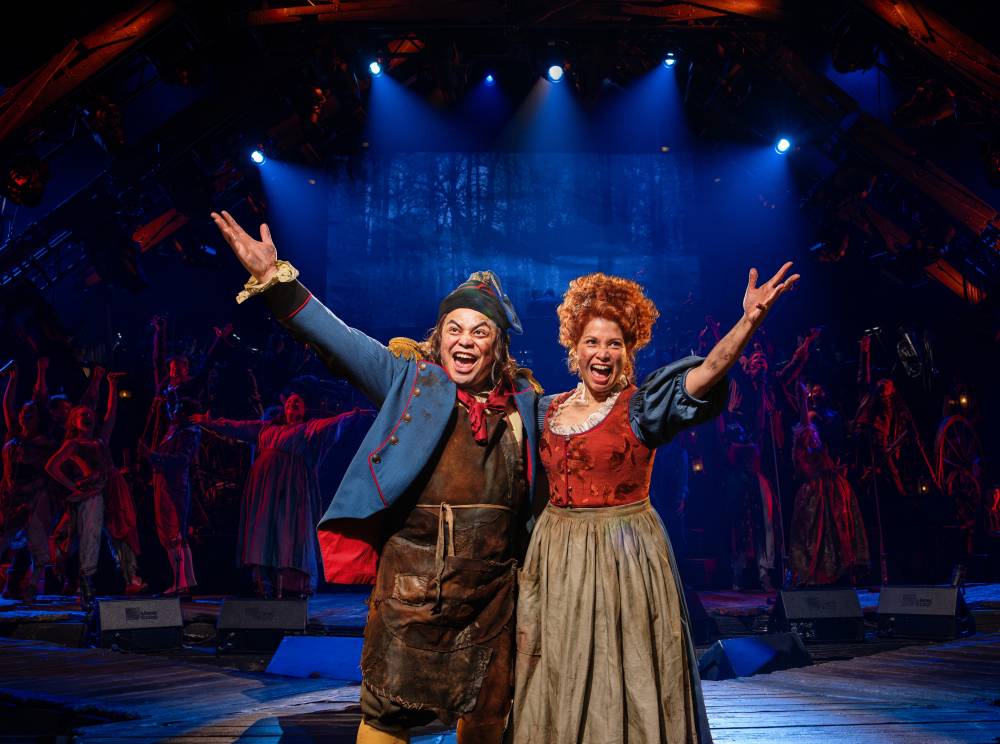
“Do You Hear the People Sing?” becomes so much more powerful when all of this unfolds before your eyes. And it’s only now—with Red Concepcion and Lea Salonga as the Thenardiers, delivering a scene-stealing bravura performance—that I see how significant their characters are to the whole show. Because they survived the bloody revolution and have managed to enrich themselves greatly in the aftermath of the conflict.
In our country, how many people do we know have managed to do the same in the aftermath of every election, of every political scandal or national crisis? I don’t want to say “flood-control projects,” but there, I said it.

“Do You Hear the People Sing?”
It is also very different to hear the music live, in particular. Unless you have the most state-of-the-art sound system, could you really hear the intricacies of Schonberg’s score? The Theater at Solaire probably has the best acoustics that I’ve ever experienced on a Philippine stage. The show’s magnificent orchestra—with orchestration by Stephen Metcalfe, Christopher Jahnke, and Stephen Brooker—beautifully rendered the score, though they increased the tempo in many of the songs, maybe to shorten the play to under three hours, so that you could hear every instrument clearly while still bringing out the glorious symphony of the score.
The brass section and the oboe were particularly moving to me, and hearing it at its full force, along with the whole cast and the ensemble, got into my system.
I now fully understand the power and the enduring legacy of this show. In these troubled times of political unrest and the blurring of our moral centers —whether it be in real life or on social media—a show like “Les Misérables” can emphasize the importance of challenging what is wrong (even if we don’t win) and the need to defend those who cannot defend themselves.
What a show. I’d love to see it again.
******
Get real-time news updates: inqnews.net/inqviber