











Mary, Mary, quite contrary

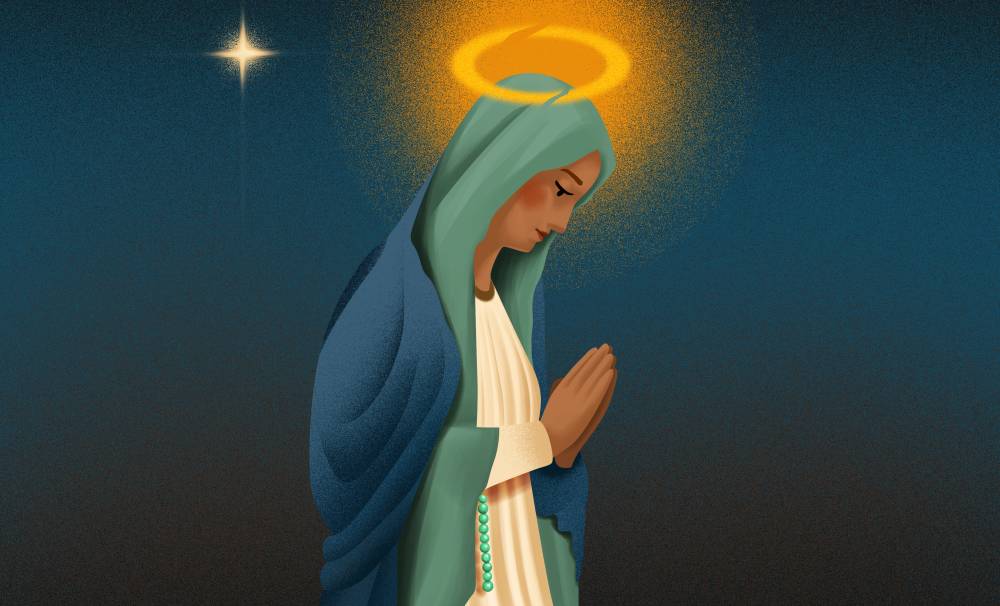
Scripture is rather scant on what Mary, the mother of Jesus, might have looked like, but if there’s one thing we can be sure of, it’s that she was not white.
The many faces of Mary
The earliest images of her—a painting on stone found in the baptistery of a 3rd century Christian church in Dura-Europus in Syria, as well as a fresco on the Priscilla catacombs in Rome dating back to the same era—are vague, her face indistinct, but her gestures consistent with the lore surrounding the birth of her son Jesus.
In the Dura-Europus painting, she is depicted fetching water from a well; scholars believe that this alludes to the annunciation, the moment the angel appeared to her with a message from God that she was to bear his child. The Priscilla catacomb fresco, on the other hand, refers to the presentation of the Infant Jesus to the Magi from the East.
As Christianity spread throughout the Roman empire, imagery of the Virgin Mary began to proliferate, mostly as painted icons or mosaics. Some show her as the Madonna carrying the Christ child; others have her reigning as the queen of heaven. In all these depictions, she is presented as she was imagined to be (if she did exist): a brown-eyed, dark-haired, olive-skinned young woman likely still in her teens.
In other words, albeit idealized in portraiture, she must have looked like many other Palestinian women of the time, for she was Palestinian, a Semitic Jew, a peasant from Nazareth.
Mary as the feminine ideal
Mary came to represent the feminine ideal, i.e., the devoted mother and queen of heaven, and her features were similarly idealized in early Christian and Byzantine art.
There is the Madonna from the Sta. Francesca Romana in Rome, rendered in encaustic on wood, that echoes the Graeco-Roman style of portraiture prevalent at the time, writes H.W. Janson in his encyclopaedic “History of Art”—”the heart-shaped outline of the face, the tiny mouth, the long, narrow nose, the huge eyes under strongly arched brows.”
The same features can be gleaned from an exquisite 7th-century icon painted on wood, the Agiosoritissa Icon. These two paintings seem to balance both strength and delicacy, much like the qualities mothers have always relied upon to navigate the world.
A new, whitewashed Mary
With the dawning of the Renaissance, however, a new Mary began to emerge—fair-skinned, light-haired, and blue-eyed. In the hands of artists like Fra Angelico, Fra Lippo Lippi, Leonardo da Vinci, Raphael, Sandro Botticelli, and the like, she was still the devoted mother nursing the young Jesus at her breast, or perching him on her lap.
She had, in other words, been whitewashed, undergoing a makeover that was perhaps more representative of the European Christians who now worshipped her. Such is the power of Renaissance iconography that the image we tend to have today of the Virgin has completely erased her Semitic origins.
The same holds true for Jesus Christ, who, again, if he did really exist, has been stripped of his Palestinian Jewishness. This transformation is no accident, coinciding with the colonial fervor that gripped a Europe in search of lands to conquer, resources to extract, and peoples to subjugate through Christianity.
By positioning Jesus as white, the notion of white supremacy was drilled in and upheld, for who but Jesus—and by extension his mother, Mary—could be elevated as the ideal to which all humans must aspire?

The imagery tied to divinity
Interestingly, in the Spanish colony of Mexico, an image of Mary, which came to be known as Our Lady of Guadalupe, is said to have mysteriously materialized on the cloak of a man named Juan Diego and his uncle, Juan Bernardino, in a series of apparitions in 1531.
The Virgin of Guadalupe was depicted as a mestiza, a woman with a mix of indigenous and European features, said to represent the unity of both peoples under one God. Juan Diego himself had been an Aztec who converted to Christianity.
I imagine one latches onto the image of divinity that one relates to. Which is why some people, presumably white, were up in arms a few weeks ago when the UK Post Office released the latest series of nativity stamps to coincide with the festive season. Beautifully illustrated by British artist Paula Doherty, show the main characters—Jesus, Mary, Joseph, the Three Kings, and the angel—in resplendent finery. True to their West Asian (yes, the term “Middle East” is a colonial construct) origins, they are brown-skinned; Mary even wears a veil.
Why should that be so offensive?
I am reminded of something the author Ann Lamott once wrote: “You can safely assume you’ve created God in your own image when it turns out that God hates all the same people you do.”
Amen.