











“Material Instincts”: When women let medium lead

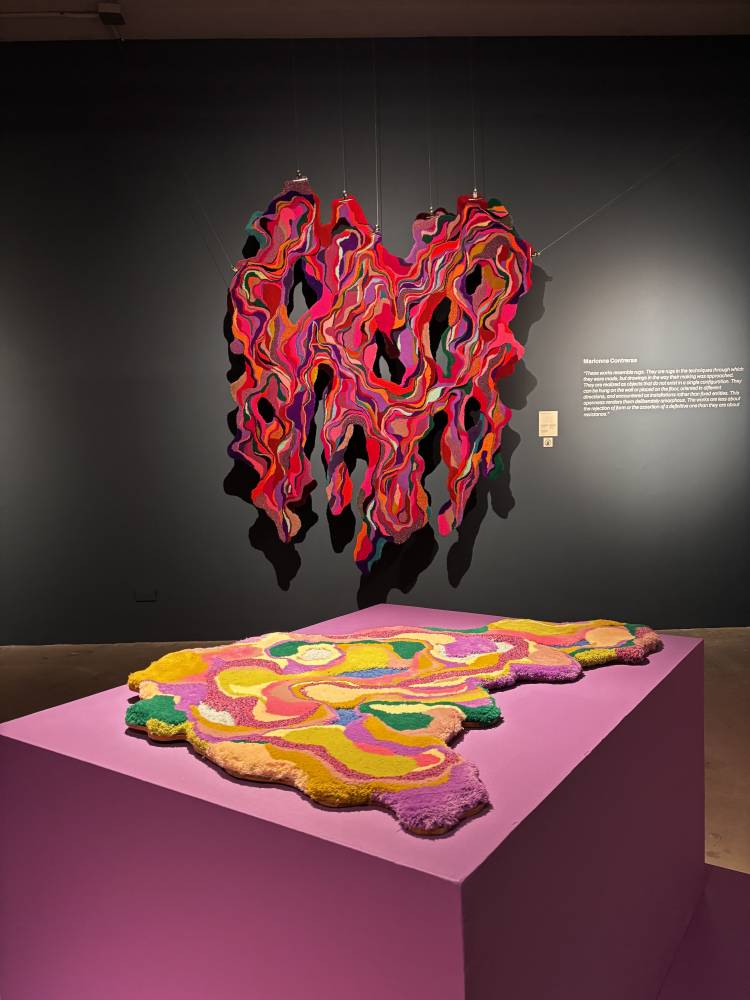
At the opening of “Material Instincts,” I noticed my friend, who doesn’t usually go to art exhibitions, standing still, transfixed in front of a psychedelic textile work by Marionne Contreras. Titled “How to Dissolve a Girl into a Puddle but Beautifully,” it resembled a rug but was hung from the ceiling, its pink and purple textured curves undulating around each other. “I feel like I’m sinking in it,” my friend said under her breath.
This feeling of being pulled in, absorbed, and maybe even slightly disoriented may be the honest entry point into “Material Instincts.” The exhibition at the Metropolitan Museum of Manila, or The M, opened during the peak of art month last Feb. 11, and runs until April 30. Featuring female Filipina artists Contreras, Olivia d’Aboville, Monica Delgado, and Michelle Perez—curated by Bambina Olivares—the show explores material in focus, with undercurrents of the female perspective, reframed.
A woman’s touch, reframed
While “Material Instincts” does not announce itself as an all-women’s exhibition, it subtly addresses assumptions that have long defined that kind of show.
“Women artists have often been marginalized in art, their output relegated to the realm of ‘craft’ or ‘hobby,’” the keen-eyed curator says, pointing to how textile, thread, and other so-called “domestic” materials have historically been dismissed, either because of the common nature of materials or “even identities as being a wife or mother over being artists.” This exhibition does otherwise, centering instead on these female artists’ rigor.
“There is boldness in the materials these artists have chosen to use… physicality in the way they apply their respective media… resulting in a practice that is labor-intensive, time-consuming, and often with a real physiological toll,” she says, noting how Contreras calls it “process fatigue,” with strain to their hands, eyesight, and backs.
The placement of the show also makes a contrast to its neighboring show. “Material Instincts” is installed in a smaller room beside the sprawling exhibition of “Painting Rules” by German artist Peter Zimmermann, who presents sleek, resin and epoxy-layered works, which Olivares describes as “shiny and trippy,” projecting a “a kind of meditative chill, an almost ‘feminine’ smoothness, although his art is also layered and process-driven.”
“Material Instincts” was conceived as a response to “Painting Rules,” adhering to The M’s practice of presenting the Philippine perspective whenever showing international artists. With works that are dense, tactile, and worked over, the mind behind the show notes, “the women’s art seems more ‘masculine’ in this context,” confronting gendered assumptions head-on.
From flatness to form
Formally, the works in “Material Instincts” also resist the historical insistence on flatness in painting—a hallmark of the postwar abstraction that Olivares, citing her favorite art critic Clement Greenberg, traces back to his coined term, “color field painting.” He called it a “new kind of flatness, one that breathes and pulsates… their surfaces exhale color with an enveloping effect that is enhanced by size itself.”
In “Material Instincts,” the artists push outward into space. “I wanted to showcase artists whose work defied the two-dimensionality of painting and embraced the tactile and sculptural qualities of the material… and explored the ambiguity between painting and sculpture.”
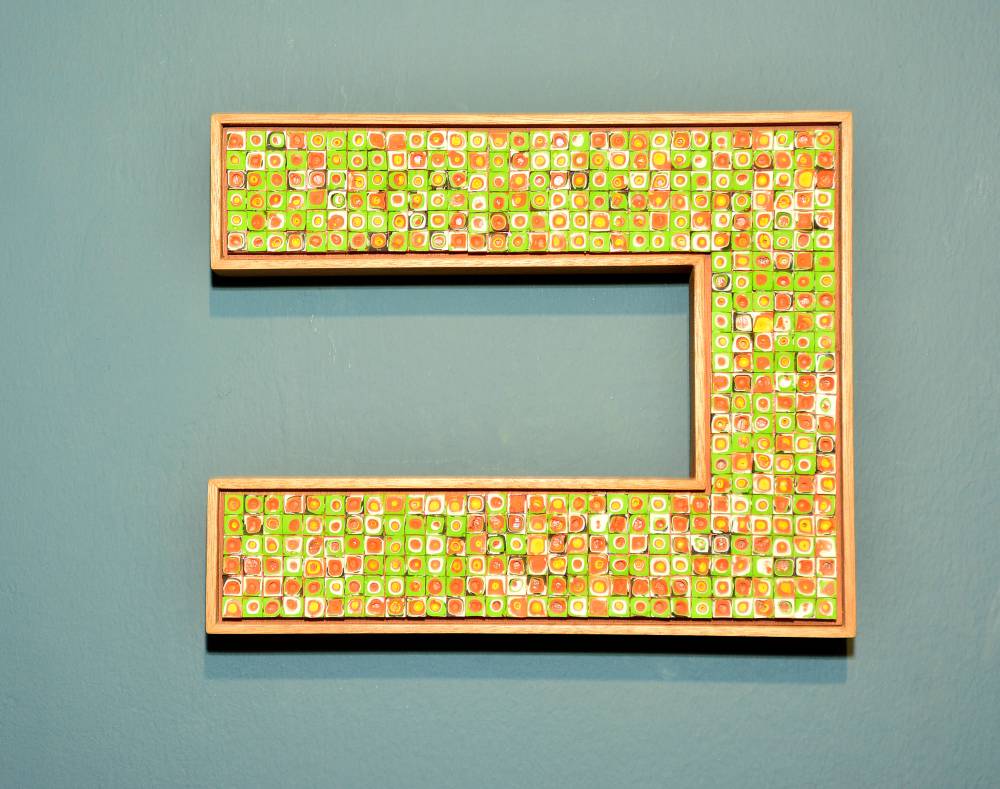
And they certainly do so, all in a meticulous manner. Delgado layers dripping, hardened paint in acrylic, through “Chromaticity #11,” which appears like “paint left to trick down a wall… turned into sculpture,” Olivares gushes. In “Cul de Sac,” Perez constructs complex miniature boxes in “elastomeric paint that has been stretched, dried, rolled together, sliced, shaped, and set against a grid.” These multicolored squares are aligned in a modular U-shape that can be hung any way.
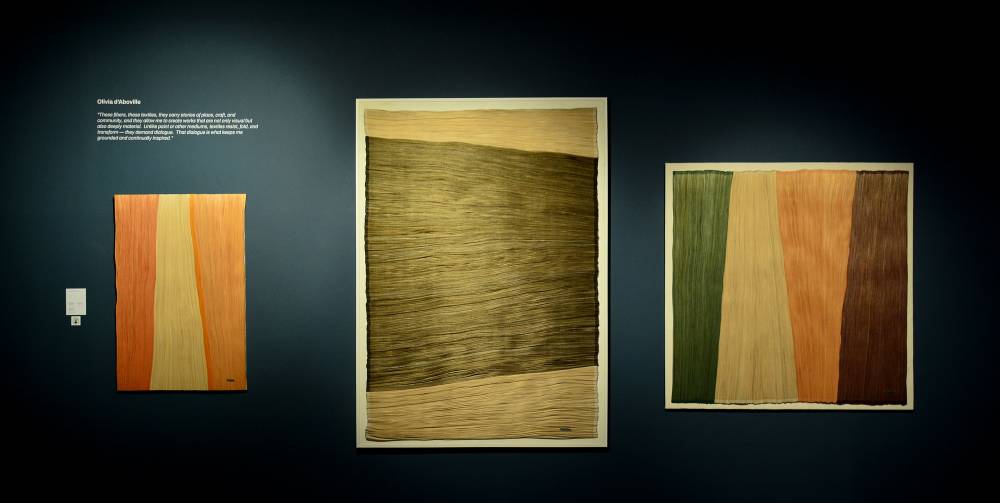
Contreras works with a “riotous river of color” in acrylic yarn that spills and pools, which “makes you rethink not just the notion of a rug, but of art itself as an act of resistance—against gender conventions, academic form, limited and limiting categorization.” Meanwhile, d’Aboville explores the structural and sensory possibilities of textile in “Fields of Color,” with “painstaking manipulation of textile into rows and rows of pleats,” the curator states. “There is a symmetry to her lines… a meditative quality.”
“All four women are artists I personally admire, and whose work I’ve been following for some time,” reflects the curator. “I was intrigued by their originality and singularity: how doggedly almost they work… the potential of their chosen material when manipulated in unconventional ways.”
Recalibration and creative risks
There’s also a broader recalibration happening here in “Material Instincts,” one that feels especially resonant this Women’s Month.
Olivares recalls a recent talk at The M Museum, where former Italian ambassador Giorgio Guglielmino asserted that women artists are often more innovative than men. “Could this perhaps be because women are more resourceful in general and more willing to take creative risks,” she reflects, “as the weight of ‘greatness’ is not something that is thrust upon them?”

Art history, after all, is filled with women who were overshadowed by proximity to geniuses, such as Lee Krasner to Jackson Pollock, Françoise Gilot to Pablo Picasso, or Artemisia Gentileschi to Orazio Gentileschi. “Moreover,” she adds, “the gatekeepers—the gallerists, museum directors, critics, patrons, historians—of art have traditionally been men.”
In the Philippines and around the world, this dynamic continues to shift, too, as women are no longer peripheral but run these galleries, curate exhibitions, write criticism, and shape discourse.
The instinct to look
After working on the exhibition, the curator admits her thinking has evolved. “Sometimes one thinks you can take painting only so far,” she says. “But I really love these constant explorations… fearless experimentations… that blur the boundaries of painting, sculpture, and installation.”
Back in the gallery, my friend is still standing there, her eyes tracing the edges of each work. Maybe this is the instinct the exhibition is pointing to, not just material, but before theory, before the stratifications made by history, the simple act of looking.
And, if you’re lucky, getting lost in it, too.
“Material Instincts,” curated by Bambina Olivares, runs from Feb. 11 to Apr. 30, at the Metropolitan Museum of Manila, located in 30th St., Taguig, Metro Manila