





Rap Carloto’s explorations of corruption, memory, and everyday light

“Buwaya” is a term common to Filipino conversation. The word is a metaphor for greed, pointing fingers at corrupt politicians and likening them to crocodiles. Walk into Rap Carloto’s latest show, curated by Norman Crisologo, “Everything, Nothing, and Something’s,” and you’re bound to spot a crocodile or two in works that tackle the reality of the everyday Filipino.
At 29 years old, the contemporary Filipino visual artist majored in advertising at the Technological University of the Philippines in Manila. And presently, he is known for photorealistic paintings that merge layers of social commentary.
Using oil and acrylic, he captures the movements of daily urban life in suspension.
Walking into Carloto’s latest exhibition at Artinformal, you might get the first impression that the atmosphere feels muted, especially when it’s dark at night. This is because the majority of the gallery walls are painted gray. But give it a little more time, and the space bursts with unexpected energy.
Painting outward from the side of the canvas, Carloto continues his brushstrokes into thick, meticulously painted colored lines on the wall (accomplished with a little help from his painter friends). Through this artistic choice, curator Crisologo also adds layers to the space, stretching beyond the paintings’ boundaries and making the paintings’ scenes more immersive.
Personal and social realities in the room
While there are just four paintings in the room, the expanse of space leaves room to breathe—much needed, as the frames are filled with an overwhelming array of images, textures, and scenes—all of which are based on Carloto’s experiences, feelings, and most especially, what he sees on the daily news.
“Yung mga works ko ay umiikot sa konsepto ng ‘overwhelmed with information…’ Hindi maiwasan na pumasok ‘yung mga social at political issues sa works,” he says. “Lahat ng information na na-a-absorb ko… sinubukan kong i-compress at ilagay sa series na ’to.”
These images blur and merge, with gaps that Carloto says can be “interpreted as wasted time or days.”
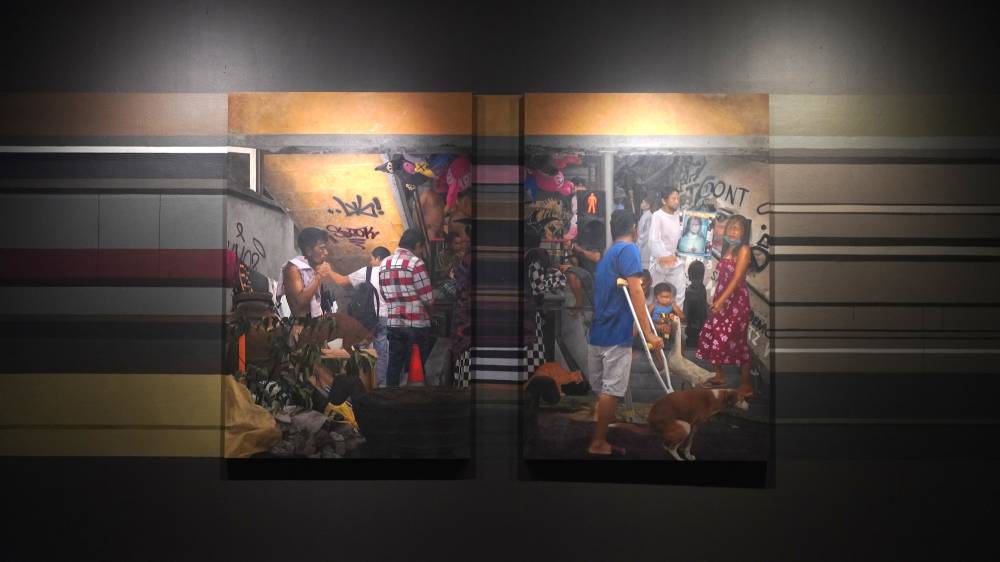
Breaking down walls between indoor and outdoor spaces, Carloto explains that the indoor areas represent his consciousness, while the outdoor elements are analogies of social issues.
Some of these issues come to life in works like “Sometimes we drown, sometimes we drift” with images of a trickling fountain and a man collecting droplets. Surrounding him are neighbors waiting for water, referencing the country’s inconsistent water supply, and of course, the nonstop news of flooding and absent flood control.
He describes the water fountain as a double symbol of constant processing of information that is “never static, minsan calming, minsan sumosobra, at palaging in motion.”
Navigating ups and downs
Other works in the series continue this interplay of personal and political. “Some things, some where, some times” is filled with imagery, such as a balikbayan box. Spot a crocodile here in a bone-white crocodile skull sitting on a pedestal, its gaping mouth holding a piggy bank. In this triptych, Carloto also features images like the police (“ACAB,” we laugh) and a skeletal figure he saw on a trip to the congressional museum.
Meanwhile, “Sometimes the end, sometimes the beginning” captures the literal and figurative ups and downs of life, particularly successes and failures. This is conveyed through figures ascending and descending stairs, struggling on crutches, or confidently bearing photos of the Sacred Heart of Jesus. On the floor, a sinister-looking crocodile lurks.
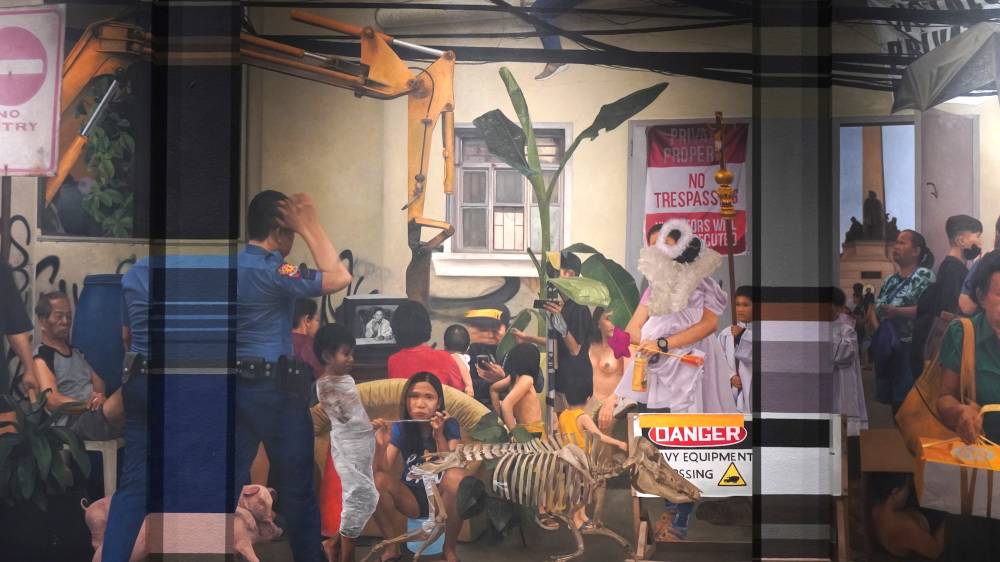
Among the ups and downs are “Something you have never thought of in some way,” set in a distinctive classroom that critiques the Philippine education system. Carloto explains, “Noong binubuo ko ‘yung painting kasagsagan ng issue sa DepEd… Medyo frustrating ‘yung magulong education system, tapos naging DepEd head pa ‘yung Bise ng Pilipinas (Sara Duterte), tapos may mga nagsabi pa na dahil sa magulong education system kung bakit kung sinu-sino ‘yung mga na-elect na public officials.”
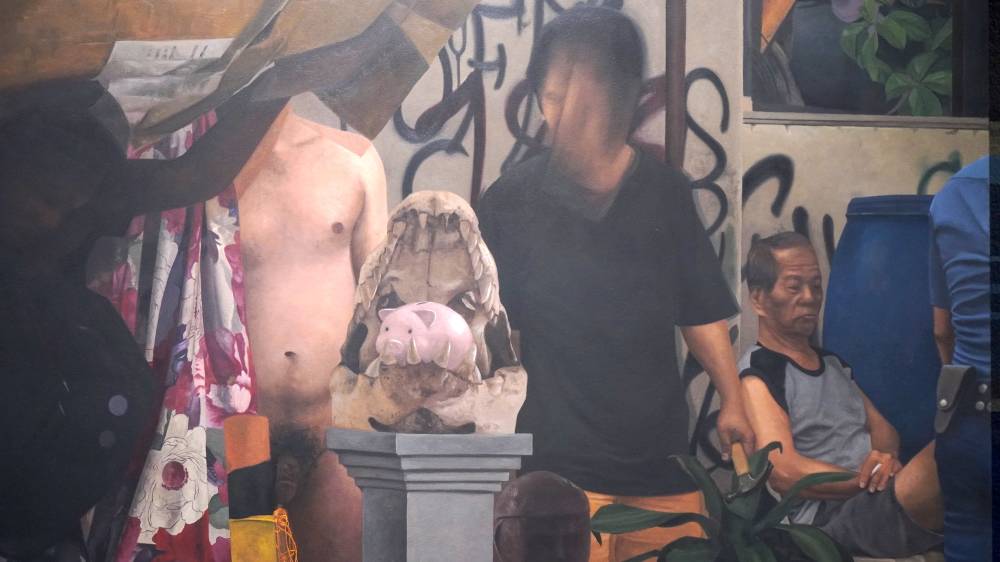
It was from this frustration that Carloto made this painting. The classroom scene is one of the most chaotic and densely packed in the series. Much of it seems nonsensical, with a randomly placed ATM, street sign, armed soldier, baby, nudes, and animals, from a monkey to a cat and geese.
He goes on to say about this painting, “Education is everywhere, puwede tayo matuto from the right or the wrong people. At minsan may ibang edukado ginagamit ‘yung talino sa masama… Makikita dito ‘yung reality at struggles ng education sa isang magulo at distracting na environment.”
Blurring memory
While occasionally hard-hitting in his commentary, Carloto’s process comes from a very personal perspective. Many of his blurred elements originate from photographs he takes while cycling, later translated into soft, dreamlike patches.
Open-ended interpretation is key, too. “Importante sa akin na may space ‘yung viewer kasi iba-iba naman tayo ng pinanggagalingan.”
As visitors navigate the gray and colorfully-lined rooms, and then descend further into the familiar yet faraway urban scenes, we see paintings dense with life and absurdity—everything and everyone converged tightly.
In this visual overload, Carloto mirrors our information-saturated country, with an experience of chaos that is sometimes muted, occasionally frustrating, and often, just too much to comprehend.
“Nothing, Everything, and Something’s” runs from Jan. 15 to Feb. 11, 2026, at Artinformal, C1, Karrivin Plaza, 2316 Chino Roces Ave., Ext., Makati City