








Redefining ‘Made in China’ in 2026

Toward the end of 2025, one article of clothing dominated feeds across the internet. It’s neither from a hundred-year-old European luxury house nor in line with the quiet luxury aesthetic that has taken over public consciousness amid recent economic volatility.
The dark horse? The Adidas Originals Tang Jacket. This track top features the brand’s classic three stripes, but this time with a high mandarin collar and frog buttons, reminiscent of the tangzhuang, or “Tang suit.”
The Adidas Tang Jacket’s virality, spanning hundreds of thousands of posts across TikTok and Instagram, marks another shift away from Eurocentric designs and into East Asian heritage and sensibilities. The rise of Maison Margiela’s tabi signaled this move in September 2023, thanks to the tabi swiper.
However, what separates Margiela’s tabi—which is based on Japanese footwear—from the Adidas Tang Jacket is relative accessibility. One pair of Margiela tabis costs upwards of a cool P100,000, while Adidas’ Tang Jacket is priced at P6,500 and can be found in Adidas Originals stores around Asia—if they aren’t already sold out.
Joining the Adidas Tang Jacket’s meteoric rise are the meme “you met me at a very Chinese time in my life” and day-in-the-life videos set in many of China’s gleaming cities. Chinese culture is now framed as aspirational. This stands as a far cry from earlier negative stereotypes of “Made in China” goods as low-quality and unreliable—and derogatory labels of Chinese, such as “intsik” and “beho,” tossed around in the Philippines.
As we shed away 2025, the Year of the Snake, and enter 2026 with renewed vigor, it’s time to redefine “Made in China.”
The road to Made in China 2025
China’s transformation into a manufacturing superpower started in the 1970s. Despite political and ideological differences, the United States and China engaged in friendly trade during the Nixon administration.
Though not the only manufacturing destination in Asia, China’s large population—of over 980 million by 1980—and labor force working at lower wages made the country attractive to Western companies looking to outsource. American entrepreneurs and companies began sourcing from China, and, consequently, trained Chinese staff and suppliers in the best practices.
The Chinese government also invested in turning cities into hyper-specialized manufacturers by bringing in foreign companies. For example, Shenzhen, previously a fishing village, is now China’s answer to Silicon Valley.
Fast forward to the 2000s, and China’s manufacturing industry earned the moniker “the world’s factory.” Popular exports include textiles, electronics, machinery, and steel. As of 2023, China accounts for 35 percent of the world’s gross production and produces almost three times that of the US, the world’s second-largest manufacturer. Despite China’s gargantuan output, “Made in China” products are perceived as being less durable and reliable compared with goods made in the United States and Europe.
In 2015, the Chinese government launched “Made in China 2025,” a 10-year plan to expand Chinese manufacturing into high-tech sectors, such as electric vehicles (EVs) and artificial intelligence (AI). The aim is to reduce China’s dependence on countries like the US for more advanced technology.
And, in 2025, it seems like China succeeded.
The rise of Chinese brands
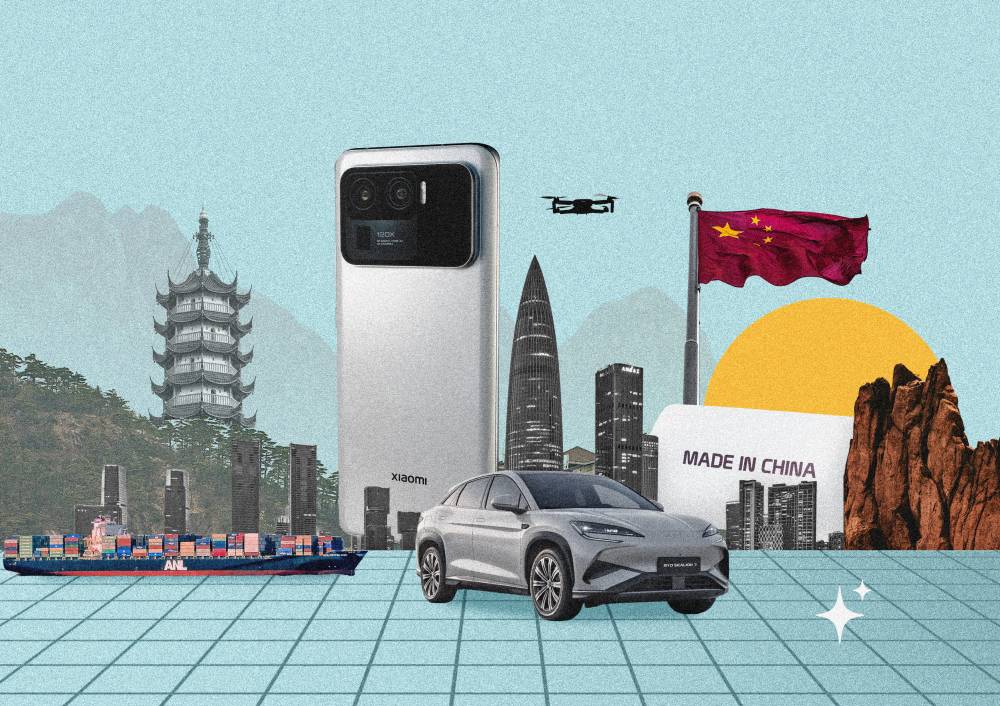
EDSA and other Philippine highways used to be filled with a few car brands: Toyota, Mitsubishi, and Nissan. While these three Japanese brands remain the most popular car brands in the Philippines, another brand is quickly catching up. Chinese EV maker BYD (Build Your Dreams) sold 26,122 units in 2025, up from 4,780 units in 2024. The same year, BYD overtook Elon Musk’s Tesla as the top EV seller worldwide.
Chinese manufacturers shine in other sectors. Xiaomi is the world’s third-largest smartphone manufacturer and, in Q3 2025, had a 14 percent share of the world’s smartphone market. Similarly, camera brands DJI and Insta360 make video cameras smaller than your palm that could be submerged in water or thrown from a few meters away.
What separates the rise of these manufacturers from China’s rise as an industrial power is brand awareness. Consumers buy directly from Chinese brands rather than from Western brands that source from China. In other words, Chinese makers and suppliers no longer need Western companies as middlemen as much.

This allows Chinese companies to move up the value chain to increase the price of goods while still remaining competitive. One brand that exemplifies this is luxury bag maker Songmont, which incorporates Chinese visual culture into all its collections. In 2025, they opened an exhibition in Paris. Another example is Beijing-based Popmart, whose Labubu line of collectibles dominated fashion in 2024 and 2025.
Decades ago, “Made in China” was printed in inconspicuous text on the back of goods from Western companies. Now, the same types of companies are incorporating and crediting, rather than appropriating, elements from Chinese culture.
It took decades for Adidas’ Tang Jacket to become an overnight success.
What this means for Filipinos
China’s ascent as a manufacturing superpower has geopolitical implications. For starters, the Trump administration raised tariffs in April 2025, which affected all goods entering the US and prompted a tariff war with China. There’s also the question of the West Philippine Sea territorial dispute and Filipino distrust in China, with reports adding that around six in 10 Filipinos believe China does more harm than good.
As a Chinese Filipino, seeing China—where my great-grandparents were born—evolve stirs difficult feelings. Derogatory and classist remarks against the Chinese in the Philippines, such as “intsik beho, tulo laway,” and “intsik wakang, kaon, kalibang,” entered the public lexicon during the late Spanish colonial period.
Today, I wonder if those who flaunt their Adidas Tang Jackets sang those nursery rhymes growing up.
Attitudes toward Chinese in the Philippines are changing for the better, and I hope it will continue this way. The late Clinton Palanca wrote, “All I’m saying is that it’s a lot more complicated, and individual citizens don’t always represent the authoritarian fist of the Chinese government.”