







Samm Henshaw—unplanned unplugged

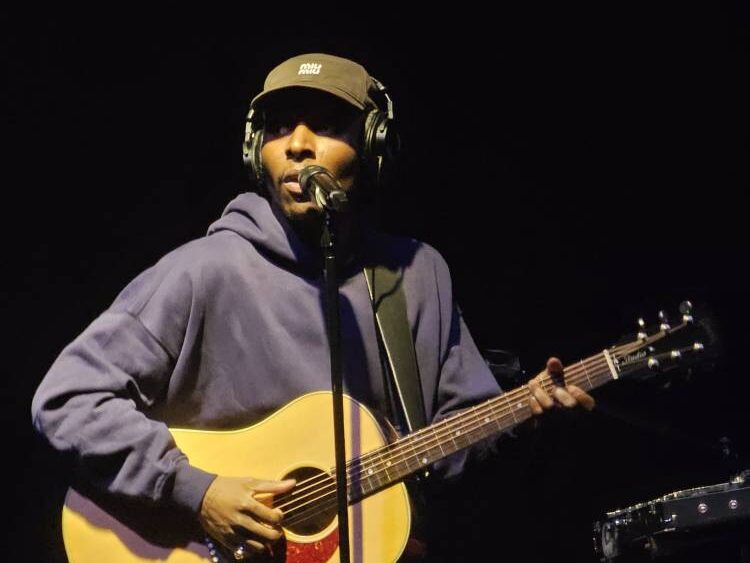
A couple of songs into his recent Manila concert, Samm Henshaw pointed out that, just in case not everyone had already noticed, the setup was “a bit more stripped down” from what fans may have expected. “Logistics… basically,” he said, to chuckles and murmurs of amusement.
Typically, the British singer-songwriter performs with a live band of at least four musicians. This time, he only had two: a bassist and a keyboardist.
That meant missing out on his signature layered production—the textures and colors of a percussion set, the thumping low end of a drum kit, and the dynamic energy that comes with a second guitar. But that also meant that the fans inadvertently got what was, essentially, a rare, unplugged session. And in an already intimate venue like the Teatrino Promenade, one could even argue that what happened was the best-case scenario.
Suddenly, the title of his second album—after which this ongoing tour was named—took on a whole different meaning: “It Could Be Worse.”
The most important instrument
While some instruments didn’t make it, the most important one, mercifully, didn’t need transporting: Henshaw’s voice.
With a soulful, melodic tone and effortless power, he can more than hold his own against the finest pop and R&B singers. At times, his vocal inflections or flourishes—like those distinct yawn-like sobs and windups—brought to mind John Legend. And as someone who grew up in church, the influence of gospel music was unmistakable in his cadence, runs, and swells.
These qualities were best enjoyed in his songs like “How Does It Feel,” a groovy cocktail of soul and funk. There was a little bit of jazz and blues, too. And with its uplifting, choir-like harmonies, he could just as easily have been leading a school choir or a Sunday congregation. Except it was an unassuming Tuesday.
But in any case, the crowd—eager to live up to the Filipino reputation for being some of the best singers in the world—was more than willing to fill the void.
Weaving narratives
He could be romantic singing easy-listening fare, like the cinematic, retro soul-tinged “Sun and Moon”—on which he played the glockenspiel for a touch of whimsy.
He dialed it down even further with “Night Calls,” a barebones soul ballad whose simplicity and nature-inspired imagery (“Waiting for daylight to come and reclaim all our souls”) evoked the storytelling of folk and country music. And without a sonic cushion to lean on, every bit of rasp and gasp was there for all to hear—the better to convey his music’s sense of heartbeat and loss, and its ultimate optimism and resilience.
But more than his singing, he also proved to be a deceptively deft weaver of narrative. Unlike most artists, who simply go through their setlist one song after another, he treated his songs almost like modular musical pieces that he could dismantle to change an arc, or rearrange to create new ones. Perhaps this was owing to the spontaneity and improvisation of his jazz and gospel roots.
Eavesdroppers
It wasn’t uncommon for him to do callbacks on songs he had already performed. Sometimes, he would quote a lyric from one song while performing another. He could also take a specific line as a recurring theme.
Take his plea in “Grow,” “Jesus, take the wheel, I’m at the drive-thru,” which he turned into advice in “Hair Down”: “When you hate the way it feels, child, let Jesus take the wheel.” Or when he sang of literally being broke in “Broke,” and then realized later in “Still Broke” that material riches wouldn’t make up for the emptiness within.
Throughout the show, Henshaw and his crew wore casual fits, moving and performing as if it were just another day in the recording studio—only to realize that there were eavesdroppers when the infectious music inevitably broke everyone into song.
With such a display of vocal talent and sheer musicality, one wouldn’t have remembered the logistics mishap by the time the show wound down. Because, really, with Henshaw unbothered and bent on giving his best, and the crowd raring to listen, it could have been worse.