











Stay awhile: The design of hospitality

In the world of hospitality, it is often the unseen hands that shape the experience. The interior designer translates space into feeling. The baker nourishes, offering comfort, memory, and ritual. The DJ curates sound and cultural rhythm. The chef shapes flavor and tradition. Plant curators let greenery bring life into a space. The potter shapes form and function, creating objects that hold life.
Together, they create an invisible choreography of attention, presence, and care like a chair pulled just as one is about to sit, a glass refilled before it is empty, a room that feels right before you even know why.
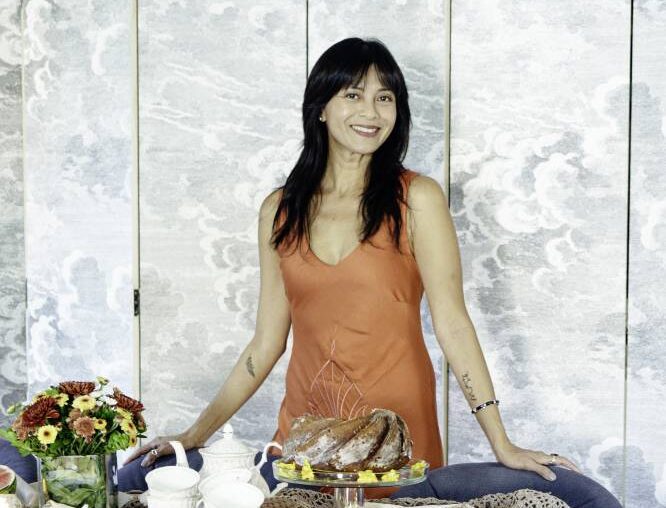
This is where hospitality blends seamlessly into design. This way of seeing is not theoretical at all. It is lived, quietly, by certain people. Few embody this intersection as intuitively as Jenny Diaz.
Life by design
Much like design, her life is a life shaped by contrast and layers.
Diaz grew up in a world shaped by hospitality and creative energy. Her parents ran restaurants and resorts. She was surrounded by artists in her own family. With a photographer brother and a cousin devoted to art, she was raised in an atmosphere where business and beauty, structure and expression, existed side by side.
After a brief, uproarious year in a rock and roll band, she left the Philippines for the stillness of the Swiss Alps, where a different rhythm of life began to take form. That shift drew her toward a discipline that would quietly define a decades-long career.
She pursued her studies at Les Roches, a hospitality school nestled in the Alps, where she was immersed in a global standard of excellence. From there, her journey carried her across Manila, Singapore, New York, Spain, and London, each city refining her understanding of service, culture, and space. She later deepened this perspective by earning a certificate in Arts Management from the Asian Institute of Management.

The art of designing hospitality
And yet, what defines Diaz is not simply her experience, but what she has chosen to do with it.
“Formal education and training in a Swiss hospitality school was good exposure to the high level of standards indispensable in the global arena,” she reflects. “What is more important is the level of passion and instinct we develop, not just in embodying these standards, but by building on them and creating our own experiences.”
It is instinct that sits at the heart of her philosophy. To design hospitality is not to impose a rigid framework, but to cultivate responsiveness—the ability to read a room, to sense its rhythm, its temperature, its unspoken needs. It is a sensorial practice, equally rooted in what is felt and what is seen. “A welcoming space has the power to bridge the gap between one another,” she says. “It requires openness in the giving and receiving of an experience. Like any good vintage, an experience is a snapshot in time. One may never replicate a moment.”
There is something radical in this idea: that hospitality is not about repetition or perfection, but presence. That each encounter is one of a kind, not intended to be repeated but rather to be remembered.
What she describes as a kind of “gustation” of experience speaks to this fully. An amalgamation of warmth, sound, scent, taste, aesthetics, and the tactile. Each element is considered, yet never forced. Together, they form an atmosphere where connection can happen naturally, almost without announcement.

All about the little things
And yet, for all its poetry, hospitality is built on the smallest of gestures. “Presence enables one to anticipate the needs of others before they even ask,” she notes. “Pouring into a glass that is a quarter full. Pulling the chair as one is about to sit. Opening the door for another. Eye contact. The seemingly small gestures that speak volumes.”
“Good service,” she says, “is about being fully present in the moment. It is giving your best in any situation without expecting anything in return. It’s not being attached to the outcome because service always goes beyond the self.”
There is humility in this. A form of emotional intelligence that cannot be taught in manuals—only practiced over time. And perhaps this is why Diaz’s approach translates so seamlessly beyond hotels and restaurants into the everyday spaces we inhabit. She is, in essence, a designer of experience.
“Translating standards into personal space is highly nuanced,” she explains. “What makes me comfortable? A clean home. Elegant dinnerware. Mood lighting. A great playlist. Scented candles. Plants and flowers. Delicious food and wine. A well-balanced guest list.”

These are not extravagant requirements. What elevates them is not cost, but care—the intention behind their curation. It is here that hospitality becomes deeply personal, an extension of one’s values and sense of self.

“Hospitality design is the curation of experiences based on the unique and personal expression of one’s own standards and values,” she says. “This can apply to a corporate setting based on company culture or at home in terms of family values. Each setting involves different personalities, and it is important to have people who are open to learning these standards so they can represent each company or home with confidence and clarity.”
There is structure here—communication, training, consistency—but also something more elusive: the alignment between people, place, and purpose. Not every environment, not every team, not every guest is meant to fit seamlessly.
And this, too, is part of the design.

The most enduring design
To create ease, Diaz believes, one must begin within. “It requires authenticity. Feeling at home with ourselves creates resonance with our surroundings. Ease is all about energy, and energy cannot be manufactured or faked.”
It is a reminder that the most memorable spaces are not constructed solely through objects or aesthetics, but through presence, the ability to meet the world without pretense. And in a world increasingly defined by speed and spectacle, Diaz offers a quieter definition of luxury. “Time is a luxury in this day and age,” she says simply. “The company we keep, and to whom we give our presence and attention, needs to contribute to our overall growth as individuals.”
Experiences, she notes, have also become more curated—less about abundance, more about discernment. And perhaps this is where the true design of hospitality lies: not in excess, but in restraint. Not in impressing, but in understanding. Not in performance, but in care.
To stay awhile, after all, is not just to linger in a space. It is to feel held by it. To be seen, anticipated, and quietly understood.
And that, in the end, is the most enduring design of all.