









The billionaire boys club monopolizes fashion

Fashion is often described as cyclical, and so too are claims of its political awakening. In a recent article, Vogue noted that the industry is “getting political again,” citing moments in which celebrities appear in designer clothes while addressing current issues. Among them was Bad Bunny, who spoke about the United States Immigration and Customs Enforcement (ICE) while attending the Grammys in a custom Schiaparelli suit.
Such instances, however, raise a distinction worth examining. A celebrity’s political statement is not automatically a brand’s political position. Fashion houses like Chanel and Schiaparelli did not even reference the issue when posting their designs, meaning they are not taking part in the issue itself.
Yes, there are political undertones on runways. Collections may incorporate social themes, and designers may gesture toward broader cultural conversations. Yet few global luxury brands issue explicit statements aligning themselves with contentious policy debates.
While fashion may speak politics, its priorities remain rooted in business. Visibility, influence, and cultural authority can be bought or leveraged, and the industry’s newest players are some of its wealthiest.
Billionaires enter the runway
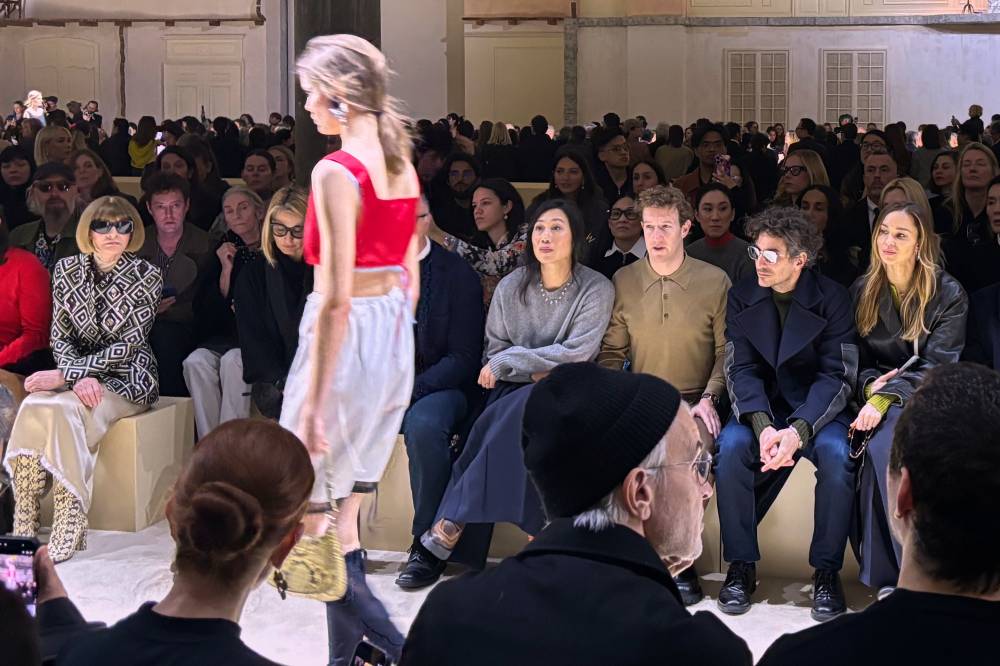
If fashion is careful about politics, it is far more open about business. One of the industry’s newest players is Mark Zuckerberg and Priscilla Chan, who appeared front row at Prada for Milan Fashion Week. Meta is reportedly planning to release Prada-branded artificial intelligence (AI) smart glasses, building on the commercial success of partnerships with Ray-Ban and Oakley. In fact, sales of Ray-Ban Meta glasses more than tripled in 2025, with Zuckerberg describing them as some of the fastest-growing consumer electronics products in recent history.
However, publications such as The Times and The New York Times flagged them as a threat to women’s safety, pointing to hidden cameras that make recording frighteningly easy. Reports also emerged about internal Meta discussions on facial recognition that could identify people in real time using data from Instagram and Facebook. Domestic abuse charities warn that these features could even track or locate survivors of violence.
The risks are not hypothetical. The End Violence Against Women Coalition cited cases of secret recordings posted online, leading to harassment and stalking. In fact, in October 2025, the University of San Francisco issued a campus-wide alert after a man allegedly used Ray-Ban Meta glasses to record women without consent.
Against this backdrop, Prada’s involvement carries weight. Under Miuccia Prada, the house has cultivated a reputation for intellectual rigor and feminist engagement. The irony is hard to miss. Aligning that reputation with surveillance-enabled eyewear exposes the transactional nature of the luxury business.
Especially now that Meta glasses are under scrutiny, the brand name “Prada” makes the devices desirable to women.
In fashion, billionaires rule
Of course, everyone is now aware that Jeff Bezos and Lauren Sánchez have also stepped decisively into the industry. The couple is sponsoring the 2026 Met Gala, an event once tightly curated by Anna Wintour around cultural relevance and creative authority, but one that increasingly reflects the financial structures sustaining it.
But at the same time, in late January, roughly 60 foreign correspondents at The Washington Post sent a collective letter to owner Bezos amid reports of up to 300 company-wide layoffs. These were journalists who had reported from war zones in Ukraine, covered water crises in Iran, and documented political crackdowns. As their desks faced dismantling, Bezos and Sánchez were photographed attending couture shows in Paris, including Schiaparelli and Dior, circulating within fashion’s most exclusive rooms.
The couple was also seen with Jonathan Anderson and LVMH executive Delphine Arnault. Sánchez lunched with Anna Wintour at The Ritz and was reportedly styled by Law Roach. The sequence of appearances suggested not a casual attendance, but a deliberate alignment.

People within the fashion circle didn’t hold back and pointed to the contradiction. Fashion editor and stylist Gabriella Karefa-Johnson publicly questioned the optics on social media, arguing that the industry cannot signal political engagement while embracing figures linked to the issue. She deliberately said, “Amazon cloud systems are the backbone of the Department of Homeland Security’s deportation operations and hold billions of dollars in government contracts that keep Trump’s terror machine alive.”
Fashion is not yet a political force; it remains commercial and is likely to stay that way. It engages with culture when it is profitable to do so and retreats when the stakes are high. And if anything, the current landscape makes this clearer than ever.
The industry will continue to reflect the world, but it will rarely challenge the forces that sustain it.
******
Get real-time news updates: inqnews.net/inqviber