






The many, many religions of everyday Filipinos

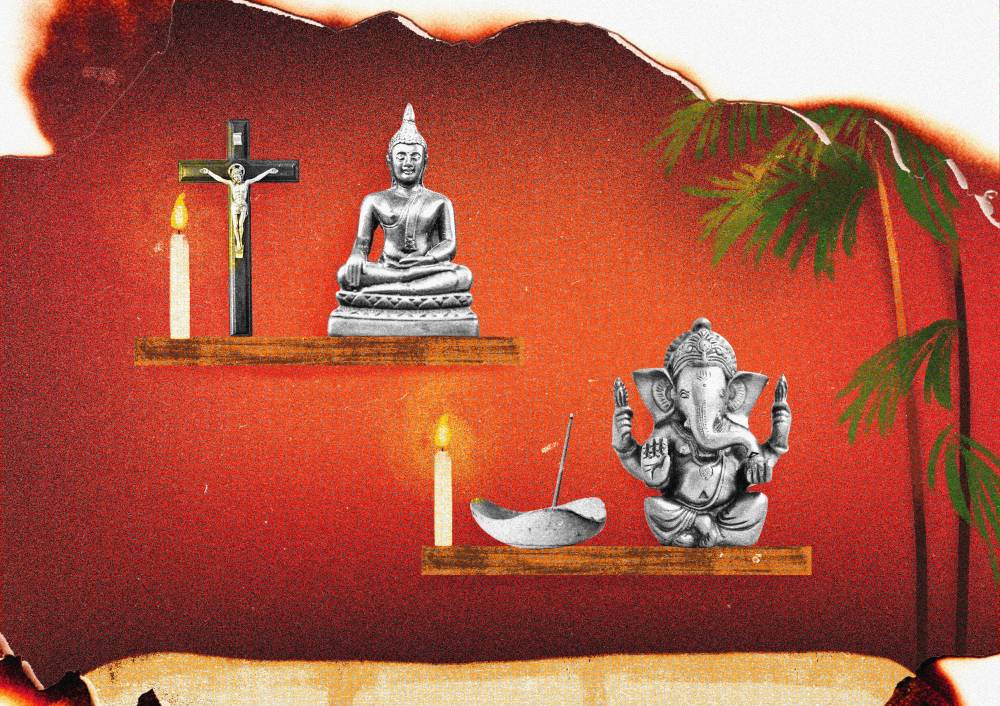
Whenever I visit a friend’s house, I play a little game: I try to identify as many religions as I can find, represented on their altar or shelves. You can try it, too. Visit the house of someone you know and count how many distinct religious symbols there are.
For most Catholics, there might be a crucifix, a Santo Niño, and one of the many types of Mary. In my own house, since my mother is a devotee of Mary Mediatrix, she has that statue in our garden. Someone had also gifted her a beautiful statue of Our Lady of Manaoag—“Manaoag,” by the way, is “the one who calls,” as in, “magtawag.”
Many dining halls also have some artistic rendition of the Last Supper of Christ. Some doors may also have a Saint Benedict Medal, which, if you do not already know, is believed to be a powerful symbol of protection: engraved around the cross is a medieval exorcism prayer, used by early exorcists to cancel curses and prevent demonic harassment. In constructing a house, it is believed to be lucky to drop Catholic medallions into the house’s foundation.
On other shelves, there might also be some type of Buddha. It could be the plump Laughing Buddha, said to be good for business, or the slimmer, more meditative version, said to be good for inner peace. They might also have a Buddha head as decor (which might actually be offensive to Buddhists).
Others might have a Nataraja statue, which is a representation of the Hindu god Shiva, Lord of Dance. If you have an elephant-headed figure, that is likely Ganesha, the Hindu god of wisdom. There may also be various taotao or bulul, which are native wooden sculptures that represent the animist belief in anito.
It is also common for many houses to have a bagua mirror hanging above their entrance door. This is a traditional Chinese symbol of prosperity and protection, but since we are not always willing to learn much about other cultures, we tend to be afraid of them.
After the 2004 movie “Feng Shui,” many Filipinos today might associate the bagua mirror with curses and a “Final Destination”-type death. Despite this, many Filipinos still believe in the power of feng shui, and many homes and businesses are still arranged in accordance with its principles.

Some “Christian” symbols are not traditional at all! A particular symbol I have always found fascinating is the Santo Niño carrying a pot or bag of gold. In some offices, the Santo Niño may be dressed up in their uniform—he might be in a police officer’s outfit or in a doctor’s white coat. A Santo Niño wearing green robes is said to be a lucky charm.
I am not a theologian, so I have no intention to preach or discuss what should and should not be “correct” ways of representing your faith. But I am a psychospiritual researcher, and from this perspective what I can say about it is that religious symbols can be representations of human values and dreams—regardless whether that is best represented by the enduring devotion of Christ on the cross or the prosperity of the Laughing Buddha.
In a world of polarized and scattered identities, divided communities, and national tensions, the everyday altars of ordinary Filipinos carry this message: Underneath superficial differences, we are all kapwa, reaching out to the heavens, and reaching out to the sacred within each other.