










The sound of silence


The use of sound as medicine is one of humanity’s oldest healing traditions. In ancient Egypt, priests used chanting and toning within specially designed temples whose acoustics were known to amplify healing vibrations. Even the Great Pyramid of Giza is believed by many researchers to have been designed partly as an acoustic chamber, its granite chambers producing resonant frequencies that match the human body.
In ancient Greece, mathematician and philosopher Pythagoras is credited as one of the first to formally document the healing power of music. He developed what he called “musical medicine,” prescribing specific modes and rhythms to treat mental and physical ailments. His concept of the “music of the spheres” posited that celestial bodies created harmonic vibrations that permeated all of existence.
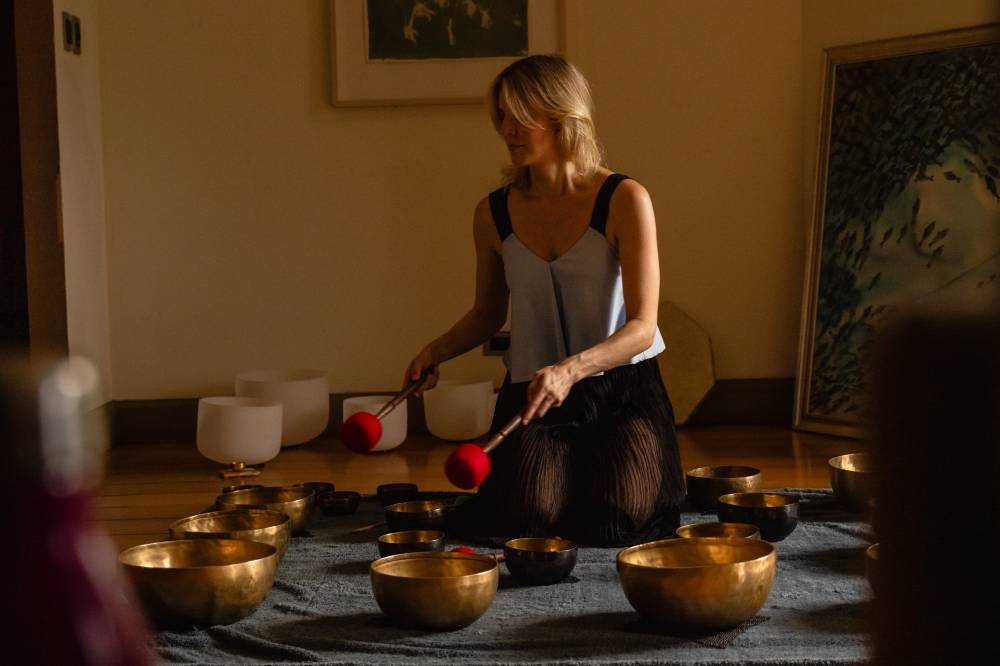
Today, Camilla Oster Yu brings the ancient wisdom to us. A certified sound healer, she has been making (sound) waves in Manila by sharing her practice.
Of ancient sound practices
Yu fell in love with the practice once she tried it for herself—and this is true for any skeptic. Her gentle demeanor and quietly comforting voice are both healing in themselves. You can expect to relax at a sound healing session, provided you enter, as Yu says—“ready to receive the healing.”
Sound healing is a therapeutic practice that uses the vibrations and frequencies of sound to promote physical, emotional, and spiritual well-being. Rooted in the understanding that everything in the universe—including the human body—vibrates at specific frequencies, sound healing works by introducing resonant tones that encourage the body to shift back into states of harmony and balance.
Sound, after all, is powerful. Think about the sonar, used by submarines to “see” underwater and navigate, or extracorporeal shock wave lithotripsy (ESWL) therapy, used to break down kidney stones.
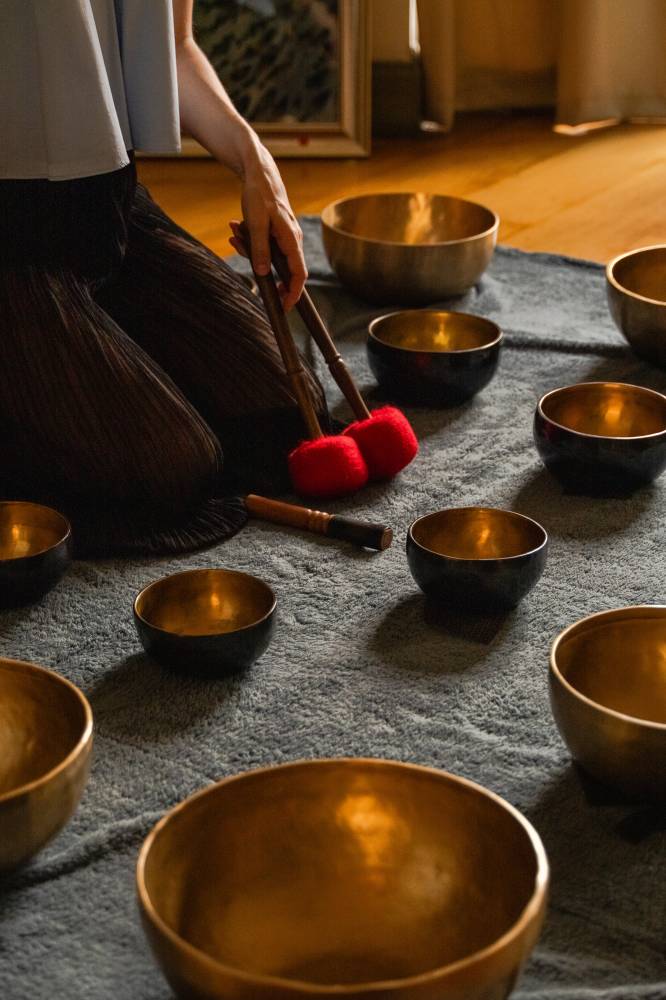
Yu uses Tibetan singing bowls as well as crystal bowls. The Tibetan bowls are handmade with seven different metals, each corresponding to a celestial body—which have been used for centuries by Buddhist monks for meditation and healing. The rich, layered overtones produced by these bowls are said to induce deep meditative states and realign the body’s energy centers or chakras. The bowls are arranged in the order they will be played.
The objective of each sound healing can be customized to the needs of a person or group, depending on which bowls are played first. Grounding, releasing anxiety, mental clarity, and even simple relaxation can be addressed in sound healing. Sometimes, when we don’t know what we need, the sound travels to where your body needs it most—and this is where it’s felt.
From a scientific perspective
The 20th century brought a scientific lens to ancient sound practices. In the 1970s and 1980s, researchers began formally studying the effects of music on brainwave activity, cellular biology, and psychological health.
The invention of binaural beat technology by Heinrich Wilhelm Dove in the 19th century, later popularized by Robert Monroe in the 1970s, opened new avenues for using sound to deliberately shift brain states. Today, sound healing encompasses everything from clinical music therapy to gong baths, crystal bowl sessions, and tuning fork therapy.
One of the most significant mechanisms through which sound healing operates is its influence on brainwave frequencies. The brain naturally produces electrical activity in distinct frequency bands, each associated with a different state of consciousness. Sound—particularly through binaural beats, isochronic tones, and harmonic resonance—can guide the brain from one state to another, a process called “brainwave entrainment.”
Gamma waves (30–100 Hz)
The fastest brainwave state, associated with heightened perception, peak cognitive function, insight, and transcendental states of consciousness. Gamma is linked to moments of “aha!” clarity and profound compassion. Some advanced meditators display prolonged gamma activity.
Beta waves (12–30 Hz)
The waking, alert state. Beta is dominant during active thinking, problem-solving, decision-making, and focused conversation. High-beta activity is associated with anxiety, stress, and an overactive mind. Standard daily life operates predominantly in beta.
Alpha waves (8–12 Hz)
The relaxed, calm state of light awareness. Alpha bridges the conscious and subconscious mind and is associated with creativity, visualization, and a peaceful yet alert focus. This is the ideal state for learning, stress relief, and light meditation. Many sound healing sessions aim to guide participants into an alpha state.
Theta waves (4–8 Hz)
The deep meditative and dream state. Theta is present during REM sleep, deep meditation, and the hypnagogic state just between waking and sleeping. It is associated with profound emotional healing, access to the subconscious, creativity, intuition, and the processing of deep-seated memories and traumas.
Sound healers often aim to induce theta states for transformative healing work.
Delta waves (0.5–4 Hz)
The slowest and deepest state, associated with dreamless sleep, deep restoration, and unconscious bodily processes such as immune function and cellular repair. Delta is the frequency of deep healing and regeneration.
Experienced meditators can enter delta while remaining conscious, a state associated with profound spiritual insight.
Entrainment in action
Binaural beats are perhaps the most studied mechanism of sound-induced brainwave entrainment. When two slightly different frequencies are played simultaneously in each ear—say 200 Hz in the left ear and 208 Hz in the right—the brain perceives a third tone equal to the difference (8 Hz, an alpha frequency) and begins to synchronize its own activity to match it.
This is entrainment in action. You can even find a playlist on Spotify.
Similarly, the sustained, complex overtones of singing bowls and gongs naturally cause brainwave entrainment through their layered harmonic content. The brain, upon hearing the complex sounds, shifts downward through beta into alpha and theta, allowing the nervous system to move from sympathetic (fight-or-flight) dominance into parasympathetic (rest-and-digest) regulation.
Some truth to ancient practices
Modern research has begun to validate what ancient traditions have long claimed. A 2016 study published in the Journal of Evidence-Based Integrative Medicine found that a single session with Tibetan singing bowls significantly reduced tension, anxiety, and physical pain while dramatically improving spiritual well-being. Participants even showed measurable decreases in heart rate and blood pressure.
Research into binaural beats has demonstrated their ability to reduce preoperative anxiety, improve long-term memory consolidation during sleep, and alleviate mild-to-moderate symptoms of anxiety and depression. Studies by neuroscientist Dr. Lester Fehmi on alpha synchrony demonstrated that synchronized alpha brainwave activity across both hemispheres was associated with profound states of relaxation and openness.
Perhaps, most intriguingly, Japanese researcher Dr. Masaru Emoto’s research suggested that water exposed to positive sound and intention formed beautiful, coherent crystalline structures, while water exposed to dissonant sounds formed irregular, chaotic patterns—raising questions about the potential of sound to influence the body’s water content, which constitutes approximately 60 percent of human physiology.
Think about each time an unpleasant sound has made you feel irritated or upset—there is some truth to this.
As interest in holistic wellness continues to grow, sound healing stands at the intersection of ancient wisdom and emerging science—offering a simple, non-invasive, and profoundly accessible pathway to healing the body, quieting the mind, and opening the heart.
Benefits of sound healing
• Reduced cortisol levels and lowered blood pressure through deep relaxation responses
• Improved immune function associated with delta-state sleep and deep meditative recovery
• Relief from chronic pain through the release of endorphins and serotonin

• Improved sleep quality—particularly through theta and delta brainwave induction
• Cellular regeneration supported by specific resonant frequencies (notably the Solfeggio frequency of 528 Hz, associated with DNA repair)
• Reduced muscle tension and inflammation through parasympathetic nervous system activation
• Profound stress and anxiety reduction through guided relaxation into alpha and theta states
• Processing of deep emotional trauma stored in the body and subconscious mind
• Increased mental clarity, creativity, and problem-solving ability
• Relief from symptoms of depression through the stimulation of feel-good neurochemicals
• Reduced mind-chatter and rumination, supporting those with overactive minds
• Enhanced emotional resilience and self-awareness
Spiritual and consciousness benefits
• Access to expanded states of consciousness and heightened intuition
• Deepened meditation practice—breaking through plateaus caused by mental resistance
• A sense of connection to something greater than the individual self
• Activation of the parasympathetic system as a gateway to awe, gratitude, and compassion
• Facilitation of spiritual experiences and inner visioning through sustained theta states