








The steady climb of Philippine football

For decades, football in the Philippines has lived a quiet, parallel life—played in pockets, overshadowed by a national obsession with basketball. Courts bloom in every barangay, while pitches are hidden behind private schools and exclusive villages.
Yet in the past year, Philippine football has stopped asking for space. It has started taking it.
Carving its place in history
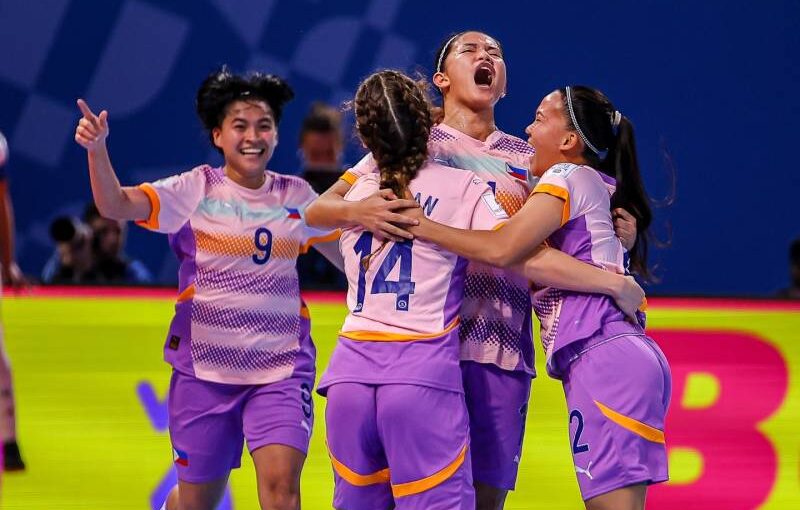
The latest SEA Games confirmed what the Philippine Football Federation (PFF) has long believed. The results spoke across formats and genders: a historic Women’s Football gold medal; the U22 men’s football and women’s futsal teams reaching the semifinals; and, for the first time, three Philippine teams advancing that far in a single SEA Games.
PFF President John Anthony Gutierrez framed the moment at IPE Chonburi Stadium in a recent statement, saying that, “We are witnessing Philippine football carve its place in history… This is a testament to years of collective effort, belief, and commitment from everyone in our football community. Moments like this define eras, and we are proud to share it with the entire nation.”
Not a one-off surge
This was not a one-off surge. In November, the Philippine men’s national football team (PMNFT) closed its year with its first clean sheet in the 2027 AFC Asian Cup Qualifiers, defeating the Maldives 2–0 at the National Football Stadium in Malé. Goals from Jefferson Tabinas and Sandro Reyes secured all three points, keeping the Philippines tied with Tajikistan at 13 points heading into the decisive Group A finale in March 2026.
Inside the squad, the year felt heavier than medals could measure. UP Men’s Football Team and U22 defender Josh Meriño describes the SEA Games run as “a bittersweet moment for everyone.” “Making it to the semi-finals after 34 years and then falling short of a podium finish is difficult to reconcile,” says the defender.
But Meriño refuses to isolate the tournament. “It’s not just the SEA Games we should be happy and sad for, but all the tournaments we played this year: the AFF, AFC U23 qualifiers, and the SEA Games.”
The accumulation, he insists, is the point. “Making history at the AFF Mandiri Cup and the SEA Games, [but] falling short of a podium finish [in the latter], [and] almost qualifying for the AFC U23 Cup—we [proved] that we belong on this stage. [That] we belong on top.”
A debate on identity
Perhaps nowhere was that belonging more visible than in the Philippines’ victory over Indonesia—a country where football is cultural identity, not a niche interest. The upset reverberated online, where celebration quickly turned into scrutiny. Southeast Asian fans questioned the heritage of Filipino players, criticizing how many were of mixed descent.
Diaspora players have long shaped Philippine football, offering opportunities while exposing fault lines around identity and local development. The criticism often ignores history. But Filipino excellence has always existed beyond borders. David Alaba—born to a Nigerian father and a Filipino mother—became one of Europe’s most decorated defenders. Pedro Fernández Sarmiento, a Filipino-Spanish attacking midfielder now with Barcelona Atlètic, represents Spain at the youth level. Talent has never been absent; pathways have.
Gated entry points
This tension reflects a deeper truth about football in the Philippines: that it is still widely perceived as a “rich kid sport,” and not without cause. Training fees are high. Fields are scarce. Entry points are often gated—literally. The sport thrives in international schools, where football programs are well-funded and insulated from the limitations of public systems.
The irony is that this year’s results suggest the country is ready for another ball to matter. The question is not whether Filipinos can compete—we have shown that we can—but how much stronger the national teams might be if football were integrated into daily life. If talent were not filtered first by tuition and residence.

Climate also complicates everything. Heat, flooding, urban density, and the lack of safe open spaces shape who can realistically train and who gets left behind. For many young players, consistency is a luxury. Development becomes not just a matter of skill, but of survival. Of who can afford transport, time, and recovery.
Philippine football is here to stay
And yet, the tone has shifted. Even without podium finishes for the men’s team, Meriño sees something durable taking shape. “[Despite] bringing the best lineup the Philippines could ask for and still finishing 4th [at the SEA Games], we set a new standard for ourselves and for the younger generation to follow. We showed strong systems, higher standards, and players who are no longer afraid to compete with the best in Asia.”
When Meriño says, “What we built here is something future teams can push even further,” it echoes an earlier chapter. One that Filipino fans still measure themselves against. “It wasn’t just about results. It was about proving that Philippine football is growing, and that the glory everyone talks about is something we can truly build again.”
This carries the memory of the Azkals, the belief they sparked, and the sense that something was left unfinished. They aren’t chasing nostalgia. They’re extending it. If that era proved Philippine football could arrive, this one is arguing it can stay. And for the first time in a long time, the timing feels right.
Read the full story on lifestyle.inquirer.net