







The urgency of theater

Over 10 years ago, when I expanded my scope of reviews of film to include theater—at the time I was writing for the now-defunct website Juice.ph—I had taken a literary approach to how I criticized productions I was lucky enough to see.
Later on, I met The Sandbox Collective’s Toff De Venecia, who later gave me the book “Palabas: Essays on Philippine Theater History” by Doreen Fernandez. The book was essential to transforming the way I looked at theater and productions staged in the country. From one essay, I gleaned an important question that I ask from every show I now watch: What is the play addressing to the needs of its community now?
No two shows are alike
In the essay by Fernandez called “Practical Questions on Drama Criticism Today,” she talks about a conversation she had with the director and actress Laurice Guillen about a meeting she had with theater directors in the United States.
From the essay: “The third world participants realized that the vitality of their theater lay in its urgency, in the fact that the matter of drama had to be expressed, and was not a matter of whim, fashion, trend, or even art—even though it could be all that.”
The power of watching a show is the singular experience that an audience gets because, as many of my friends who work in theater tell me, no two shows are ever alike. There’s a tangible power in the medium that completely arrests its spectators because the story is unfolding right in front of them—in real time, with breath and sweat, and real tears—and the magic of that can never be replicated by the best of film.
Its urgency and tangible quality are what make theater an art form that is of the moment, of the now. It is the best way by which an artist can speak directly to the crowd.
It’s why I always ask every show I see: “What is this production trying to tell its audience about the Filipino condition?”
Theater for the people
PETA (Philippine Educational Theater Association) has always been very good at this. From “Rak of Aegis” to “Care Divas,” “Arbol de Fuego” to “Control + Shift,” their shows always felt catered to their base; oftentimes student-friendly, and with a clear message of progressive values to tear down tyranny and oppression of all forms.
Their recent show, “Kislap at Algo,” is a double feature of two one-act plays—“Kislap at Fuego,” a translation by Gentle Mapagu of Dominique LaVictoria’s “Towards the Fires of Revolution,” and Mixkaella Villa’s “Children of the Algo.” It was a solid set to spark a conversation with its intended high school audience.
“Kislap at Fuego,” directed by Maribel Legarda and J-mee Katanyag, is a fantastical tale set during the Spanish occupation, where a young girl (Felicity Kyle Napuli) hides in an enchanted forest from Spanish soldiers who suspect her of distributing seditious books. The girl asks for help from a kapre (CJ Navato), to whom her father owes a debt. She will repay the debt in exchange for sanctuary.
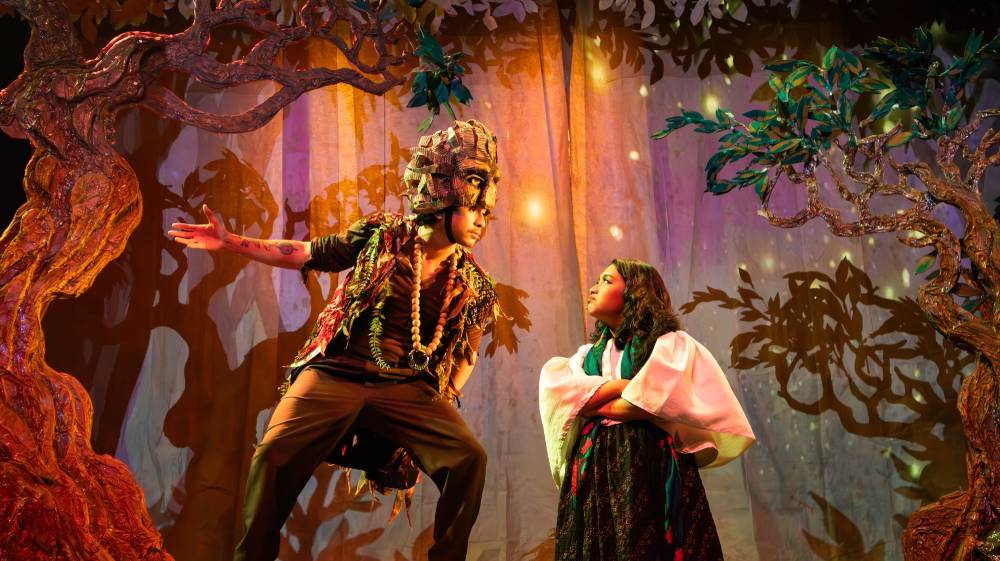
In the enchanted world, she does what she is told, and the two spark a romance, but this is merely a backdrop for a larger story about women’s place in the revolution and the power (and importance) of the Indigenous over that of the colonial.
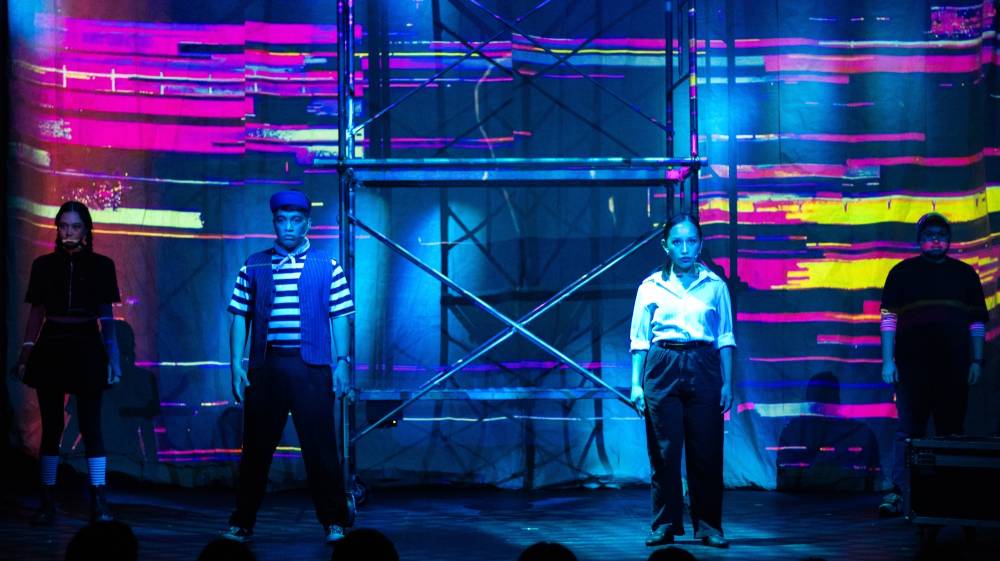
After the intermission, “Children of the Algo” brings us into the virtual world of content creators. Four actors—Otep Madriaga, Nyla Festejo, Frances Marie Akol, and James Pe Lim—play social media influencers as they post videos and livestream their daily lives and struggles.
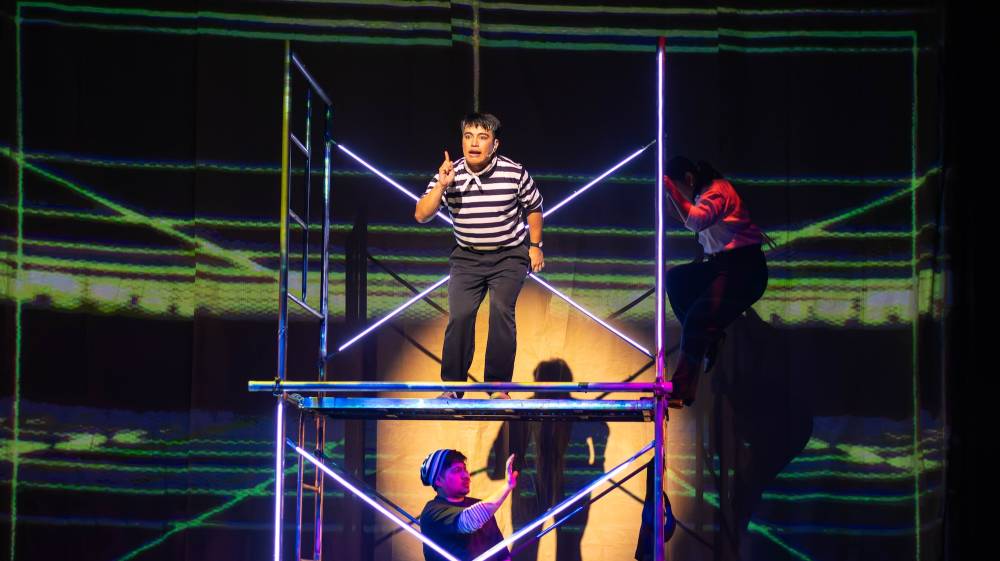
At first, it feels like scrolling through your mobile, but then a narrative begins to form as the dangers of living your whole life online start to take their toll. Directed by Johnnie Moran, the play really questions our online consumption and the need to get out of social media and back into the real world.
While putting both shows back-to-back feels tonally off, I could see how each play speaks directly to the needs of the audience.
Yes, both plays have been staged previously, but re-staging them continues to create a dialogue about the pressing issues of the day. The first reminds us that we need to constantly reclaim our sense of national pride and remember who we are outside of the colonial influences that surround us, while the second play reminds us to fully connect once again with the people around us.
A waiting and an awakening
Interestingly enough, there are two plays—one a musical and another a straight play—that are currently running, which are stagings of foreign plays. While they make no attempt to Filipinize their productions, the urgency of the plays’ messages feels so deeply rooted in the current Filipino experience.
The Sandbox Collective, under the direction of Andrei Nikolai Pamintuan, has Steven Sater and Duncan Sheik’s “Spring Awakening.” Set in 19th century Germany, the story follows teenagers in the throes of puberty, discovering their sexual awakening as well as their maturing into a world that is oppressive in its conservativeness.
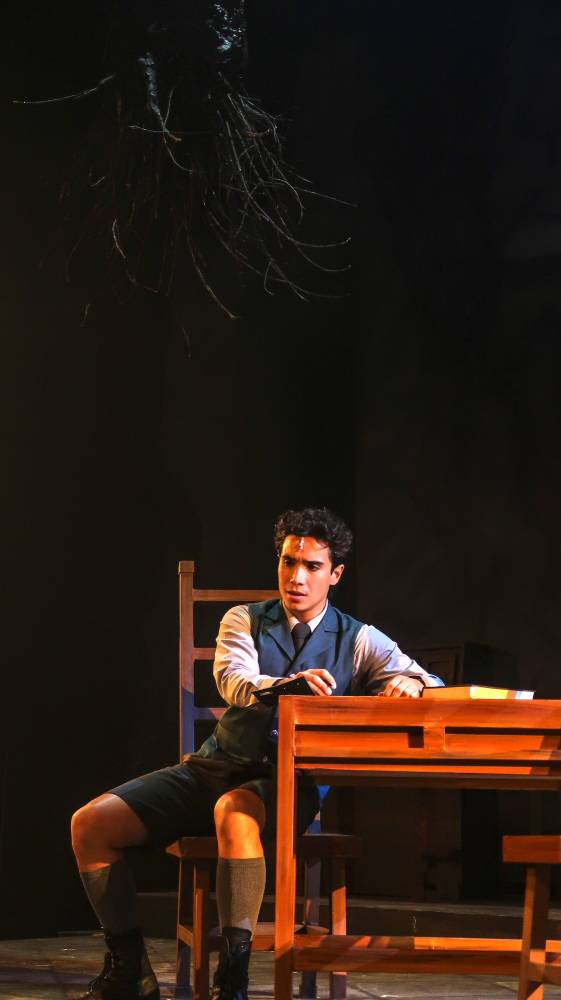
Pamintuan doesn’t shy away from the original material and makes no external attempt to localize his revival. Wika Nadera’s symbolic stage design feels reminiscent of fascist, cold architecture and design, while a descending platform in the shape of a cross hangs above the youths throughout most of the first act. A tree hangs suspended in the air with its roots exposed, a gorgeous symbol of what these characters must feel like.

Even without the localization, the play’s narrative, which includes withholding information from children, punishment for questioning authority, physical abuse by parents, and the trouble of uninformed (or misinformed) exploration of their blossoming sexual desires, harkens to many of the issues that still plague our country. We still have a rising teenage pregnancy rate, while the younger generation is up in arms and calling for accountability to an older generation that refuses to listen.
There’s an urgency in the production that mirrors our country’s own anger and passion.
Teatro Meron, on the other hand, takes a more DIY approach to theater. Their production of Samuel Beckett’s “Waiting for Godot” has the vibe of a community theater production, in what feels like a makeshift stage in a section of the Mind Museum in BGC. Directed by Ron Capinding, the absurdist play is mined for all its hilarity and pathos, played with great aplomb by its entire cast, which includes Tareck El Tayech, JJ Ignacio, John Bernard Sanchez, Lenard Tiongson, and Yael Ledesma.
Also staged without any sort of localization, the production still manages to take me from the barren and desolate setting of Beckett’s tragicomedy and back into my own experience as a Filipino. Much like its two main characters, I also feel like I’m waiting for something that never comes—an experience shared by many Filipinos who have been waiting for change.
There’s nothing within the piece that would point me towards my own localized understanding of the world, but there is some sort of convergence that happens on the stage—with its actors, the location, the time, the audience, and maybe even the message of the play itself—that brings me back to the now.
Shows that resonate
These four plays, at the start of the year, are what I really look for in a production. We get quite a few shows by local companies that stage popular shows from abroad, but are mined merely for their entertainment value or for their popularity. It feels counterintuitive to theater’s ability to really reach out to people. It’s something I can understand with film. The camera and the screen have the power to take me into that other world; to detach myself from that very moment.
But in theater, to truly utilize the medium is to key in to that urgency and reach out to us where we are seated and wake us up.
That’s what I take away from Doreen Fernandez’s book, and it’s what I love about theater—and it’s what I appreciated from these four shows. I’m hoping for more productions like these.