










Two minutes faster—but the real win was elsewhere

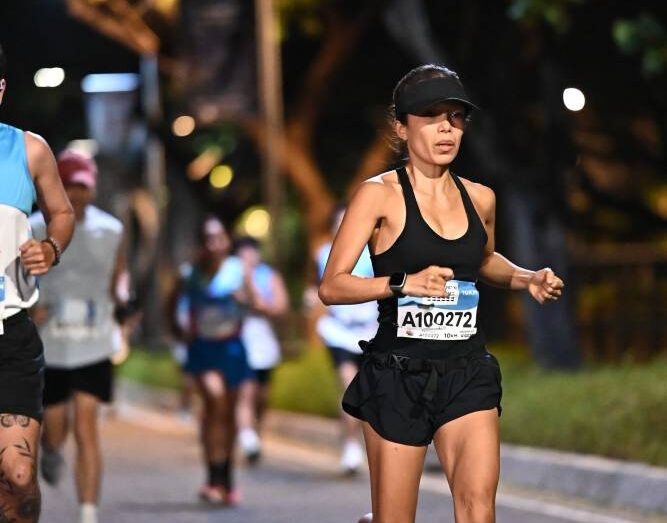
This running piece isn’t about winning. It’s about fully committing to the journey behind a goal, and pacing it steadily and sustainably.
Too often, people rush results, trying to achieve something in just a few days or weeks. And yes, some achieve their goals, but without a strong foundation, those results are often unsustainable. We see it all the time: resorting to quick fixes to achieve a body goal for a beach trip—pushing too hard, burning out, then starting over sometime during the year, once, several times, or not anymore. Then the New Year arrives, and many realize they haven’t truly moved forward at all.
Running has taught me that the best progress doesn’t come from rushing because it comes from building gradually and steadily. This principle applies not just to fitness but also to health, work, relationships, and life itself. Focusing only on the outcome risks overlooking the process—the very element that ensures an enduring growth.
Allow me to share my race experience, not as a story about running, but as a metaphor for approaching life.
The sub-50 goal
Last Sunday, I joined the 7-Eleven race in Filinvest City, Alabang, with a clearer and more achievable goal. My client, Armi Cagayan, strategic merchandise division head from 7-Eleven, who had consistently encouraged me to sign up for this major race, informed me about it six weeks before.
So my target this year was to finish 10K under 50 minutes, the same race course I’ve run several times. With years of consistent strength and run workouts, plus a six-week game plan leading up to the race, I was more confident I could achieve it. I set this goal quietly, not to win, but to see what would happen if I trusted the work I had done more intentionally.
The six-week game plan
I thoroughly analyzed my previous 7-Eleven runs using my fitness tracker (containing all my run records) to understand why achieving sub-50 had been so repetitively challenging. I realized that on the actual race days, I would doubt myself and get stressed out because I hadn’t fully prepared mentally, physically, and even emotionally—often just telling myself to try to run faster than the previous one.
I ended up pushing too hard at the start to compensate for those doubts and avoided checking my pace on my watch, fearing it would add extra stress. This pattern consistently led to slower second halves of the race, making it impossible to finish strong, even when I felt capable.
Weeks one to six
This time, I changed my approach. I prepared, really enjoyed the process, matching my training to my current lifestyle and daily load to avoid burnout. I trained consistently for six weeks that started during the Christmas season—two shorter runs of five to seven kilometers and one longer Sunday run of eight to 12 kilometers each week.
I maintained my usual frequency of three runs per week, with paces ranging from 5 to 6.5 minutes per kilometer. My goal was consistency, not intensity. I skipped speed training to conserve energy for workload and daily tasks, and to protect my hormones—given that running at 48 is very different from racing in my 20s. I really prioritized regulating my nervous system, more consciously than ever before.
Two weeks before the race
I adjusted my sleep schedule—going to bed an hour earlier each night to match the 4:15 a.m. race start. My runs began at 4:30 a.m., supported by balanced nutrition, strength training, hydration, and recovery. I prioritized my immune system, supported my hormones, and made sure to enjoy the training, even during life’s distractions, especially during the holidays.
One week before the race
I increased my carbohydrate intake and hydration. I ran three short training runs during the week leading up to the race to help break in a new pair of shoes. My family celebrated my brother’s birthday the night before the race. I asked them to have dinner before 7 p.m., and although I slept late from excitement, as has happened before with all my races, I went to bed feeling confident and ready to run strong.
The race day strategy
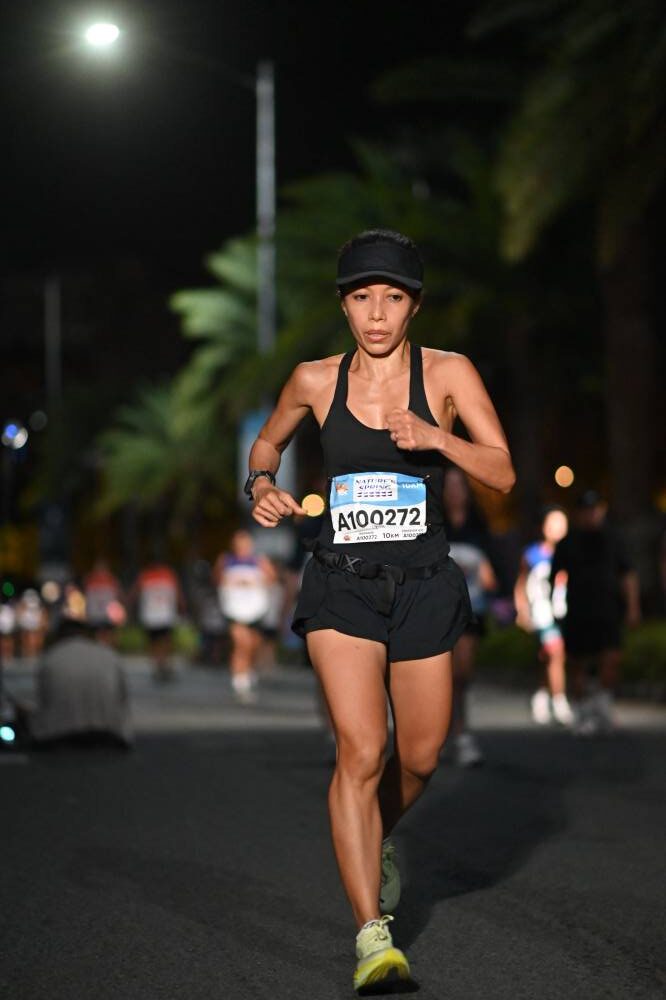
On race day, I warmed up and jogged a kilometer before the 4:15 am gun start. I started the race strong and controlled. I paced myself while staying aware of my energy, breathing, posture, form, and strides. I checked my watch strategically rather than pushing blindly. I passed only one water station. I talked to myself, repeating that I could do it—sub-50.
I also prayed and dedicated the run to each of my loved ones, which really helped me endure the entire time.
Results
I sustained a sub–5-minute-per-kilometer pace from km 1 to km 10, even through the uphill terrain in the second half. I finished strong, crossing the line at 49 minutes and 47 seconds.
That’s two minutes faster than last year, with a consistent pace throughout and a stronger push toward the final stretch. I also placed second overall in the female category—something I hadn’t expected given the major competition.
Best of all, recovery was much better than in previous races. In the past, I could barely walk afterwards, and my muscles were sore from the hard push and a stressed-out body. This time, I felt strong and pain-free the next day.

Compounding: Why small improvements matter
For those who don’t run or race, two minutes may not sound like a big deal. Thirty seconds could appear insignificant. But meaningful progress—whether in running or life—rarely happens in big leaps, because it compounds.
Small improvements stack over time: better recovery, stronger immune system, faster metabolism, and a more resilient body. Weeks before the race, my resting heart rate and stress levels dropped to levels I had never seen before (based on my tracker). This wasn’t just my fastest run—it was my strongest. It was the result of taking care of the whole journey, not just race day.
Reflect on this: Numbers do not measure your worth—not speed, weight loss, or money—because the real win is the strength and joy you build along the way. That effort extends outward into better health, deeper motivation, and stronger relationships.
The real essence of winning
The real preparation didn’t start with the six-week focused training. It began long before—through the lifestyle strategies I’ve always preached and lived by: recovery, nutrition, movement, mindset, and social health. That foundation gave me confidence going into the race. It empowered me to trust my strategy, strengthened my discipline to stay consistent in my daily habits, and supported everything I needed to pursue the goal I set—to run sub-50.
Yes, I ran two minutes faster. Yes, I placed second. My gratitude is overflowing. But the real win was showing up every day with a more resilient mind and body. Those daily wins, and the sustainability behind them, matter far more than any outcome.
So what’s next? A sub-49? Maybe. I’m not sure yet. But one thing is certain—this race will always remind me that the most powerful progress and wins, both in running and in life, come from pacing it steadily.
******
Get real-time news updates: inqnews.net/inqviber