









Valentine’s Day across Asia: The different ways love is expressed

Valentine’s Day is recognized all around the world, but the way it’s celebrated can look very different depending on where you are. Across Asia, Feb. 14 is not only about the roses and fancy dinners—it is more about roles and rituals, and sometimes, even fate. For some of us, love is coded in rich chocolates, while for others, it’s in public performance, communal milestones, or an experience manifested in tradition.
These moments and gestures reveal not simply how people choose to express their affection, but the meaning of love in each culture.
Japan: Playful, deliberate, and subtle language
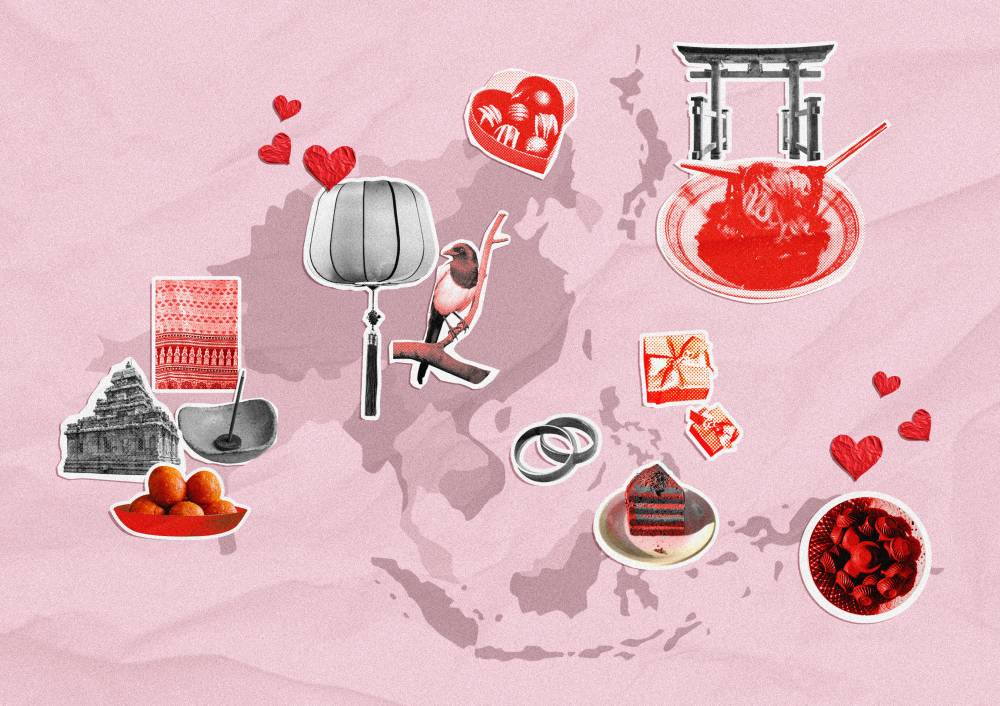
In Japan, it’s the women who traditionally take the lead. In the bustling streets of Tokyo, cafes, shops, and department stores are filled with neatly-wrapped chocolates, each type carrying a separate message: “honmei-choco” for a romantic interest, “giri-choco” for colleagues, and “jibun-choco,” a little indulgence for oneself.
A woman may linger over the display of confectionery, carefully choosing the chocolate that communicates exactly what she wants to say. And, a month later, men traditionally return the gesture on White Day, completing the quiet and thoughtful exchange.
Love here is a playful language—deliberate yet subtle, and quietly performed.
South Korea: Public and performative intentions
Across the sea from Japan, a slightly similar yet louder, more social rhythm plays on Valentine’s Day in South Korea. Here, women also give gifts on Feb. 14, and on White Day, the men reciprocate in ways that are laden with intent: a little box of chocolate may signal friendship, while a more extravagant gift may show a more serious and romantic intent.
This exchange is a little more public and performative, noticed by coworkers and friends, and the tradition goes beyond couples. On April 14—Black Day—single people gather over bowls of jajangmyeon (black bean noodles), marking a place of their own in the calendar of love.
The streets are abuzz with friends and couples participating in these shared, social traditions.
China: Shaped by history, bound by tradition
Now, while many cultures emphasize structured exchanges, gifts, and chocolates, others let history and traditional mythology shape their day.
In China, while definitely observed in cities, the Feb. 14 tradition is the Qixi Festival, drawing inspiration from the legend of the Cowherd and Weaver Girl. In this tale, the lovers are torn apart by the heavens, divided by the Milky Way for daring to love across realms. Just once a year, magpies gather to form a bridge so they may meet again.
This myth transforms the celebration into something tender and enduring; A reminder that love, even when separated by distance, can survive through faith. During this time, couples visit temples, exchange symbolic gifts, and make wishes for lasting harmony.
Philippines: A love rooted in community
Further south, we find a publicly celebrated celebration of Valentine’s Day in the Philippines. Here, local governments transform city halls, basketball courts, and public plazas into wedding venues for the day, and organizations host “Kasalang Bayan” or mass weddings.
For many couples, the ceremony offers an accessible way to formalize their union, with sponsors often providing rings, bouquets, cakes, and even modest receptions. Rows of brides in simple white dresses or coordinated shirts stand side by side, reciting vows in unison as families and onlookers gather to watch.
It is both practical and deeply romantic—a reminder that love can be rooted in community as much as intimacy. A love that’s not just felt, but performed for all to witness.

India: Modern romance meets tradition
Now, not all expressions of love unfold before a crowd. In India, Valentine’s Day often blends modern romance with tradition.
In cities, young couples exchange chocolates, flowers, handwritten notes, and even pose for photos inspired by Bollywood romances. Others visit temples together, seeking blessings for their relationship—removing their shoes at the entrance and offering flowers or incense, seeking blessings for a harmonious future.
Traditional gifts such as sarees, delicate bangles, or boxes of mithai (laddoos, barfi, or silver-leafed kaju katli) may accompany the gesture. In this single day, contemporary affection meets the beautiful, longstanding cultural practices. It becomes a negotiation between the personal and the ceremonial, showing that love can adapt without losing its meaning.
What is love?
Across the continent, Feb. 14 is less about a single, universal idea of romance and more about how love is enacted through intention. This is expressed in chocolate, noodles, tradition, myth, ceremony, or gifts. Some gestures are private, some public; some solemn, others playful. Valentine’s Day, in this way, becomes less about imported romance and more about adaptation.
Though this day may have global recognition, it isn’t adopted wholesale and instead bends to absorb local values, religious practices, social expectations, and even humor. It becomes structured in some places, mythic in others, and communal elsewhere.
And perhaps this is the beauty of Valentine’s Day. It shows us that love neither arrives in a single language or culture nor does it require a performance. It is up to interpretation and is negotiated, reshaped by the people who truly see us.