





What’s cooking in Ji Chang-wook’s Filipino restaurant?

In creating the menu for the Filipino Korean culinary variety series “Kumusta,” chef JP Anglo curated a selection of what he believes are “blockbuster” dishes that could potentially appeal to Korean taste buds.
There’s sinigang, but this time inspired by the spicy pork neck soup, gamjatang. Palabok is always a good idea, he says, because it’s versatile—“you can make your own version of it wherever you go.” And with the addition of local crab fat, his hybrid take on the rice noodles dish “is pretty hard to beat.”
Chicken is enjoyed virtually everywhere, and Anglo says our inasal is right up there with the best. They kept the kare-kare faithful to its traditional preparation, which was “a gamble” because its creamy texture, slight sweetness, and the punch of bagoong, which “can be an acquired taste.”
Of course, he adds, you can’t have a Filipino menu without lechon, pork sisig, and gising-gising.
In between helpings of the mains—and in keeping with the Korean custom of serving banchan—small side dishes of dilis, atsara, and tokwa’t baboy (well, without the pork) were laid out. Calamansi juice washed everything down, while halo-halo provided a sweet, colorful finish.

Funnest kitchen ever
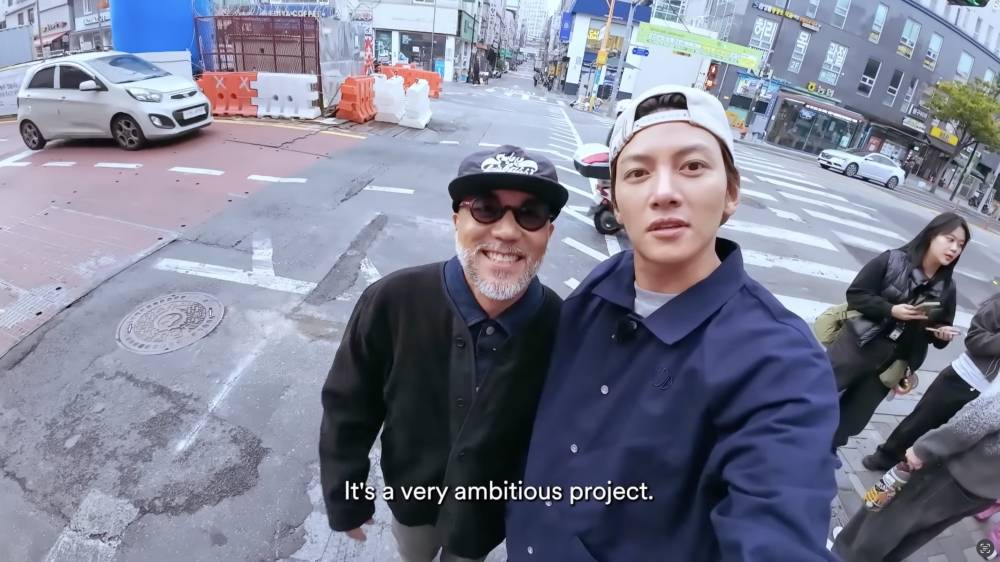
The cherry on top, however, wasn’t the dishes themselves, but the people cooking and serving them. Don’t be surprised if South Korean star and beloved action hero Ji Chang-wook swaps his guns for an apron, and comes out with your food or turns the lechon on the spit.
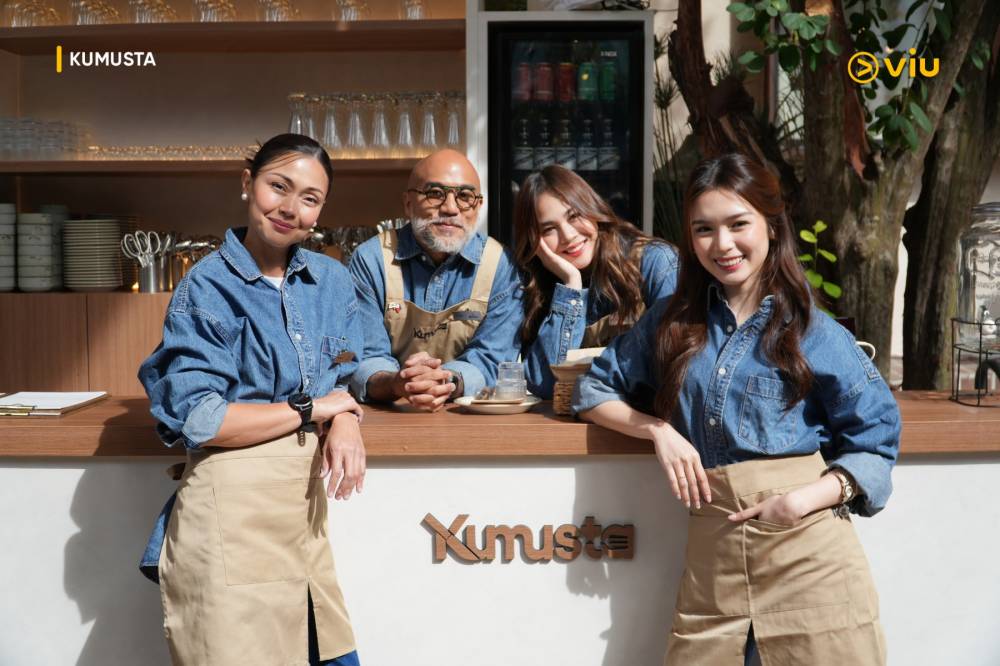
Joining the staff at Kumusta, the series’s namesake Filipino pop-up restaurant set up in Seoul’s posh Gangnam district, is a cast of Filipino actors, whose cooking experience varies from existent to nonexistent. Jodi Sta. Maria and Francine Diaz are part of the waitstaff. Janella Salvador assisted Chef Anglo in the kitchen. Meanwhile, all-arounder Arci Muñoz shuttled in and out of the kitchen and front of house, wherever needed.
Watch out as well for Korean actors Seo In-guk, Kim Myung-soo, and Kim Min-seok, who appear in different episodes as guests or part-time staff, jumping in to help Wookie when the restaurant gets overwhelmed.
“One reason I chose to serve is because I’m not good at cooking. If I went to the kitchen, it would have been a big trouble for them!” says Ji Chang-wook, who describes “Kumusta” as a “very human-centered” program, to which he ends up feeling a personal “attachment.” “It’s going to be the funnest kitchen ever.”
Moments of levity and drama
In this show, harmony is found not only in the flavors but also in the people. The cast reportedly worked 12 hours, seven days straight, and in such a pressure cooker situation—where not everyone has the skills and experience to match—contrary to the poised exterior we usually see onscreen, which eventually gave way to their unguarded selves.
All the while, Filipino cast members have to navigate cultural and language barriers. At one point, Sta. Maria might as well be playing a game of charades, trying to explain what a calamansi is to the local diners. The same goes for Ji Chang-wook when interacting with his co-workers. Shot near the winter season, working al fresco in chilly temperatures added a layer of exhaustion that Filipinos aren’t used to.
But before long, they forgot the cameras were even there, revealing moments of vulnerability and drama—Salvador burning herself with a torch and Diaz mixing up the orders. There are moments of levity and humor with the surprise guests. And then, at last, the thrill and satisfaction of seeing the light in people’s eyes as they take their first bite.
“You see so many sides of a person, so many emotions. The moment you enter the kitchen, the cameras are already rolling. There were no cameramen getting in the way, so everyone was just real,” Anglo says.
And for someone of Ji Chang-wook’s stature, Anglo was struck by how normal he is in real life. “He was fun, sobra. He was a trooper and a professional. He was really good in the sense that he didn’t slow down. Tuloy-tuloy lang siya,” he says.
Big eater
But perhaps the biggest surprise of all was seeing just how much Ji Chang-wook could eat. The guy loves his snacks, too, Anglo says, and he couldn’t help but wonder where in his lean body he was putting it all. “Grabe ang lakas niya kumain!” And Filipino food at that.
The actor especially loved palabok, sisig, and halo-halo. He seemingly came around to enjoying sinigang. “But his favorite is chicken inasal,” Anglo says. “When we saw each other a while back, he kept telling me, ‘Inasal, inasal, inasal!’”
The rest of the crew was a joy to work with. Anglo would pinch himself talking to Sta. Maria, because he used to just watch her on television. Muñoz was a ball of energy that kept the mood light. Anglo felt that Salvador had developed a newfound respect for kitchen workers. Diaz, “the bunso,” powered through despite feeling under the weather. “Kahit magkamali siya, makukuha ka niya sa charm,” Anglo says.
“It didn’t feel like we were doing a show,” he adds. “Parang may pop-up restaurant lang talaga kami. We made mistakes, but we had fun—and most importantly, the food was good!”
Flipping the script
Produced by Echolive Korea’s E&S Partners, “Kumusta”—which premieres on TV5 and streams on Viu on May 24—was envisioned as a cultural bridge: a program that fosters greater understanding between Filipinos and Koreans through food and friendship.
For the most part, it’s Filipinos who consume Korean entertainment and culture. This show hopes to flip the script. While their Korean guests couldn’t express their appreciation for the food in words, the empty plates said it all.
“Many of them have never really tried our food, so it makes us proud to see that they loved it. The show being the bridge for them to experience our cuisine is a big thing,” Anglo says.
And at the end of the day, Ji Chang-wook says, “Even though we’re from different nations, in front of delicious dishes, we’re just all the same people.”