









Why 2026 is the year to ditch your horoscope

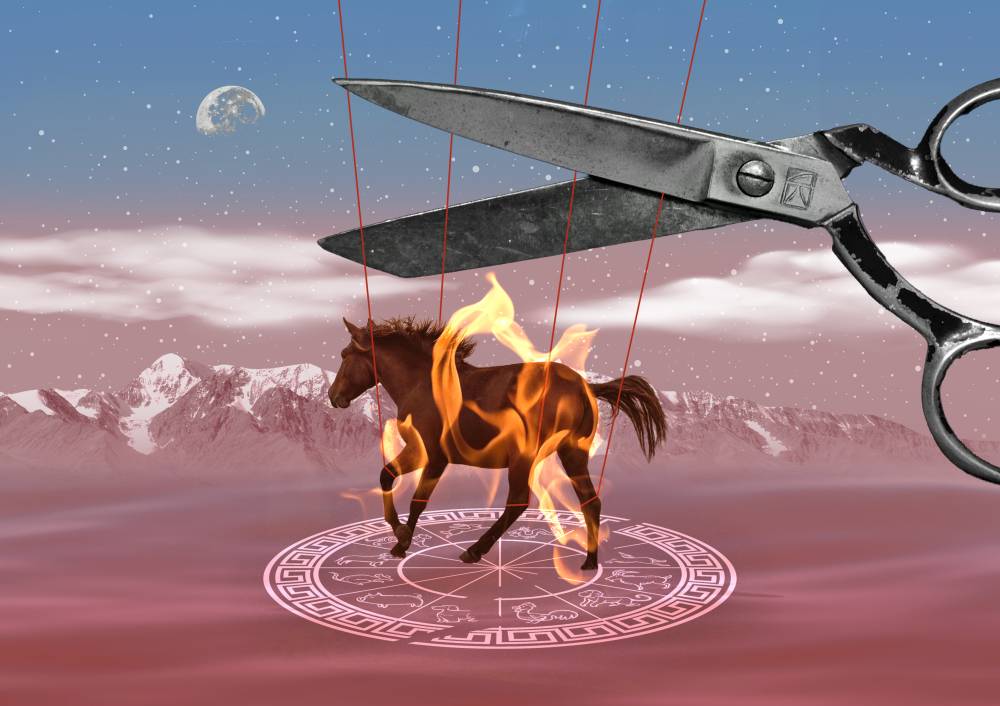
Feb. 17, 2026, marks an exhilarating gallop into the Year of the Horse after a quiet, reflective Year of the Snake. But what sets this Year of the Horse apart is the sign’s element. In addition to the 12 animal signs, the Chinese zodiac also includes five elements: wood, fire, earth, metal, and water. An animal sign is in one element in every cycle, so it takes five cycles or sixty years to complete a run of the elements.
For example, 2025 was the Year of the Wood Snake, and 2026 is the Year of the Fire Horse.
Before you rush off to read your horoscope, there’s something you need to know about the Fire Horse. Fire gives the already-zealous Horse even more energy, passion, and volatility. These traits appear exciting to most, but in Japan, one superstition states that women born under this sign are unpredictable and even violent. Fire Horse women are even said to kill their husbands.
Though only a superstition, the Fire Horse belief had very real effects, including a drop in births in 1966, the previous Fire Horse Year. But, more importantly, revisiting this superstition asks us to see how we’re letting an astrological system made millennia ago rule modern life.
The superstition surrounding Fire Horse women
In 1966, Japan recorded 1,361,000 births, which was 500,000 fewer than the previous year’s. The birth rates rebounded the following year, which makes 1966’s low birth rates an anomaly. But what caused this isolated drop in births?
According to sociologist Tōru Kikkawa, a superstition from the early Edo period (1603-1868) might have caused this. After all, it was said that girls born in the Year of the Fire Horse would grow up to be temperamental women who would eat their husbands.
Despite being unsupported by evidence, this myth spread through theater and books. Women born under this sign received fewer marriage proposals and, come the next Year of the Fire Horse, many couples avoided pregnancies altogether or recorded girls’ births a year before or after. There were even some instances of infanticide.
Centuries later, this superstition still holds power, yet without dire outcomes. In the years leading up to 1966, media coverage focused on the challenges and tragedies that women born in 1906 faced. As 1906 women neared marrying age, they received fewer proposals, with some women even dying by suicide.
1966 saw lower birth rates, especially in rural areas. In writing for the World Bank’s blog, Emi Suzuki and Haruna Kashiwase propose that this superstition might hold more weight for arranged marriages. But as arranged marriages became less common in Japan, the superstition’s power declined.
Kikkawa also hypothesizes that the lower birth rates are due to the media’s interest and, notably, couples planning their child’s birth. Reproductive health knowledge and birth control became more widely available in Japan at that time.
The Fire Horse superstition is not backed by any empirical evidence, but the public’s reception to it, media coverage, and other social shifts at the time give it weight. Yet, this doesn’t erase the power these beliefs hold.
Lucky Dragons, difficult Tigers
The Fire Horse isn’t the only zodiac sign with a reputation that precedes it. Throughout Chinese history and culture, the Dragon has been the most auspicious sign. Many families, especially those in China, Taiwan, Hong Kong, and Singapore, favor Dragon babies. In 1976, a Dragon year, Taiwan recorded 425,125 births, an increase from the crude birth rate of 396,479 over the decade. China saw births swell to 14.5 million in 2012—the highest it’s been since 1999.
Standing in direct opposition to the favored Dragon is the Tiger. Many believe the Tiger to be stubborn and temperamental. Singapore’s “Population in Brief” report reveals that the total fertility rate for the Chinese Singaporean population fell to 0.87 births for every woman in 2022, a Tiger Year. In 2012, a Dragon Year, there were 1.18 births for every woman.
While parents might prefer a Dragon baby over a Tiger or Fire Horse, this favor doesn’t always carry into adulthood. More births in a given year mean more competition for limited spots in classrooms from kindergarten to college.

A study by Poh Lin Tan at the Lee Kuan Yew School of Public Policy found that Singaporean Chinese born in the Year of the Dragon earn lower income than other Chinese birth groups, relative to the difference among non-Chinese. In her TED talk, entrepreneur ShaoLan Hsueh found that more CEOs in Forbes’ Top 300 richest people in the world were born in the Years of the Tiger and Goat—another unfavorable sign—than the Year of the Dragon.
It’s tempting to ascribe these twists in fortunes to fate. But the real answer is much more mundane. Tan cites the Easterlin hypothesis, which states that individuals in larger age groups are less prosperous because they face more competition for scarce resources. Case in point: In Singapore, increased births during Dragon Years also affect women born in the Year of the Horse, since men enter the workforce two years later due to National Service.
Despite all this, there still remains no scientific evidence that proves a relationship between zodiac signs and fortune. If anything, these studies show that zodiac signs have power because we relinquish some of our agency.
The effect on everyday life
So, when you read anything about your sign, take it with a grain of salt. Being born in the Year of the Dragon doesn’t guarantee you luck—it might even strip you of some. And being born a Fire Horse, Tiger, or Goat doesn’t automatically make you unlucky. Trust me: I was born in the Year of the Earth Tiger. Perhaps I benefited from less competition in my smaller cohort.
I grew up following zodiac-based advice, even rearranging my room and sitting beside relatives with compatible signs to boost my luck. Every year, I read the same advice in my horoscope: work hard and stay healthy.
But clearly, I don’t need a horoscope to know that.