








Why Apolinario Mabini is the hero for a jaded generation

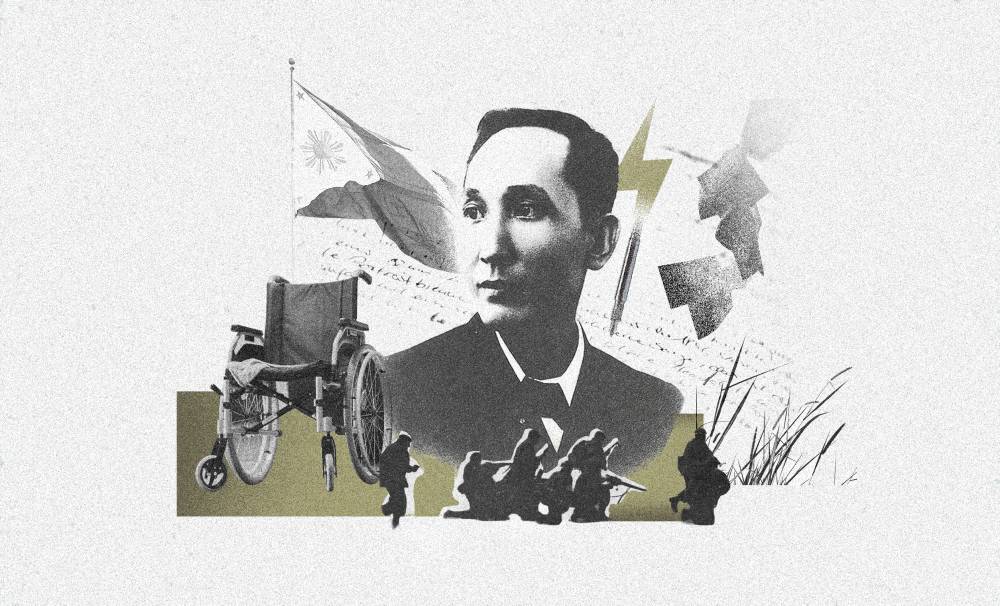
Despite it being a Rizal course, Ambeth Ocampo often repeated that Apolinario Mabini needs to be studied more. That statement left an impression on the decade that followed since taking that college class, and Ocampo continues to write, research, and advocate.
In that span of time, whenever a post about Mabini came up on my feed, I’d linger to read it, sharing the good ones. At game trivia nights, I’d be able to answer some questions about Mabini whenever they came up. This interest was also enriched by his depictions in the Jerrold Tarog “Bayaniverse” movies, where he played a significant role in the first two, serving as the voice of critique and conscience. I even bought “La Revolucion Filipina,” a book compiled by historian Teodoro M. Kalaw and published by the National Historical Commission—a part biography and part transcript of Mabini during his work during the Philippine Revolution.
But it was only at the (apparent) conclusion of the Bayaniverse with 2025’s “Quezon” that this passing interest morphed into focused curiosity. It seems Tarog’s cinematic universe is open to continuing, with the Marvel-esque post-credits teaser in the background winking at a Ramon Magsaysay movie. And perhaps this was also a call for investors?
Ahead of his time
In the 10 years since taking that Ambeth Ocampo class, I’ve come to see that the ideals taught in such classes and written about by our revolutionaries were not just theories or lofty ideas. There were warnings about what could happen to the Philippine Revolution, and eventually, the nation, if the better angels of our nature didn’t prevail over our baser inclinations. And we’re seeing that today.
Given the realistic (if controversial) portrayal of our historical figures in Tarog’s cinematic universe revealed how they were flawed and human, too. In the second movie, which came out in 2018, there’s a quote attributed to Mabini, and I paraphrase: If a small man does the bare minimum good deed, we consider it heroic, but if a leader were to do the same, it’s evil. Again, Mabini! He was onto something.
I dusted the Kalaw book and sat down, distractions-free, to do a deep dive. Why was Ocampo often advocating for him? Was his portrayal in the Bayaniverse accurate? Is he really the underrated hero Ocampo makes him out to be?
Here’s what I found: He was loyal to Aguinaldo but not blind to our society’s capacity for excess. He was principled but not naive, and warned against repeating the abuses of the Spanish, most notably via nepotism. He presciently cautioned that we should not devolve into an oligarchy, to build “a society based not on blood ties or pompous titles but on the work and merit of each one.”
Believing in the power of education
These convictions came from a rural Batangas childhood marked by poverty. Mabini’s family struggled to sustain his education, and he was sponsored by a teacher who believed in him. When he found work, he supported himself. It took him six years to finish law, stopping to work when funds were low, refusing offers from benefactors who wanted to sponsor his tuition.
In a nation where only three in 20 households can be considered middle class, Mabini’s ability to persevere amid the poverty of his youth, rise up through hard work, and, when his time as a statesman came, deal with internal and external threats might resonate more than other historical heroes noted for already-well-off backgrounds.
As Ocampo said in his lectures, Mabini received all of his education in the Philippines, and most of it from public schools. This informed Mabini’s belief in both the power of education—intellectual, moral, and political—and how nobility isn’t something one is born with but is something one can cultivate.

Preventing the collapse of society
When his polio eventually struck and rendered him paralyzed from the waist down, it was both a blessing and a curse: During the 1896 roundups and summary executions upon the discovery of the revolutionary Katipunan secret society, while his friends and compatriots in the Liga Filipina were killed, he was spared.
In less than a month following the 1898 Declaration of Independence, as American plans for the Philippines remained ambiguous, Mabini was able to prevent anarchy in towns liberated from the Spanish through decrees, some signed by Aguinaldo, which detailed functions of a civil government. As there was an ongoing war, full democracy wasn’t feasible, but Mabini’s efforts still prevented the collapse of society.
Midway through 1899, at the height of the Philippine-American War, the maneuvers of cabinet members with vested interests eventually forced him to resign. We all know what happened after. While in exile in Guam, he found the space to pen his analysis of the events surrounding the Revolution and War with the Americans, before he died in 1903.
Despite his short life, he was truly alive, giving his life to a cause bigger than himself, when it mattered. It isn’t an understatement to say that the life of the nation—then and now—could be revitalized if more people drew from his example. But more importantly, he did not see just our capacity for selfishness, but for goodness as well. Despite his body being racked first by poverty, illness, and then war, his belief in the Filipino spirit, in a nation that could serve as a good example to and of humanity, did not waver.
Mabini was low-key and thus underrated: He did not stop cavalry charges or deliver rousing speeches, but his quiet conviction, steadfast principles, and work ethic left us with not just a record but a blueprint of what we can be, if we choose—daily—to build on it.