







A Suzuki rescue mission, part ‘Two-rtle’


Ask Suzuki Philippines its greatest strength as an automotive company, and it’ll probably tell you that big things come in small packages.
If you know a thing or two about cars and their histories, you’ll definitely believe it, because Suzuki has consistently lived this philosophy of theirs since the early ‘90s, giving it the official term Sho-Sho-Kei-Tan-Bi –“smaller, fewer, lighter, shorter, beauty”—cars, motorcycles, and outboard motors that generate some of the highest fuel efficiencies and lowest material wastes in the automotive world.
Apart from applying this philosophy in their research, development, and production processes, Suzuki Motor Corp has also been committing small but meaningful acts of environmental activism around the world.
The global brand has been known for its Suzuki Marine’s Clean Ocean Project, which grew out of a voluntary initiative called the “Clean-Up the World Campaign” that started in 2010. The project is a long-standing commitment to reducing plastic waste and protecting marine ecosystems. During severe weather disturbances in the Philippines last year, Suzuki’s marine equipment was used to deliver relief packages to families and communities stranded in their homes, with Suzuki boats transporting food and essential goods directly to affected households.
In 2020, to mark its 100th anniversary, Suzuki launched its Environmental Vision 2050, which, among many goals, aims to reduce CO2 emissions from new vehicles by 90 percent by 2050 (compared to 2010 levels) and minimize water withdrawal and expand global automobile recycling systems.
At its home base, Suzuki has been maintaining two forests, one of which is the “Suzuki Forest,” a reforestation project in Hamamatsu, Japan, where employees have been planting trees and managing forest health for decades.
The company also regularly conducts research on flora and fauna surrounding their global plants to ensure their production doesn’t disrupt local endangered species.
Here in the Philippines, Suzuki has turned its attention to the gentle but endangered Pawikans (sea turtles), partnering with the Pawikan Conservation Center (PCC) and helping initiate the Adopt-A-Pawikan program shortly after its 2025 typhoon relief efforts. Furthermore, the team turned over a 3-door Jimny to the PCC in Bataan.
I witnessed Suzuki integrate its global environmental stewardship into its core business philosophy within local Philippine communities firsthand when Suzuki Philippines tagged a group of us motoring media along last September to the PCC in Morong, Bataan, part of the itinerary of the media ride-and-drive for the just-introduced Fronx compact crossover.
There, Suzuki adopted 50 Pawikan nests and turned over the Jimny to PCC manager Angeline Vigo. Vigo told us that the Jimny, along with a Suzuki-branded ATV, would greatly help the team patrol the shoreline, rescue nests, and transport volunteers to hard-to-reach communities and schools for endangered species awareness programs.
This activity has inspired me to plan my own project—one that would hopefully make me cross paths once more with Vigo and the PCC team to help document the struggle to save our endangered marine turtles, from nest protection to the release of hatchlings into the sea.
From adoption to release
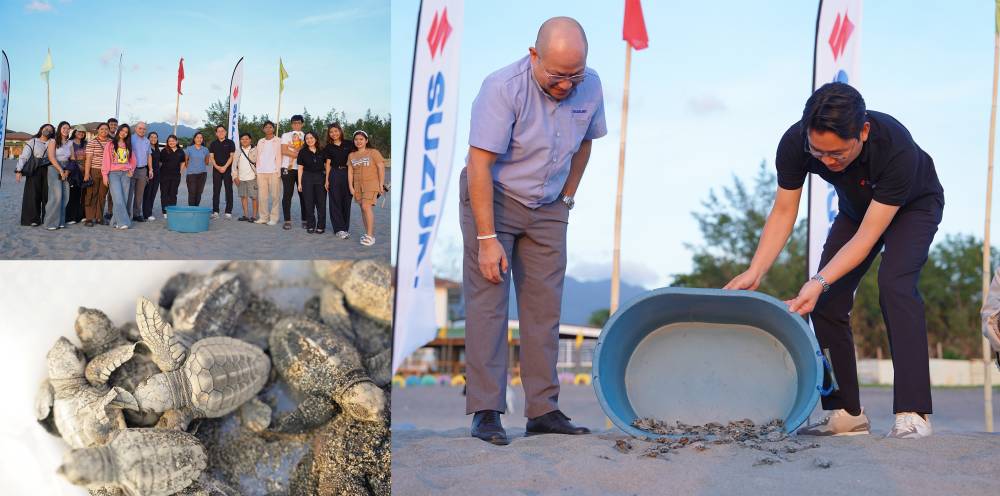
Those Pawikan eggs buried in the nests that Suzuki adopted last September had just recently hatched, and the hatchlings were then released along the shore fronting the PCC on Feb. 8, to continue their long, arduous journey into adulthood in the world’s oceans.

The Suzuki Philippines Automobile division team was also on hand for the event, notably its director and general manager Norihide Takei, national sales manager Ira Valte, and brand communications group head Jeff Lopez.
PCC reported that “their conservation efforts have yielded encouraging results.” Out of 100 nests, a total of 9,468 Pawikan eggs were safely secured. From these, 8,713 baby turtles successfully hatched, demonstrating the impact of sustained conservation work and community partnerships.
Suzuki Philippines team members weren’t there just to witness. They participated directly by carefully digging out the nests to collect the hatchlings, then releasing them along the shoreline at sunset—a powerful reminder of the shared responsibility to protect nature for future generations.
In a statement, Suzuki Philippines said the activity reflects its brand philosophy, “By Your Side,” which extends beyond mobility solutions to supporting communities and protecting the environment. “Suzuki Philippines looks forward to strengthening this partnership through more collaborative initiatives… remaining committed to being by the side of communities, nature, and future generations.”
Big things in small packages. That’s how I would best describe the Suzuki brand. And that’s what it demonstrated yet again last September during our drive of the Fronx to Bataan, and when Suzuki Philippines revisited PCC for the hatchlings release. These are reminders that even the smallest acts of stewardship and protection can cross oceans and human boundaries.