











Audi’s winning record sets the tone for Formula 1’s new era

When Audi arrives on the Formula 1 grid, it won’t be chasing relevance—it will be extending a pattern the four rings have followed for more than a century: enter moments of technical change, prove the technology in public, and aim for wins that matter.
That story begins earlier than most people remember. In 1906, Horch won the Herkomer competition, a grueling early test where engineering endurance mattered as much as speed. In 1912–1914, Audi followed with three victories and secured the trophy cup of the Austrian Alpine Rally—an era when reliability, composure, and mechanical discipline decided reputations for generations.
Over time, Audi’s most famous successes became tied to the world’s most demanding formats. Endurance racing is where the brand built its modern legend—because it rewards the same qualities Formula 1 demands: efficiency, strategy, teamwork, and flawless execution under relentless pressure. Audi is credited with 13 overall victories at the 24 Hours of Le Mans, making it one of the event’s most successful manufacturers—an era also shaped by legends like Tom Kristensen, whose Le Mans legacy is closely linked with Audi’s dominance. In the FIA World Endurance Championship, Audi captured two consecutive Manufacturers’ World Championships (2012, 2013)—and in those same seasons, its drivers also took the Drivers’ World Championship (2012 and 2013), reinforcing that the pace was backed by season-long consistency, not one-off brilliance.
Audi’s endurance résumé is also stitched with iconic “around-the-clock” battlegrounds that fans instantly recognize. At the 24 Hours of Spa—often called the world’s biggest GT3 race—Audi has recorded four overall victories in the modern GT era (2011, 2012, 2014, 2017), proving its customer racing ecosystem can win in the deepest GT3 field on the calendar. in the United States, the record is just as striking: at the 12 Hours of Sebring, Audi is credited with 11 overall victories—a benchmark built across multiple generations of endurance engineering.
At the 24 Hours of Daytona, Audi has delivered two major class wins in the modern era: a GT class victory (2013) and a GTD class victory (2016)—proof the brand can win in North America’s most brutal “day-and-night” chess match, whether as factory-backed tech or customer racing execution.
On the sprint and touring-car side—where races are shorter but the pressure is constant—Audi’s track record is equally defining. In DTM, Audi drivers have captured 12 drivers’ championships, reflecting mastery in tight regulations, intense weekends, and margins measured in tenths.

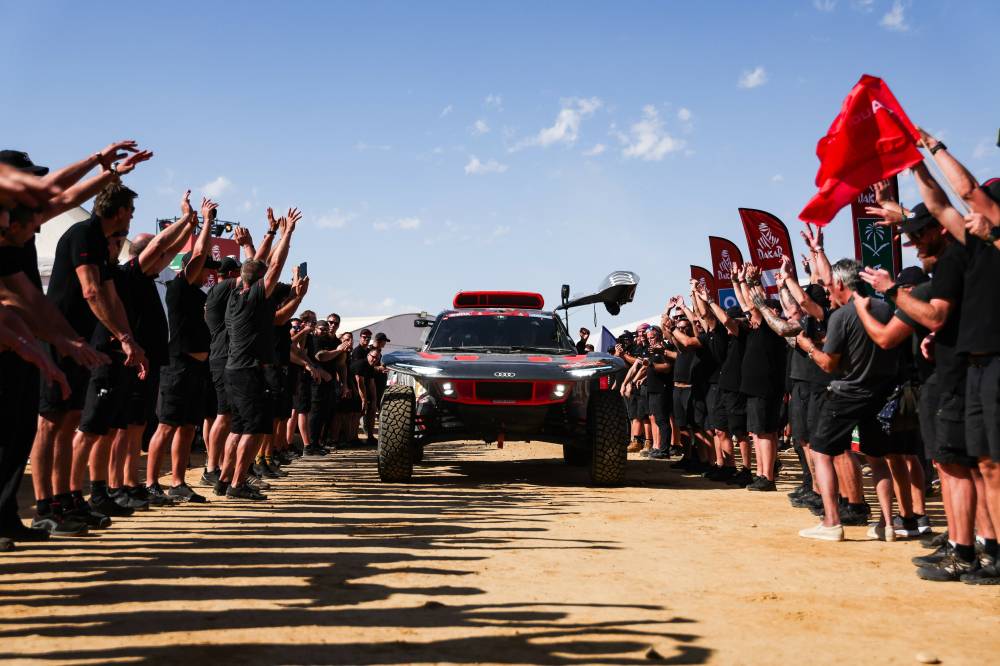
Then there’s the Audi habit of winning where conditions are extreme and variables explode. From the mid-1980s, quattro turned impossible surfaces into an advantage, highlighted by Pikes Peak International Hill Climb—where Audi claimed three consecutive overall victories (1985–1987), with Michèle Mouton (1985), Bobby Unser (1986), and Walter Röhrl (1987) setting a new benchmark run by run. And more recently, a headline win at the Dakar Rally showed that electrified performance can survive the harshest proving ground in motorsport: Audi secured its first overall Dakar victory in 2024, winning with the Audi RS Q e-tron after roughly 7,900 kilometers with a lead of 1 hour 20 minutes, validating a low-emission concept built around electric drive, a high-voltage battery, and an energy converter.
That is why Audi’s step into Formula 1 makes sense now. The 2026 regulations push hybrid contribution and sustainable fuel to the center of performance—a technical reset that fits Audi’s “race-to-develop” identity. In other words: the same brand that learned to win by balancing speed with efficiency over 24 hours is now preparing to do it in the fastest laboratory on earth, every other weekend, in front of the world.