









284 drug case acquittals due to poor police work

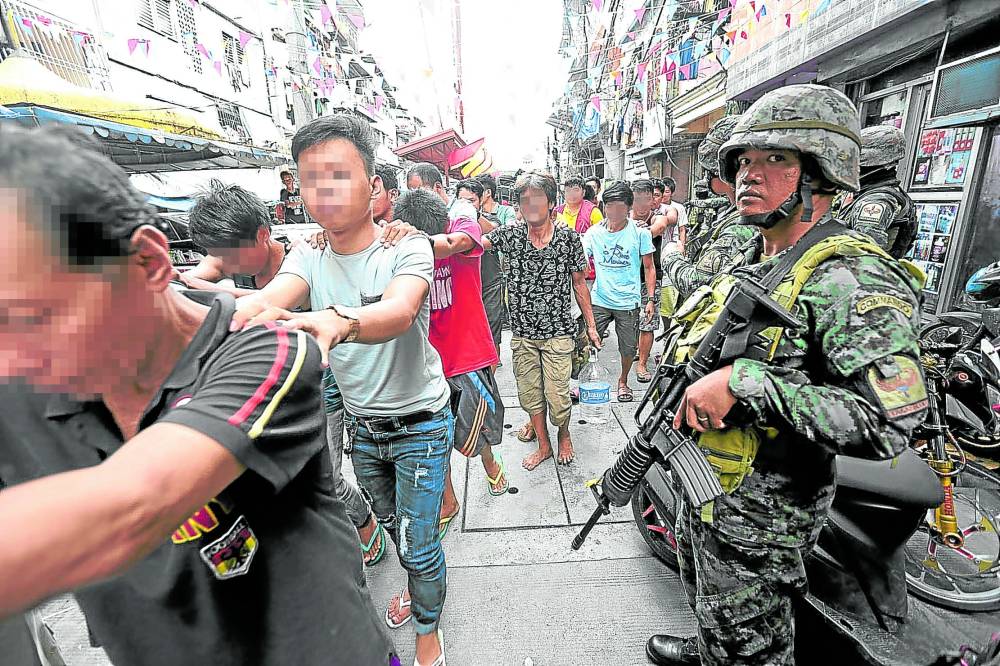
“Sloppy” police work and poor compliance with the rules on handling evidence resulted in acquittals for 284 drug cases in the first five months of 2025, some of them filed during the deadly antinarcotics campaign waged by then President Rodrigo Duterte.
Among those acquitted were Jerome Gaje and Bryan Salceda, who were arrested by the Philippine National Police in a buy-bust operation in Makati City in January 2022 based on an informant’s tip.
Prosecutors alleged that the two men acted as couriers for another individual, delivering more than one kilo of “shabu” to a poseur-buyer in exchange for P1 million.
Police further alleged that an additional five kilos of drugs were recovered from the suspects after their arrest.
Gaje and Salceda denied the charges, saying they were framed.
They testified that they were about to eat at a nearby “paresan” or eatery when armed men emerged from a black van and suddenly grabbed them, took them to a house, cuffed them, and forced them to lie face-down while police “planted” the drugs.
‘Glaring gaps’
A Makati City court convicted the two in 2023, sentencing them to life imprisonment and ordering them to pay a P500,000 fine.
The Court of Appeals (CA), however, found “glaring gaps” in the chain of custody or how police handled the seized drugs, leading to the acquittal of Gaje and Salceda on May 30, 2025.
Among the lapses identified by the CA was the absence of the weight of the seized items in the inventory receipts, indicating that the drugs were not weighed either at the place of arrest or at the police station.
In the ruling penned by Associate Justice Eduardo Ramos Jr., the CA’s Second Division acknowledged the seriousness of the country’s drug problem and the need to curb it.
But it also cited a 2019 Supreme Court ruling warning that when the Constitution is violated, “the war on illegal drugs becomes a self-defeating and self-destructive enterprise.”
The CA reiterated the high court’s reminder: “A battle waged against illegal drugs that tramples on the rights of the people, is not a war on drugs; it is a war against the people.”
Weak evidence
Gaje and Salceda’s case is just one of 284 drug-related acquittals handed down by the CA from January to May 2025, a figure that already exceeds the 2018 total of 257 acquittals, based on data from the Supreme Court Office of the Spokesperson.
More broadly, since 2016, when Duterte enforced a ruthless antidrug campaign that mostly targeted small-time suspects and resulted in thousands of extrajudicial killings, drug case acquittals at the CA and the Supreme Court steadily increased.
What emerged was a trend that lawyers said can be traced to “sloppy” police work, such as failures to comply with strict legal requirements and the submission of weak evidence in court.
Data obtained by the Inquirer showed that an average of 46,044 drug cases were filed annually in regional trial courts from 2017 to 2024.
During the same period, the CA and Supreme Court increasingly overturned convictions, most notably in 2019, when the CA recorded 944 acquittals, a 267-percent increase from the 257 cases recorded in 2018.
At the Supreme Court, the highest number of drug case acquittals was recorded in 2021 at 405, a 249-percent increase compared to 116 cases in 2018.
The high tribunal did not provide an explanation for the spike.
Some CA justices, however, have publicly pointed to recurring violations of the rules governing chain of custody.
‘Too strict’
When Associate Justice Carlito Calpatura applied for a post at the Supreme Court in May last year, he told the Judicial and Bar Council that he would revisit those rules in drug cases if appointed.
“I believe it is too strict insofar as the procedure against law enforcers. If these are revisited, there should be a review on specially the time requirement like requiring witnesses to be present near the site of operations because that is dangerous also for civilians,” Calpatura said.
Meanwhile, CA Associate Justice Jaime Fortunato Caringal, in an Aug. 15 episode of the Supreme Court Podcast, emphasized the rules’ significance, noting that many cases are dismissed for noncompliance.
“I can also say that for the Court of Appeals, in a lot of our cases here, we also acquit the accused because of breaks in the chain of custody,” he said.
For lawyer and physician Lee Yarcia, a senior law lecturer at the University of the Philippines, the rise in acquittals may be traced to early drug cases built on “planted evidence.”
He cited a 2019 report by the United Nations Office of the High Commissioner for Human Rights, which found that firearms allegedly used in drug-related crimes were often recycled, having identical serial numbers across different incidents.
“I would say a big contributor to the rise in acquittals would be the filing of many cases that are products of poor evidence. Either they were sloppy at their job, but I do think a big part of that also is on manufactured evidence and noncompliance with the rules,” Yarcia told the Inquirer in an interview.
Bian Villanueva, legal officer of Initiatives for Dialogue and Empowerment through Alternative Legal Services Inc. which also handles drug war cases, said the trend shows that courts continue to enforce due process under Republic Act No. 9165 and act as a check on executive excesses.

Despite policies imposed during the previous administration’s antidrug campaign, Villanueva said, courts did not relax requirements on chain of custody, evidence integrity, due process, witness protection, and the validity of searches, seizures, and arrests.
“So inasmuch as it might be tempting, for example, for enforcers to try to skirt those requirements. In the end, it will just lead to acquittals because the law does not change. Those requirements have not changed for a while,” he added.
Mandatory policy
Under Section 21 of RA 9165, the chain of custody rule requires seized drugs to be properly handled, marked, inventoried, photographed, and accounted for at every stage to preserve their identity and integrity.
This involves four links that should be properly complied with: seizure and marking by the arresting officer; turnover to the investigating officer; submission to the forensic chemist for examination; and presentation of the same items in court.
In 2018, the Supreme Court, in G.R. No. 231989 penned by then Associate Justice Diosdado Peralta, enforced a mandatory policy to “weed out early on from the court’s already congested docket any orchestrated or poorly built up drug-related cases.”
The guidelines require arresting officers to state in their affidavits their compliance with the chain of custody rules or explain any deviations and how the evidence was preserved.
If no explanation is given, prosecutors should not immediately file the case, and courts may dismiss it outright or refuse to issue warrants for lack of probable cause.
Public health issue
As the country reckons with the toll of the Duterte drug war, the government now under a new administration has begun signaling a shift toward treating illegal drugs as a public health issue.
Yarcia, a harm reduction advocate, said the current legal framework remains largely punitive, prioritizing incarceration over treatment.
Moving away from punishment toward a public health approach, he said, would require removing criminal penalties that often cause more harm than benefit.
One such alternative is harm reduction, or providing health services to people who use drugs regardless of continued use.
“For example, some inject drugs. If we go with the present law, that’s automatically criminalized. You are penalized for drug rehabilitation, or if you use it again, imprisonment. With harm reduction, you remove that criminal penalty, and then instead you provide health services. That could mean providing HIV testing, providing clean needles, mental health services, psychological counseling, and even drug treatment and rehabilitation. You remove that criminal penalty, and instead you focus on a public health approach,” Yarcia explained.
But even as advocates push for reform, and various stakeholders continue to tackle amendments in the current law to improve the implementation of antidrug policies, Villanueva said progress would remain difficult without a broader cultural shift from stigmatizing persons who use drugs.
“So we can advocate, international agencies, academics can always push for policy reform in the sense that we need to push a health-based approach to this problem of dangerous drugs. But then it has to be accompanied with a very strong cultural reimagining of this problem,” he said.