








A nation in ink and paint


As Filipinos celebrate Independence Day on June 12, Leon Gallery’s Spectacular Midyear Auction on June 13 offers more than a parade of collectibles. It presents a remarkable archive of nationhood: revolutionary documents, rare newspapers, early maps, colonial chronicles, and iconic artworks that trace the long and complex story of the Philippines.
Taken together, the auction’s Filipiniana section reads like a compressed history of the nation—from its earliest appearance on European maps to the birth of the First Philippine Republic and the cultural imagination of the 20th century.
The Republic on paper
Among the most historically significant lots are documents associated with the First Philippine Republic, Asia’s first constitutional democracy.
Foremost is Lot 96, Apolinario Mabini’s “Panukala sa Pagkakana ng Republika Nang Pilipinas” (1898), a provisional framework for the new state. Included is Mabini’s celebrated “El Verdadero Decalogo” (The True Decalogue), a 10-point guide to civic virtue and national conduct. More than a political text, it reveals the moral foundations that Mabini believed should sustain freedom.
That vision found legal expression in Lot 97, the “Constitucion Politica de la Republica Filipina,” promulgated in January 1899. The Malolos Constitution established principles revolutionary for a society emerging from more than three centuries of colonial rule, including the sovereignty of the people and the separation of church and state.
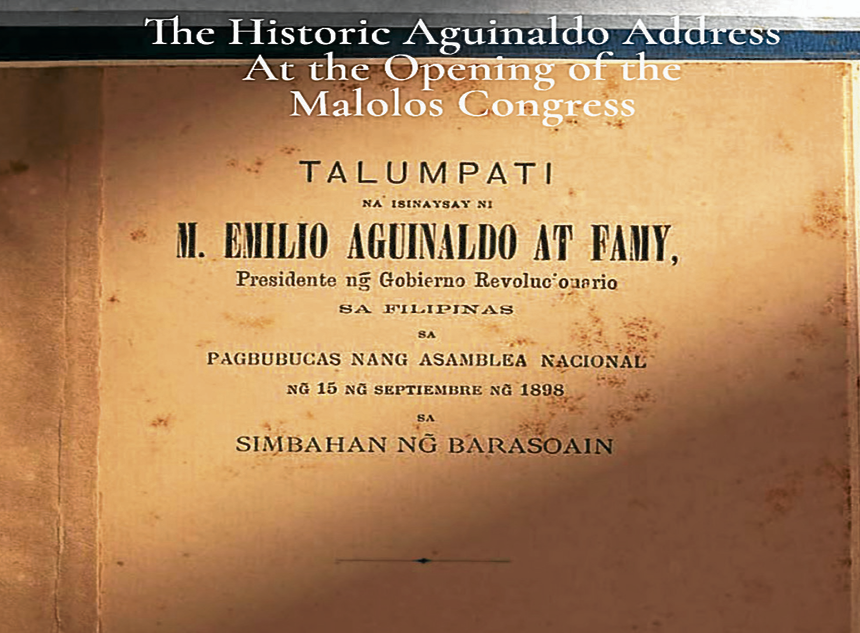
Complementing these foundational texts is Lot 98, an 1898 pamphlet containing President Emilio Aguinaldo’s inaugural address delivered at Barasoain Church. It captures the aspirations of a people determined to govern themselves after centuries of foreign domination.
The brief life of the Republic is poignantly reflected in Lot 99, the “Reglamento,” or parliamentary rules printed in 1899 as government forces retreated before advancing American troops. Even as war threatened to extinguish the young republic, its leaders persisted in preserving the machinery of democratic governance.
Newspapers of the revolution
The struggle for independence was fought not only on battlefields but also in print.
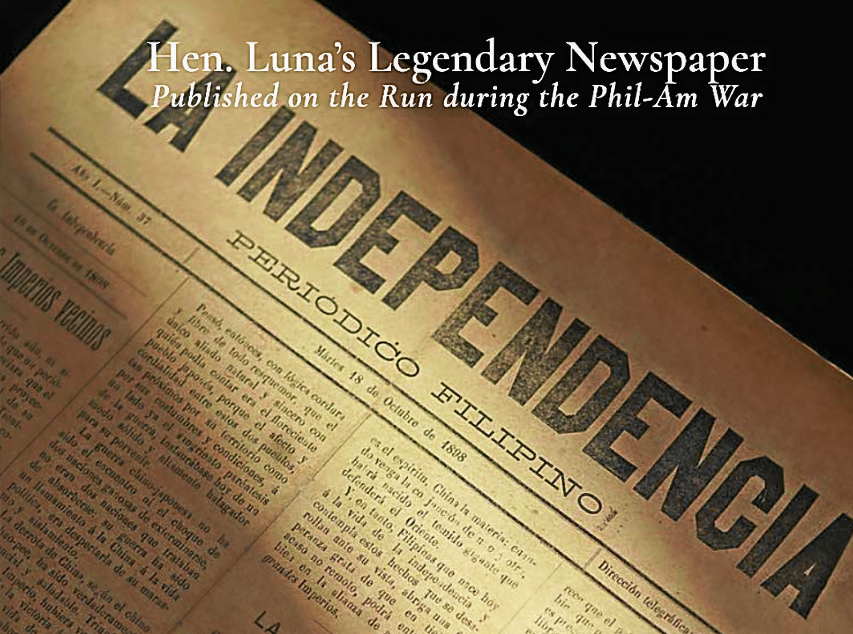
Lot 94 features La Independencia, the revolutionary newspaper associated with Gen. Antonio Luna. Its pages became a forum for some of the brightest literary and political minds of the era, including Cecilio Apostol, Fernando Ma. Guerrero, Salvador del Rosario, and the Palma brothers. Through journalism and literature, they transformed the revolution into an intellectual movement.
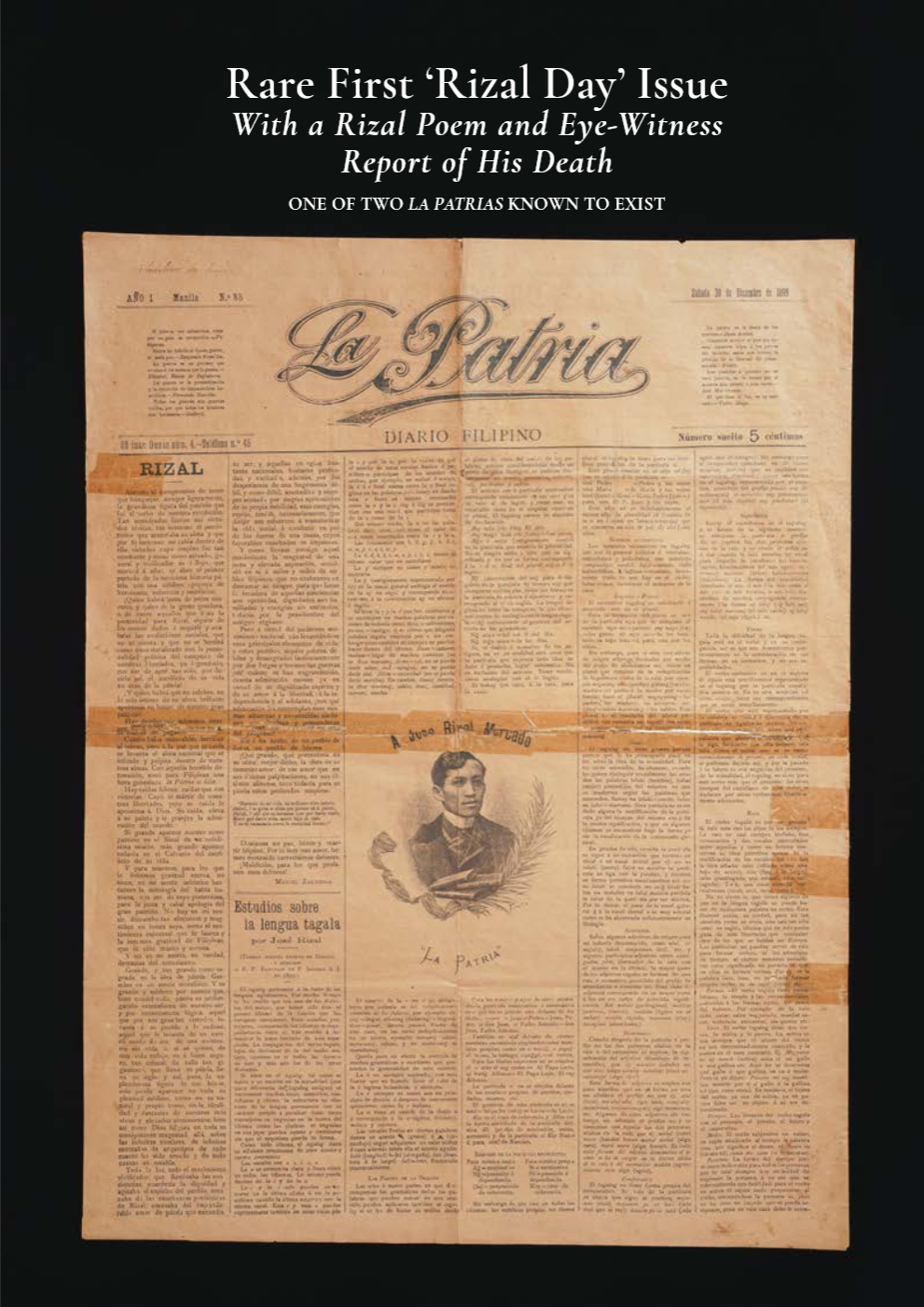
Even rarer is Lot 95, a Dec. 30, 1899, issue of La Patria, believed to be one of only two surviving copies worldwide. Edited by playwright Aurelio Tolentino and secretly financed by Pablo Ocampo, it is the earliest known “Rizal Day” edition. Published on the third anniversary of José Rizal’s execution, it juxtaposes an eyewitness account of his death at Bagumbayan with one of his youthful poems, symbolically linking the end of Spanish rule with the birth of Filipino nationalism.
Books that shaped historical memory
The auction also includes several cornerstones of Philippine historiography.
One of the most important is Lot 100, Fray Diego Aduarte’s “Historia de la Provincia del Santo Rosario de Filipinas, Japón y China (1693).” The catalogue unfortunately labels the volume as “The Triumph of the Jesuits in the Philippines,” although the work is in fact the definitive chronicle of the Dominican Order’s missionary enterprise in East Asia.
As scholar Jorge Mojarro notes in his catalogue essay, Aduarte’s history remains indispensable for understanding the early Spanish presence in the Philippines, Japan, and China. It records missionary efforts across Luzon, the evangelization of Manila’s Chinese community, and the institutional foundations of colonial society.
Nation’s earliest appearance
Aduarte himself was an extraordinary figure—Dominican prior, rector of the College of Santo Tomas, bishop, historian, and tireless preserver of memory. In the book’s prologue, he famously declared that he would “sell the blood of my heart” to see the work printed, lest the achievements of earlier missionaries be forgotten.
Equally significant is Lot 102, the 1698 first edition of Fray Gaspar de San Agustín’s “Conquistas de las Islas Philipinas.” Long prized by collectors and scholars, it chronicles both the military conquest of the islands and the missionary work of the Augustinians.
San Agustín’s observations preserved valuable information on indigenous customs and included one of the earliest recorded versions of a Filipino creation story.
If the revolutionary documents tell the story of political independence, Lot 101 reaches much further back—to the very naming of the archipelago.
Amorsolo and the Filipino soul
The rare Ramusio-Gastaldi Map of 1554 is often described as the Philippines’ “birth certificate.” It contains one of the earliest cartographic appearances of the name “Filipina,” derived from Ruy López de Villalobos’ tribute to Prince Philip of Spain.

More than a geographical artifact, the map marks the archipelago’s earliest recorded identity in the global imagination.
The historical narrative culminates in the works of Fernando Amorsolo, the country’s first national artist.
Among the highlights are “Puerta Real de Bagumbayan” (1938), “Baguio Trail” (1940), “Lavandera” (1940), and “Noon Day Meal” (1950). Though separated by centuries from the revolutionary documents and colonial chronicles, these paintings articulate another dimension of nationhood: the everyday life of the Filipino people.
Cultural homeland
In “Baguio Trail,” Amorsolo captures the serenity of the Cordilleras and the quiet dignity of ordinary travelers moving through a mountainous landscape. “Lavandera” transforms the rural washerwoman into an emblem of Filipino beauty and resilience, while “Noon Day Meal” exemplifies what critics have called Amorsolo’s vision of the “happy patriot”—a love of country expressed not through conflict but through harmony, labor, family, and abundance.
Through his luminous backlighting and pastoral imagery, Amorsolo created enduring images of a nation at peace with itself. If Mabini and Aguinaldo imagined the Philippines as a political community, Amorsolo envisioned it as a cultural homeland.
How nation remembers itself
Viewed together, the auction’s treasures form a continuous narrative. Maps gave the islands a name. Chroniclers preserved their early history. Newspapers and political texts articulated the dream of freedom. Revolutionary leaders built a republic. Artists, such as Amorsolo, gave visual form to the Filipino spirit.
In that sense, Leon Gallery’s Spectacular Midyear Auction is more than a marketplace.
Coming a day after Independence Day, it becomes a meditation on how a nation remembers itself—through paper, ink, memory, and art. —CONTRIBUTED


