








Actresses as male heroes? Theater artists speak out

Should actresses play male national heroes in a stage drama?
“If there’s a good reason for it, why not?” says veteran novelist, playwright, screenwriter and journalist Jose “Butch” Dalisay. “In Elizabethan drama, men played women. So Juliet was a boy. So it was in Greek and Japanese theater. But that was because society was then averse to the idea of women onstage.”
Dalisay said “a reversal [of roles] would be a political statement, applying not just to theater but to history. But you’d still have to ask beyond that, what for? The choice would have to work as drama, as fiction, as historical insight to be appreciated.”
But for stage director and actor Robbie Guevara, that idea might be considered “gimmickry.”
“[It’s] something different, [although it] no longer impresses, I guess, because it has been done many times. I saw ‘Operation Mincemeat’ at the West End in London recently. Five actors—three females, two males—all playing various roles and genders. Again, nothing new. They were good, sure, but for me it wasn’t anything new to behold. Maybe the new generation [of audiences] who haven’t seen it done in the past will be more delighted.”
‘Deeper humanity’
Playwright Nicolas Pichay said “Gender-blind casting is another layer of creating meaning.”
“And so long as the intention of such casting to enrich the emotional and intellectual case of the play is clear, then it should be a powerful theatrical technique,” he said.
Actress and cultural administrator CB Garrucho said “When an actress successfully portrays a male character, she creates a compelling blend of traits from a female lens—strength with vulnerability, power with compassion, and authority with kindness and wisdom.”
“In so doing, the audience is freed from ‘conventional expectations,’” she said. “The actor is able to transcend gender to reveal a deeper, richer humanity in the character.”
‘Good reason’
Another stage veteran, actress and director Joy Virata, said she had “only seen a few instances of this [a long time ago] but, in general, I would say that I have no objections.”
“However, I would like to point out there should be a good reason for the director to choose this,” she said. “Either he/she would like to subtly suggest some form of humanity in the character being portrayed, or as criticism of some element of society—political or cultural.”

“Or the playwright has specified that a female should play the role. Or the director believes that there is no other male actor available as capable of playing the role,” Virata said.
For drama critic Vincent Gregory Yu, “Plays—like culture in general—are malleable things. As long as the artists make the piece work and … it makes sense, I don’t see any problem with it. [But] bigotry is not a nice look.”
Musical on Mabini
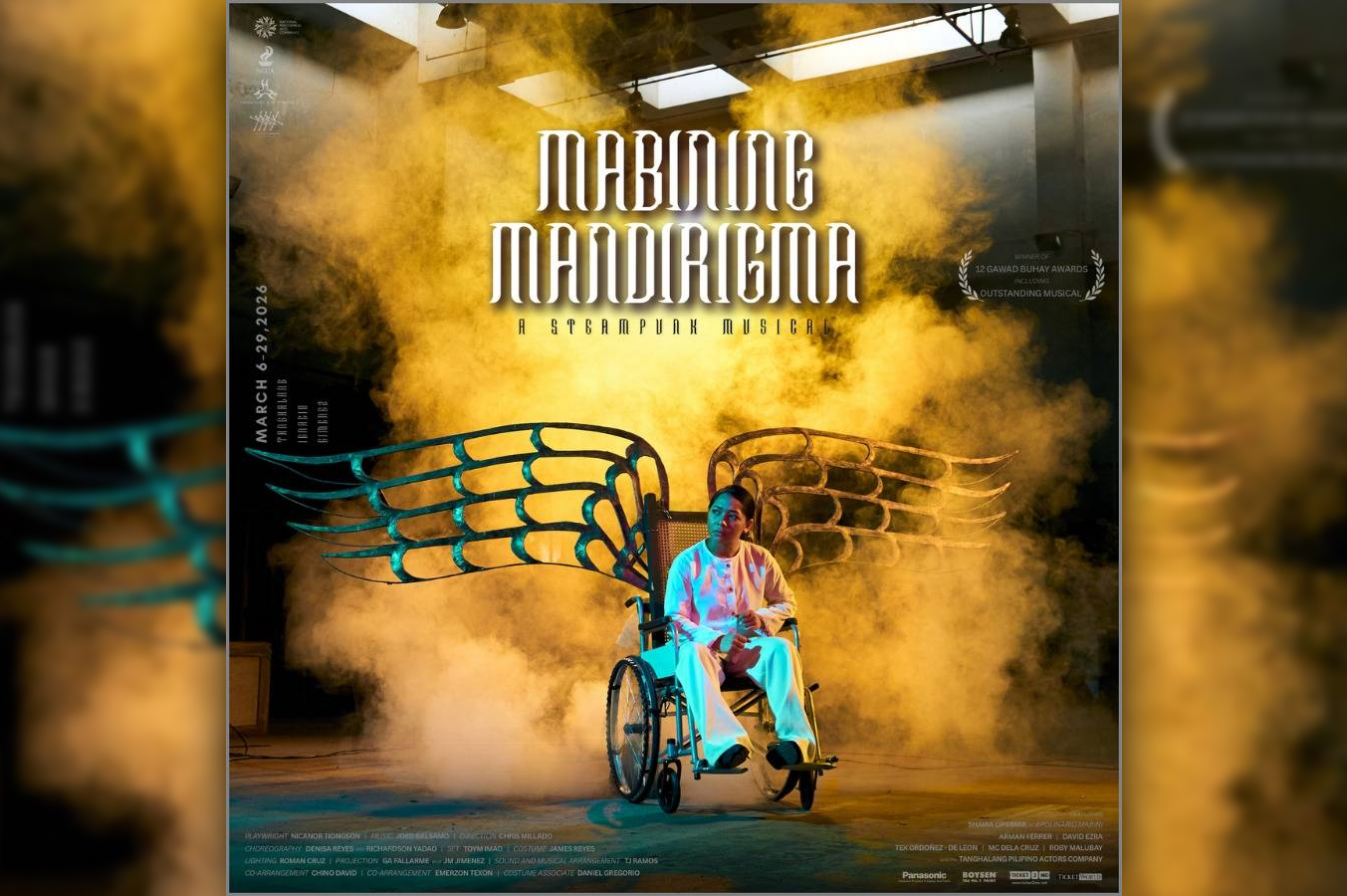
Talking about women playing male heroes, Tanghalang Pilipino, the resident drama group of the Cultural Center of the Philippines (CCP), is presenting anew “Mabining Mandirigma: A Steampunk Musical,” by playwright, academic and author Nicanor Tiongson and composer and musical director Joed Balsamo.
Shaina Optimar plays the title role, which had been previously played by A-list actors Delphine Buencamino, Monique Wilson, Liesl Batucan and Mabini descendant Hazel Mananan.
The musical dramatization of Mabini’s involvement in the Philippine-American War will run on March 6 to March 21, 7:30 pm, at the Black Box Theater (Tanghalang Ignacio Gimenez), CCP Complex.