









Antidynasty bill tested through ‘consultations’

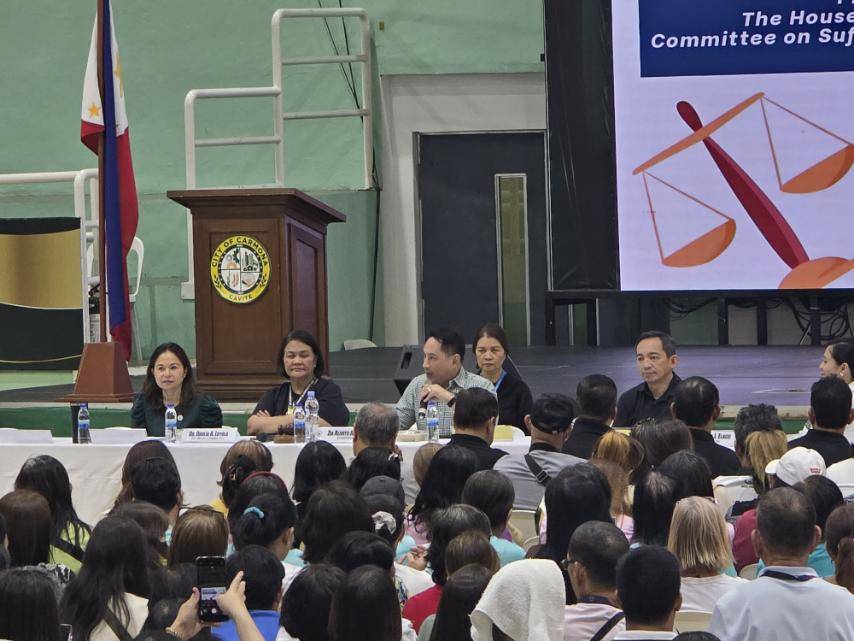
CARMONA, CAVITE—What happens when you ask a constituency born and raised under the leadership of one family about an antidynasty law?
One response is strong resistance, as the House committee on suffrage and electoral reforms found out on Thursday during its first public consultation on 22 such proposals.
Many of the residents of this city said they were wary of a law that could upend the leaders they credited for the city’s development.
This pushback was particularly pronounced among the older residents of Carmona—the country’s youngest city—who say they witnessed its transformation from a third-class municipality into an urbanized city under the stewardship of the Loyola family, one of at least five political clans that dominate vote-rich Cavite province.
For panel chair and Lanao del Sur Rep. Zia Alonto Adiong, these views merely reflected “their lived realities [and] fears that (such a measure) might create problems in terms of continuity of services being delivered by the government.”
Adiong emphasized that the passage of an antidynasty bill was “non-negotiable … [this] is not a discretionary part of Congress but a dictation by the Constitution to spell out and provide a clear definition on what a political dynasty is.”
For ‘balanced version’
The goal is not to reach a perfect consensus but a “balanced and acceptable version” of the law because “legislation has to go hand in hand with the experience of man,” he said.
Article 2, Section 26 of the Constitution explicitly mandates the state to guarantee equal access to public service and prohibit political dynasties. But the challenge, Adiong said, lay in how to define a dynasty, a task the framers of the 1987 Constitution left to Congress.
He said specific details, such as the degree of family relations to be barred from an elective post, were up for debate.
For constitutional framer and former Supreme Court Justice Adolfo Azcuna, the strong negative sentiment against such a bill shouldn’t be a cause for worry “because it cannot override a clear mandate of the Constitution.”
“The provision is in fact antimajoritarian in nature because it is an exception to the general rule of popular choice. So, it is not something you submit to the crowd for acceptance,” he said.
Azcuna lamented that such consultations had been ignored for decades.
Continuity, progress
For longtime residents like John dela Cruz, who saw Carmona when it was a “dumping ground of garbage and dead bodies,” political dynasties were a symbol of continuity and progress.
It should not be the wholesale removal of a political dynasty but of leaders who no longer serve the people, he said.
This sentiment was echoed by 70-year-old Beth Biojon, who believed that the city’s success was a direct result of the alternating leadership of Rep. Roy Loyola and his wife, Mayor Dahlia Loyola.
“We are not in favor of the political dynasty bill because the citizens have their own minds to choose a leader who carries their interests,” she said. “We see it if they invest in education, health, livelihoods.”
The consultation revealed a generational rift as the city’s youth rejected dynasties for binding the people to old traditions and ruling elites that undermine democracy.
While the older residents focused on the tangible benefits from the current system, young people were concerned about lack of fairness and the illusion of choice.
Senior high school student Hanamiel Gamutan said she supported the passage of an antidynasty bill, arguing that “competencies are not inherited and neither should positions be.”
‘Utang na loob’
“As a Filipino, I am so sick of the Filipino virtue of ‘utang na loob’ (debt of gratitude)” being used to justify support for dynastic families, she said.
John Reo Potestas of the Biñan City Youth Development Council challenged the idea that voters truly choose their leaders in a dynastic system.
“There is an illusion of choice because no ordinary Filipino can compete with them,” he said. “We are made to believe that it’s OK that our choice is a dynasty as long as they’re competent. But the issue is not competency but what they do to democracy.”
“Democracy in its simplest form means it must be for the people, by the people. If we don’t give a chance for ordinary Filipinos from different social classes and backgrounds to lead, this system will persist, and the powerful will continue to steal,” Potestas added.
ACT Teachers Rep. Antonio Tinio, who was present, saw that results of such consultations could be manipulated.
“Everyone knows that these public consultations are mainly political theater in which the players mobilize to show support for their side of the debate. Since these are hosted by local government units, it’s not surprising that a vocal contingent of prodynasty advocates are present,” Tinio said.
Potential justification
Fr. Robert Reyes, Clergy for Good Governance convenor, shared Tinio’s view as he expressed concern that the statements gathered during the public consultation may be used by lawmakers to justify why an antidynasty bill should not be passed.
“If they go to places that are held by the dynasties … If that place is controlled by the dynasties, rest assured, they will get people who will say, ‘we have no problem with our mayor, with our governor, they are really after our welfare,’” Reyes told the Inquirer.
Ateneo School of Governance senior researcher and constitutional law expert Michael Henry Yusingco said that “Carmona is just one town.”
“The fact that the hearing was conducted there is actually good because it provides a venue for the other side or the other perspective that is supportive of dynasties.”
He said that enacting an antidynasty law would not prevent a political family from participating in politics and governance, “it’s just going to regulate the number of members running for election.” Yusingco added.
Make it ‘genuine’
In a video message, Speaker Faustino “Bojie” G. Dy III said he was aware of the opposing views about the proposed law, which he said was long awaited by the people.

“These consultations are part of the commitment of the House of Representatives to ensure that essential laws are crafted through open and honest dialogue,” Dy said.
One of the bills, House Bill No. 6771, was filed by both Dy and Majority Leader Ferdinand Alexander “Sandro” Marcos III, the eldest son of President Marcos.
“What is clear is this: the House is serious about advancing and passing a just, meaningful, and humane antipolitical dynasty bill. However, we maintain that the law will be stronger if it undergoes genuine and broad consultations with our people,” he said.
More than 30 business and civil society organizations are calling on Congress to pass a “genuine” antipolitical dynasty law, which they said should bar individuals related within the fourth degree of consanguinity or affinity to an elected official from running for public office.
The fourth degree of consanguinity refers to the extent to which immediate or close family ties reach, where the first degree includes parents and children, and the fourth includes first cousins, great-uncles and aunts, and great-great grandparents.
The first degree of affinity, or by marriage, are one’s mother-in-law and father-in-law, and stepchildren; the fourth degree includes a spouse’s first cousins, or the husband or wife of a first cousin.
“Ultimately, the battle against political dynasties is a battle against corruption itself,” the groups said in a statement. “For our nation to finally break free from the bondage of corruption, political dynasties should no longer thrive.”
The groups said the Dy-Marcos bill, HB 6771, would effectively preserve “monopoly over political power” as it allows relatives to rotate, substitute for, or succeed one another in elective positions.
“In reality, HB 6771 is a prodynasty measure,” they said.
‘1 local, 1 national’
A genuine antipolitical dynasty law should also have a provision upholding the principle of “one local, one national” representation. This would prevent a single family from controlling overlapping local and national jurisdictions, the groups said.
“Many dynasties also dominate local economies through franchises, personal business and the favored granting of permits, tightening their grip on both political and economic life,” they pointed out.
Those that signed the statement were members of the Justice Reform Initiative, which includes the Management Association of the Philippines, the Makati Business Club, the Financial Executives Institute of the Philippines, the American Chamber of Commerce of the Philippines and the European Chamber of Commerce of the Philippines.
Education and civil society groups that also signed were the Catholic Educational Association of the Philippines, Parish Pastoral Council for Responsible Voting, Women for Action Towards Reform, Kontra Dinastiya and De La Salle Philippines. —WITH REPORTS FROM LOGAN KAL-EL M. ZAPANTA, GILLIAN VILLANUEVA AND ROMER BUTUYAN
******
Get real-time news updates: inqnews.net/inqviber