










Baguio hotels told to upgrade, build own wastewater plants

BAGUIO CITY—Days before the Holy Week break, hotels and other accommodation facilities in the summer capital have been directed to construct or upgrade their own wastewater treatment systems following a national regulator’s order to disconnect them from Baguio’s aging sewage treatment plant (STP).
Because the 2016 Baguio Environment Code classifies the STP as a domestic treatment system, the Environmental Management Bureau (EMB) of the Department of Environment and Natural Resources concluded in a recent meeting that commercial establishments, such as hotels must be “disconnected” to ease pressure on the 40-year-old Baguio STP, said lawyer Rhenan Diwas, city environment and parks management officer, during the council session.
The local environment code also requires large hotels to install their own STP systems if their wastewater generation exceeds 12 cubic meters per day, Diwas added.
He said the city government is currently seeking P1.2 billion in funding from the Tourism Infrastructure and Enterprise Zone Authority (Tieza) and the Department of Public Works and Highways to rehabilitate the aging facility.
Intervention
The Hotels and Restaurant Association of Baguio, along with operators of transient houses and dormitories, asked the council to intervene after receiving notices from Diwas’ office stating that hotels must modernize their STPs to meet EMB standards by Aug. 31. Hotels without STPs are required to construct their own systems by Dec. 31, deadlines set by the EMB.
Venus Parkview Hotel, represented by Isabelle Villanueva-Barter and Charito Barter, and Hotel Cosmopolitan, led by Mark and Glen Flores, told the council that rapid investments in wastewater systems would cost each hotel more than P3 million and require additional trained personnel for wastewater management.
The 40-year-old Baguio STP, completed in 1986 by Japanese engineering firm Tobishima, was designed to treat 8,600 cubic meters of wastewater. However, population growth and extreme weather have increased wastewater flow to about 12,000 cubic meters over the years, exceeding its capacity, according to a 2016 prefeasibility study on Baguio waste management commissioned by the Asian Development Bank’s (ADB) Cities Development Initiative for Asia (CDIA).
Baguio hosts the headwaters of four river systems, but these waterways have been contaminated by untreated wastewater due to heavy rainfall and a rudimentary septic tank network serving much of its population of 366,358.
The STP currently treats wastewater from more than 4,000 commercial and residential structures across about 65 barangays in central Baguio, discharging into the Balili River, which flows into La Trinidad, Benguet. The CDIA had recommended constructing additional STPs along the Bued River, which runs along Kennon Road, as well as in the Asin-Galliano and Ambalanga river systems.
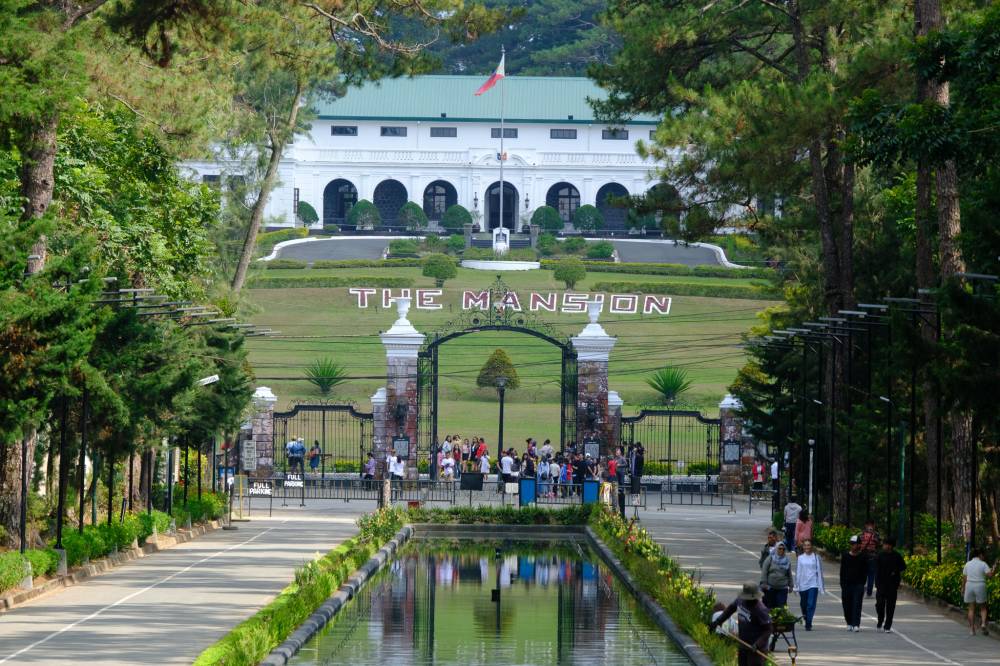
During a 2020 Cabinet briefing at the Mansion House, officials of the Rodrigo Duterte administration were told that the Balili River had a fecal coliform count of 160 quadrillion.

Facing a potential daily fine of P25,000 if prosecuted by the Pollution Adjudication Board for river pollution, Baguio was given a five-year extension by the EMB to secure financing and upgrade its STP.
However, a proposed $45-million government loan from ADB was shelved after delays led to the project being removed from the national government’s priority list in 2025.
During this year’s Baguio Flower Festival parades, Tieza chief operating officer Mark Lapid and Public Works Secretary Vivencio Dizon said in separate briefings that their agencies would help fund the STP rehabilitation. Each agency may provide up to P500 million, according to Diwas.
The city government plans to replace and expand aging septage pipes, introduce modular wastewater treatment plants, and establish community septic tanks that will be periodically emptied and treated at the Balili STP.
Households may be charged sewage fees based on water consumption, while tourists could pay environmental fees to help fund city services.