




Budget watchdog urges veto of ‘last-minute’ P319B

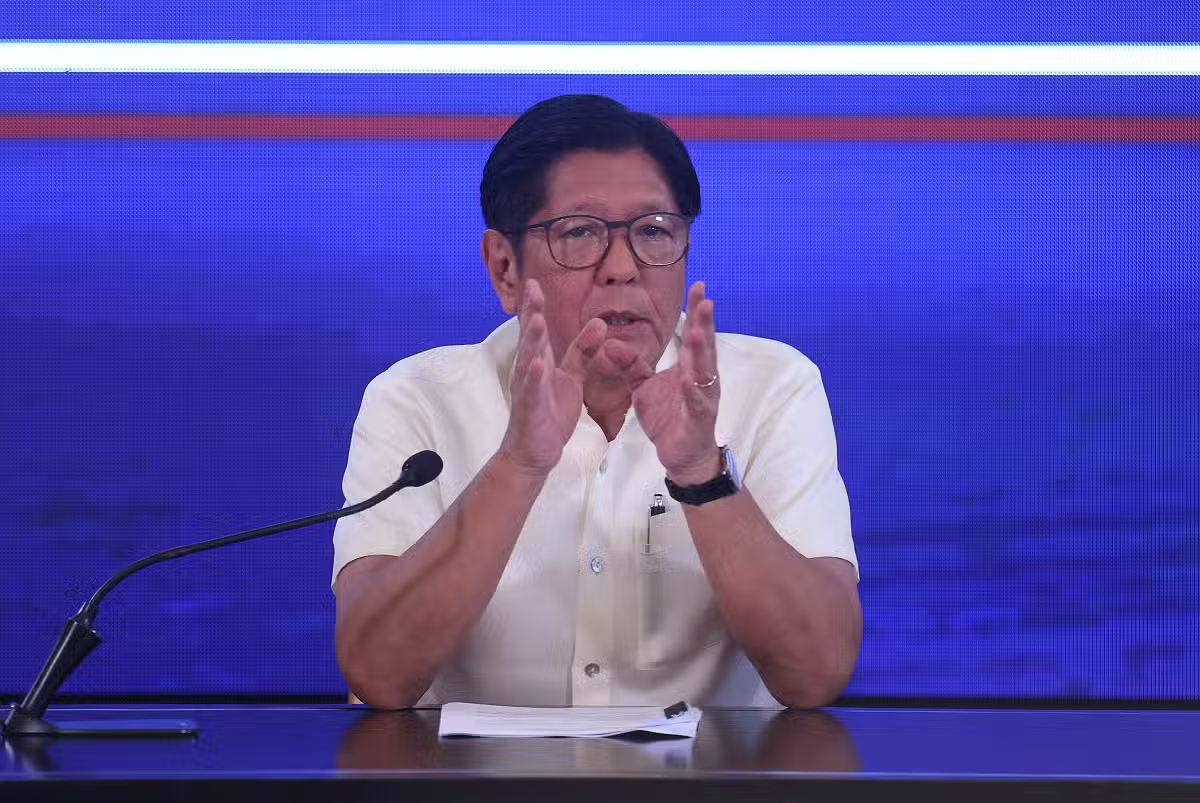
Budget watchdog Social Watch Philippines (SWP) has urged President Marcos to veto around P319 billion worth of questionable items ahead of the expected signing today of the P6.793-trillion national budget for 2026.
In a statement on Sunday, SWP claimed that members of the bicameral conference committee made last-minute insertions and lump-sum appropriations despite public outrage over corruption and wasteful spending.
It warned that this could herald the return of the old pork barrel system, which it called a “highly discretionary practice that is opaque and prone to political favoritism.”
“The 2026 budget is not people-centered, despite what the bicam committee claims. It is extremely disappointing how Congress ignores the public’s anger over unprecedented levels of corruption and the alarming use of public funds to promote patronage politics,” said Dr. Ma. Victoria Raquiza, SWP coconvener.
The programs that SWP wants vetoed include the Sustainable Infrastructure Projects Alleviating Gaps (Sipag) program for roads, bridges and flood control projects and the Basic Infrastructure Program (BIP), both under the Convergence and Special Support Program of the Department of Public Works and Highways (DPWH); as well as the P8.9 billion for farm-to-market roads and P10-billion Presidential Assistance for Farmers and Fisherfolk (PAFF) under the Department of Agriculture (DA).
It noted that BIP and Sipag, as well as PAFF, overlap or duplicate existing programs under the DPWH and DA, while the allocation for farm-to-market roads was a “last-minute adjustment” requested during the bicameral meeting and did not go through public scrutiny during hearings at the Senate and the House of Representatives.
It said these adjustments undermine the vaunted transparency and accountability of the bicameral process.
SWP is the latest to call for a presidential veto on items deemed vulnerable to corruption, after the civil society-backed Roundtable for Inclusive Development and the People’s Budget Coalition and Caloocan Rep. Edgar Erice, House senior deputy minority leader, who said he would ask the Supreme Court to intervene should Mr. Marcos fail to veto P243 billion in unprogrammed funds.
Confidential funds
SWP also flagged P2.73 billion for the Tulong Dunong Program under the Commission on Higher Education; P15.33 billion for the Disaster Rehabilitation and Reconstruction Assistance Program of the local government units (LGUs) under the National Disaster Risk Reduction and Management Fund; and P23.048 million to be spent for the Philippine Pavilion at the 2026 United Nations Climate Conference under the Climate Change Commission.
SWP likewise marked P5.25 billion in confidential funds under various agencies and P138 billion for social protection and assistance programs that saw questionable increases.
These social aid programs are composed of the Department of Health’s Medical Assistance to Indigent and Financially Incapacitated Patients or Maifip (P51.6 billion), the Department of Labor and Employment’s Tulong Pangkabuhayan sa Ating Disadvantaged Workers (P22.4 billion), and the Department of Social Welfare and Development’s Assistance to Individuals in Crisis Situations (P63.9 billion).
The watchdog also flagged the P56.873-billion LGU assistance fund, pointing out that the threefold increase granted by the bicameral conference committee was “prone to patronage and political discretion.”
It called on Mr. Marcos to revert the budget to the National Expenditure Program levels of P63.4 billion and P6 billion for the “ayuda” and LGU assistance fund, respectively.
Side meetings, huddles
The Senate and the House ratified on Dec. 29 the bicameral report on the proposed national budget for 2026, with some lawmakers expressing reservations over some financial assistance programs that they warned could be used for political patronage.
Sen. Sherwin Gatchalian, chair of the Senate finance committee, said this year’s budget is a landmark “people-first” legislation that seeks to prioritize education, health and agriculture.
Raquiza, however, said numerous nontransparent side meetings and huddles took place despite livestreaming the bicameral committee meetings.
“Such actions deepen the public trust deficit in government and intensify public cynicism toward the government’s commitment to uphold every Filipino’s right to a just and fair budget,” she said.
At the House, Erice said he was ready to ask the high court to intervene should the President approve the P243 billion in unprogrammed appropriations (UAs). Watchdogs earlier warned that UAs were a form of pork barrel that the high court already declared unconstitutional.

“My problem is the constitutionality of the UAs. And if the President does not veto it, my legal team is currently drafting a petition that we will file before the Supreme Court,” Erice said in an interview on dzBB on Sunday.
“So that once and for all, the Supreme Court can finally put to rest the constitutionality of this,” he added.
Unconstitutional
Erice was citing the separate opinion of Associate Justice Ramon Paul Hernando in the court’s decision in December, voiding the transfer of the P60 billion of unutilized subsidies for the Philippine Health Insurance Corp. to the national treasury to fund UAs in the 2025 General Appropriations Act (GAA).
According to Hernando, UAs in the GAA are unconstitutional and that the entire amount should be removed for contravening Article VI, Section 25(2) and Article VII, Section 22 of the Constitution.
Erice said the “biggest” problem of UAs was the lack of certainty in the source of funding for these line items.
Among the items the lawmaker said should be in the programmed appropriations were the P10.77 billion for salary upgrades, and P32.47 billion for retirement and terminal leave benefits for teachers, civil servants and uniformed personnel, which were moved into the UAs through a new item labeled “Payment of Personnel Services Requirements.”
SWP proposed two options to address the UA issue. The first is to retain all budget items except the budgetary support for government corporations and the Revised Armed Forces of the Philippines Modernization Program, as both already have dedicated budgets under special purpose funds.
The second option is to veto all 10 UA items, subject to a supplemental budget that clearly identifies funding sources and provides a breakdown of expenditure details.
“The Filipino people are angry and frustrated over how their money is being spent. We call on the President to veto these questionable budget items and stand with the people. This veto is essential to rebuild the integrity of the budget process,” said Raquiza. —WITH A REPORT FROM DEXTER CABALZA