








Buses, jeepneys, airport cabs, TNVS get fare hike

Commuters using public transportation must prepare extra cash this week as the Land Transportation Franchising and Regulatory Board (LTFRB) on Tuesday approved fare increases for jeepneys, buses, airport taxis and transport network vehicle services (TNVS).
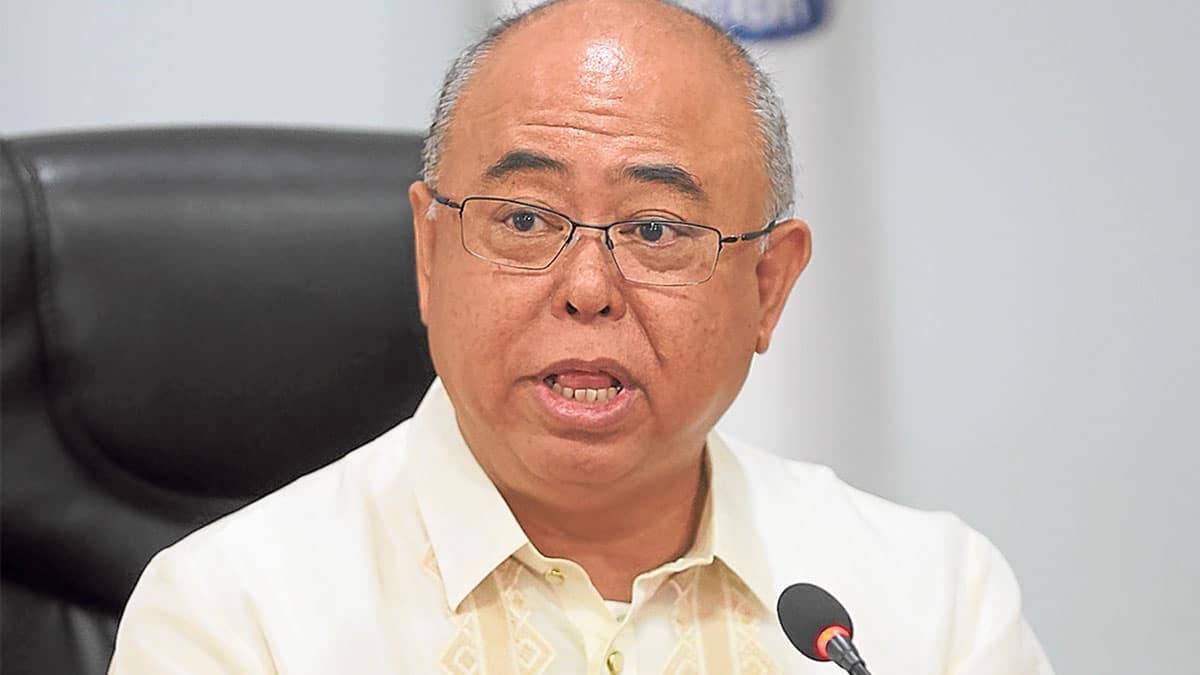
LTFRB Chair Vigor Mendoza II said the decision to increase fare rates starting on Thursday was made on account of the Middle East conflict that had sent global fuel prices soaring.
He said the price of diesel had already surged to around P75 to P80 per liter as of last week.
“This is one of the hardest decisions of the board. We circulated this multiple times. This was presented to [acting Transportation Secretary Giovanni Lopez]. There were many adjustments downwards, so we had to recompute our numbers over and over again,” Mendoza said in a briefing.
“The difficulty here is that the price of fuel is so erratic in the sense that every week we see substantial, not just minimal changes, but substantial changes,” he said.
Transport group leaders, however, called the minimal fare increase “a slap” to drivers and operators amid soaring fuel prices.
“It is a slap in the face considering that petroleum prices, particularly diesel, were raised by more than 100 percent, while the fare increase is only P1,” Mar Valbuena, president of Samahang Manibela, Mananakay at Nagkaisang Terminal ng Transportasyon (Manibela), told the Inquirer in Filipino.
Modesto Floranda, president of Pagkakaisa ng mga Samahan ng Tsuper at Opereytor Nationwide (Piston), said the fare adjustment would only translate to minimal additional income for drivers.
Floranda said the additional P1 fare was not enough.
“This is our call: remove taxes on fuel, roll back fuel price to P55, and grant the P5 fare increase,” he said.
New rates
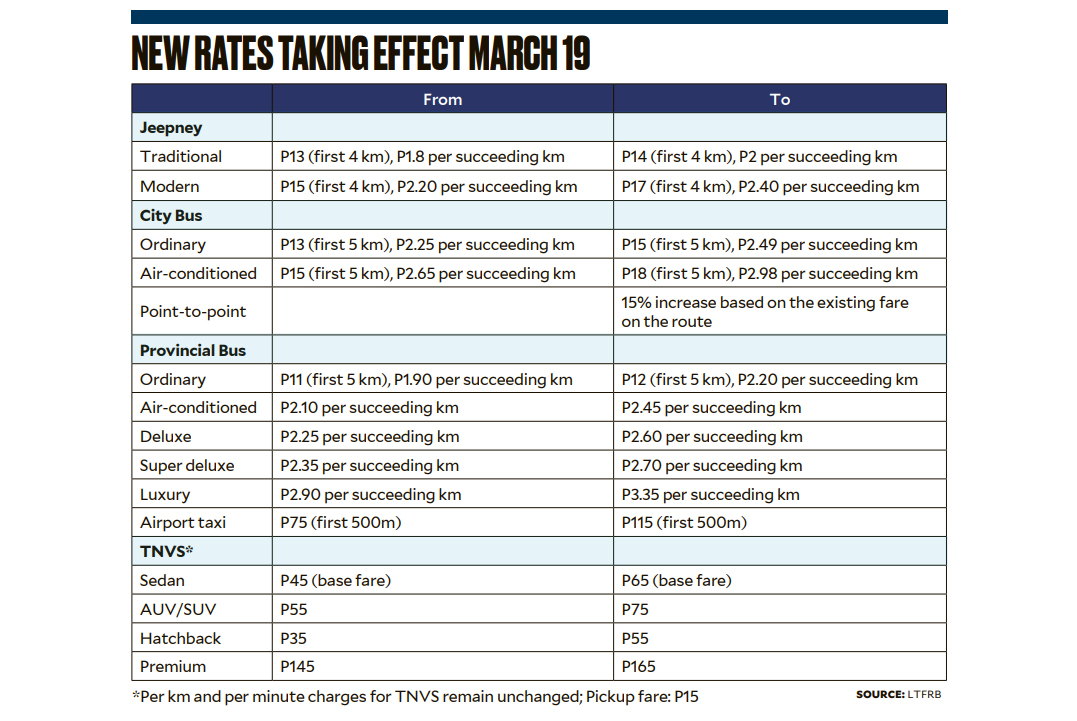
Under the new rates approved by the board, the base fare for traditional jeepneys, which covers the first 4 kilometers, will increase to P14 from the current P13. Each succeeding kilometer will cost P2 more, higher than the previous fare of P1.80.
For modern jeepneys, the base fare will increase from P15 to P17, while the rate for every succeeding kilometer will go up from P2.20 to P2.40.
“Because of these increases, the new fare of a Cubao-Divisoria route will be P26,” Mendoza said, citing an example. “That’s roughly a 9-percent increase [from the current fare of P23.80].”
For Metro Manila or city buses, the base fare for ordinary units, which covers the first 5 km, will increase to P15 from P13, while each succeeding kilometer will cost P2.49, up from P2.25.
The base fare for air-conditioned Metro or city buses will increase to P18 from P15, while each succeeding kilometer will cost P2.98 each, up from P2.65.
This means that a 10-km bus ride from SM Fairview to Luzon Avenue will cost each passenger P27.45, 13-percent higher than the current fare of P24.25, Mendoza said.
For provincial buses, the LTFRB has issued an order over the weekend which granted a provisional fare increase. Under the updated fare guide that took effect on March 14, the base fare of ordinary provincial bases will go up to P12 from P11, while the cost of each succeeding kilometer will increase to P2.20 from P1.90.
For air-conditioned, deluxe and super deluxe provincial buses, the price of each succeeding kilometer will increase by P0.35. Luxury provincial buses, meanwhile, will have an increase of P0.45 for each succeeding kilometer.
Point-to-point or P2P services will also have a 15-percent increase based on the existing fare of the route. The fare of a bus going from Ortigas business district in Pasig City to Makati central business district, for example, will go up to P69 from P60 given the increase.
The base fare of TNVS (app-based ride hailing services) will increase by P20, with sedans rising to P65 from P45, AUV (Asian utility vehicle)/SUV (sport utility vehicle) rising to P75 from P55, hatchbacks rising to P55 from P35, and premium service rising to P165 from P145.
Passengers will also pay an additional P15 as pickup charge.
The flag-down rate of airport taxis will also increase by 53 percent, rising to P115 from P75.
Mendoza said the adjusted fares would be taking effect tomorrow, Thursday.
Drivers can start charging passengers with the new prices after receiving a copy of the fare guide from the LTFRB, he said.
“For now, all of these are just provisional,” he said. “So they (drivers) can implement it immediately. The condition for these fares to become permanent is that they secure their fare matrix on or before June 2026.”
Pending petitions
He noted that regular taxis, motorcycle taxis and UV Express services have also filed petitions for a fare increase last week, which the LTFRB will decide on by next week.
In deciding on the increase, Mendoza said, the agency also considered the higher cost of spare parts and other maintenance expenses, which rose by an average of 14 percent from 2022 to 2024.
It also considered the overall average increase in the country’s minimum wage rates, which rose by around 19 percent from 2022 to 2025.

“This is the most sustainable plan so that our public utility vehicles can continue to run. And as you note, we have not increased [the fare prices] more than the increase of the minimum wage,” Mendoza said.
Should fuel prices start to stabilize and drop below the P75 level, Mendoza said the LTFRB would hold a hearing to decide on the possible implementation of a provisional deduction to immediately lower fare prices.
If fuel prices continue to increase, he said, the agency would hold another round of hearings to decide on any new applications it might receive from transport groups seeking another fare increase.
“It’s a balancing act. If it’s just mathematical, I guess people will say ‘if [fuel] goes up by P100, mathematically, you can increase [the fare].’ But we are balancing the capacity of our commuters to afford paying a higher price,” he said.
“Even if the cost goes up, it does not necessarily mean that the fares will also go up, because the balancing act will be what the commuters can afford,” he added.
Strike still on
Floranda said the latest fare hike would not stop the scheduled nationwide strike that Piston would be holding on March 19, saying the group’s demands had yet to be addressed.
“The Marcos administration’s response remains useless. The P1 fare increase is equivalent to only P200 in additional daily earnings,” Floranda told reporters in a Viber message.
“Starting today, jeepney drivers’ daily diesel expenses will reach P3,600, based on [the pump price of] P120 per liter and a 30 liter consumption,” he said.
Valbuena questioned the basis of the fare adjustment, saying authorities failed to fully study its impact on drivers.
“The Department of Transportation and LTFRB supposedly studied this thoroughly, but what we’re seeing is that they don’t know how to compute and don’t really study their decisions. They just want to hand out a small amount of aid,” he said.
Valbuena said drivers were not asking for sympathy but for adequate income to sustain daily operations and support their families.
“If this is the kind of response from the government, the drivers and those who rely on public transportation will suffer,” he said.
******
Get real-time news updates: inqnews.net/inqviber