





Chinese drills near Taiwan on 2nd day, air traffic disrupted

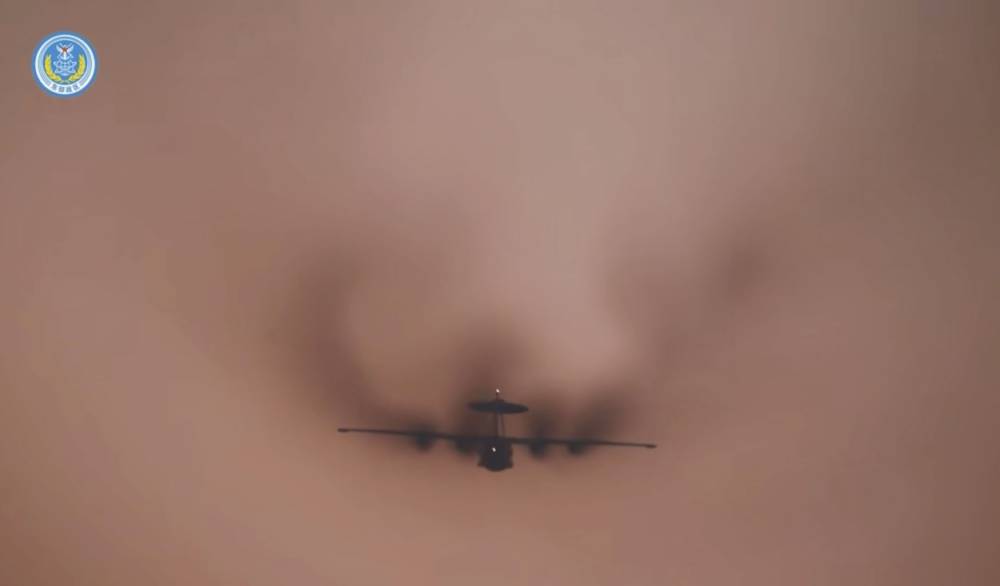
China continued military drills around Taiwan on Tuesday that were launched the previous day as a warning against separatism and external interference, according to the country’s armed forces, greatly disrupting air traffic.
The Eastern Theater Command, which covers the Taiwan Strait, has said the “Justice Mission 2025” exercises in five areas surrounding the self-ruled island involve live-fire drills, urging vessels and aircraft not to enter the waters and airspace.
Taiwan authorities have estimated that the drills would affect more than 100,000 passengers flying to and from the island. The island’s Defense Ministry said 130 Chinese warplanes, 14 naval vessels and eight official ships had been detected around the territory in the 24-hour period through 6 a.m. on Tuesday.
‘Maritime targets’
Of the military aircraft, 90 crossed the median line of the Taiwan Strait—a boundary both sides had respected for decades that China has recently ignored.
The Chinese military said on Tuesday the “drills on assault against maritime targets” as well as anti-air and antisubmarine operations were conducted in waters to the north and south of Taiwan, testing “capabilities of sea-air coordination and integrated blockade and control.” Destroyers, frigates, fighters and bombers were deployed.
It also said ground forces of the command conducted long-range live-fire drills in waters to the north of Taiwan.
A Kyodo News reporter saw the launch of several Chinese projectiles in Pingtan County in Fuzhou, located across the Taiwan Strait in Fujian Province.
The exercises followed US approval earlier this month of a potential sale of weapons and related equipment to Taiwan worth more than $11 billion.
US President Donald Trump told reporters on Monday he was not worried about the Chinese drills near Taiwan, although Chinese President Xi Jinping had not told him anything about them.
An ongoing diplomatic row between Beijing and Tokyo, sparked by Japanese Prime Minister Sanae Takaichi’s remarks in November suggesting that a Taiwan emergency could prompt action by Japan’s defense forces, has also contributed to tensions.
The Chinese military has justified the exercises as “a legitimate and necessary action to safeguard China’s sovereignty and national unity.”
Communist-led China views Taiwan as a renegade province to be brought into its fold, by force if necessary. The democratic island and the mainland have been governed separately since they split in 1949 after a civil war.

Claim challenged
While Beijing insists on its sovereignty over Taiwan, many question this position.
The European Parliament in a resolution adapted on Oct. 24, 2024, disputed the China’s basis for claiming sovereignty over the island.
Beijing has cited United Nations Resolution No. 2758 as basis for its actions toward Taiwan. The resolution recognizes delegates of the People’s Republic of China (PRC) as the only legitimate representatives of China to the UN.
The European Union, however, said Beijing has misinterpreted UN Resolution No. 2758, which does not mention Taiwan or the issue of its sovereignty. The document does not even say that Taiwan is a part of China, the EU Parliament stressed.
Thus, the EU “[c]ondemn[ed] the PRC’s continued military actions and any other forms of provocation threatening Taiwan.”