










Chinese warplanes lock radar on Japanese jets

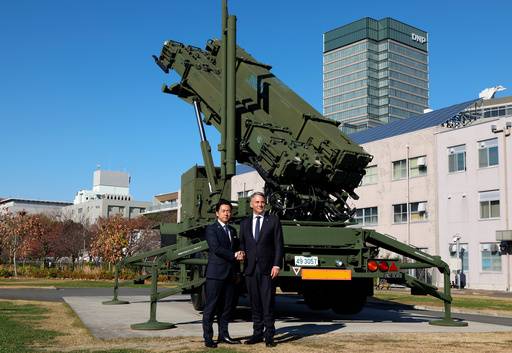
The defense ministers of Japan and Australia agreed on Sunday to step up cooperation, a day after Chinese military aircraft locked their radars onto Japanese Air Self-Defense Force (SDF) fighter jets southeast of Okinawa’s main island.
Chinese J-15 aircraft from the carrier Liaoning locked radar onto Japanese F-15s on two occasions, once in the afternoon and again in the evening, according to Japan’s defense ministry.
“The events last night are concerning and Australia has also experienced concerning events in interactions with China,” Richard Marles told his Japanese counterpart Shinjiro Koizumi in Tokyo at the start of their talks that were initially open to the media.
Australia will stand with Japan “to assert the rules-based order in this region and we will do it resolutely,” said Marles, who doubles as deputy prime minister.
Koizumi called the radar lock incidents “dangerous and extremely regrettable” at a hastily called press conference in the early hours of Sunday amid heightened diplomatic tensions between the Asian neighbors.
He said Japan had already lodged a strong protest and told China to ensure there is no repeat.
Japanese Prime Minister Sanae Takaichi urged China to prevent a recurrence of the incident.
Japan and China have been locked in an escalating dispute since Beijing harshly criticized Takaichi’s answer to parliamentary questions on Nov. 7, in which she said a military attack on Taiwan could present a “survival-threatening situation” for Japan.
Her remarks were interpreted as indicating that her government could authorize the SDF to take action in support of the United States if China were to impose a maritime blockade on Taiwan or engage in other forms of coercion.
‘Unclear’ intentions
Okinawa is close to Taiwan, a self-ruled island, which Beijing regards as a renegade province to be reunified with the mainland, by force if necessary. China insists that the Taiwan issue is purely an “internal affair.”
“China’s intentions are unclear, but if it is to locate (aircraft), there is no need to do that intermittently,” said an official of Japan’s defense ministry, who held a press briefing after Koizumi spoke.
Chinese drills
Based on the distance between the jets confirmed by the ministry, the Japanese side “didn’t do anything that could be considered a provocation,” the official said.

On Saturday, China’s navy conducted training flights in the Pacific Ocean from the Liaoning after the ship passed through waters off Okinawa Prefecture, prompting the SDF to scramble aircraft.
The latest takeoff and landing drills involving Chinese fighters and helicopters marked the first to be confirmed in waters around Japan since China commissioned its third aircraft carrier, the Fujian, last month. They come amid heightened diplomatic tensions between the Asian neighbors.
China is thought to be testing and boosting its operational capability in waters far from the mainland and its increasing maritime assertiveness has alarmed Japan and other countries in the Indo-Pacific region.
The Japanese defense ministry spotted the Liaoning sailing in the East China Sea on Friday, around 420 kilometers (km) north of Kuba Island, an islet controlled by Japan but claimed by China.
Joined by three Chinese destroyers, the aircraft carrier then headed toward the Pacific Ocean and conducted the training flights in waters some 270 km west of Okidaito Island, the ministry said.
The recent spike in tensions between Tokyo and Beijing stems from Takaichi’s remarks that a military attack on Taiwan could present a “survival-threatening situation” for Japan, indicating the SDF’s potential involvement in response to such a scenario.


