





Chronicling the drug war

In May 2016, just days after Rodrigo Duterte won the presidential election, my then Metro editor Volt Contreras and I sat down to discuss what was coming. Reports of “pasalubong”—a code or bodies left on the streets—were emerging under “Oplan Rody,” an anticrime campaign from Duterte’s years as mayor of Davao City.
I told Volt that the killings were likely to spread nationwide once Duterte officially entered Malacañang.
“How should we cover this if it looks like this is his national policy?” I asked.
Volt’s order was simple: “Cover the way we cover.”
Keep it factual
That meant sticking to journalism as we knew it. Meaning: Keep it factual, human and grounded in verification. Talk to families. Check police accounts against witness testimonies. Read every police spot report we could obtain. Tell stories that “take readers by the hand.”
Before Duterte’s national program “Oplan Tokhang”—billed as a “knock and plead” campaign where police would visit alleged drug users at their homes—bodies had already started to fall. In both operation plans, the result was the same: men found dead in alleys or dumped on the street, next to cardboard signs accusing them of drug peddling.
Some colleagues believed Duterte’s campaign rhetoric would soften once he assumed office. I did not, for his record in Davao suggested otherwise.
The Inquirer itself was in a vulnerable position. Duterte publicly attacked the paper for exposing his bank accounts. And we were still mourning the passing of our editor in chief, Letty Jimenez-Magsanoc, who died just months before.
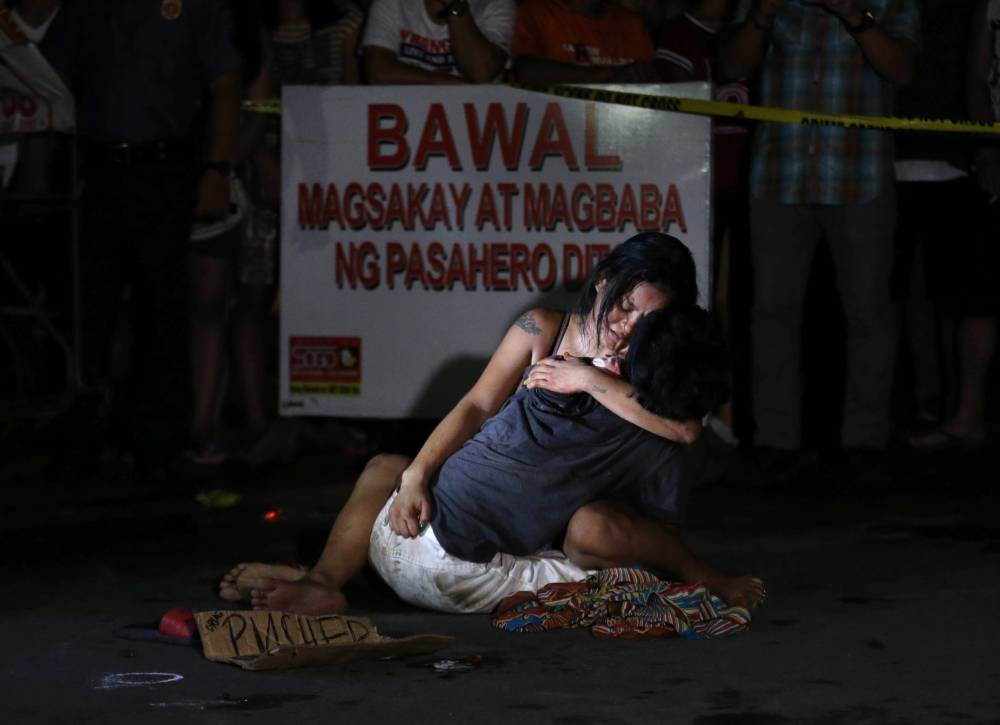
Then came the front page that hardened Duterte’s anger. Volt recommended to the national desk that we run Raffy Lerma’s photograph of Jennilyn Olayres cradling her husband’s lifeless body. It appeared on Page One the following day under the headline “Thou Shall Not Kill.” All hell broke loose.
Nightly killings
My drug war coverage formally began on July 3, 2016— Duterte’s third day in office. That day, eight people were killed in Manila, the nation’s capital. The killings became nightly. Soon, eight deaths became 14. Then 25.
Other reporters documented 32 in a single coordinated police sweep.
Statistics sounded abstract, but every number was a father, a son, a husband. Almost all were from poor families.
In August 2016, we wrote about the emerging pattern, the go-to script, that the government used to justify the killings. The narrative conveniently began and ended with “nanlaban,” or the claim that the suspect “fought back’’ that’s why the police had to take him down.
By September, I decided to do double shifts and cover day and night. I slept in my car to cover the nighttime killings, showered at a nearby gym at dawn and reported to my shift, which covered other beats like City Hall, the local courts and the National Bureau of Investigation.
At the time, I felt it was the only way to see the operations unfold: to hear the police radios crackle, to arrive before bodies were removed from where they dropped, before officers could rehearse the nanlaban narrative. What kept me going was the sense that the truth on the ground had to be recorded while it was still visible.
There was no additional compensation and no special protection or resources. But I carried the belief that documenting the truth mattered in those trying times, especially with trolls flooding social media with praise for the killings, attacking journalists and detractors, and dismissing the dead as “collateral damage.”
Blaming herself
The scenes at night contradicted that rhetoric. I saw the body of Sandrex Ampo-an in front of a statue of the Virgin Mary, his blood splattered on a tricycle painted with the word “Jesus.”
For the story “I’m blaming myself for their death,” published in October 2016, I listened to then 11-year-old Love Ramos as she recalled how she tried to hold back the men who killed her parents. She spoke, then fell silent, burying her face in her hair. She blamed herself for failing to stop the killers.
I met Luzviminda Siapo, a domestic worker who rushed home from the Middle East to bury her eldest son, Raymart. Fourteen masked men abducted him after a neighbor falsely accused him of being a marijuana peddler. Luz left the Philippines to give her children a better life. She returned to a coffin.
It changed my relationship with the beat. The police officers who once tipped me off about corruption were now producing spot reports that hid the truth. These reports soon stopped being public records altogether; even the grieving families were denied copies.
Nothing prepares a journalist to cover this kind of violence. Volt and my other Metro editor, Steph Asuncion, supported me, but the physical and emotional toll accumulated. It was unlike anything I had covered before. At certain times, I found myself trapped in extremely dangerous situations.
Arbitrary decision
On July 3, the same day eight men were killed, I found myself caught in a gunfight inside the Manila Police District (MPD) headquarters. I was interviewing a drug war widow when a young officer—PO1 Vincent Paul Solares—who had passed by me smiling minutes earlier, suddenly opened fire, forcing a lockdown at the MPD headquarters. I sought cover while SWAT units tried to subdue him. After 20 minutes, he surrendered unharmed.

His colleagues accused him of being on drugs. Later, it was revealed that he had never used them. He had snapped from internal bullying.
That incident showed me how easily someone could be labeled a drug user and how arbitrarily the police decided who lived or died. Solares survived because he wore the uniform. Others, like Farida Bonifacio’s husband, killed while fixing a water meter, did not.
During a raid on a secret police holding room in Tondo, I witness a standoff between an officer and a Commission on Human Rights representative. The argument became so tense that I feared the officer might open fire. I was the only journalist left; others had been asked to leave and stop documenting the illegal detention center for drug dealers, whom cops had been using as milking cows. In the thick of it all, I was trapped in the exact space where suspects “disappeared’’ without their cases being recorded on the police blotter.
Over time, the images got more chilling and disturbing: dead men found wrapped in packaging tape, children opening body bags to identify their fathers, neighbors avoiding one another for fear of being linked to the wrong person.
Motorcycles—often used in drive-by killings—began to trigger anxiety even among reporters. Some journalists coped by drinking after their shifts. Others cried while transcribing interviews.
Documenting truth
By late 2018, I was experiencing burnout. I resigned on June 12, 2019, Independence Day.
I had hopes that the stories would shift public opinion, that people would see the human cost. Instead, many cheered the deaths. The killings went on.
Eventually, I learned to accept that journalism isn’t about “changing the world”. It is about documenting truth, holding power accountable, and creating records that endure, even when the present refuses to listen or when circumstances prefer that you turn a blind eye.
The dead could not speak. Our job was to make sure the country—and the world—would one day hear them.
Our stories did not stop the killings, but they exposed them. They became evidence that cannot be erased in the nation’s chronicles.
That evidence mattered. On March 11, 2025—nine years after the killings began—Rodrigo Duterte was arrested by the International Criminal Court for crimes against humanity. Now he faces trial at The Hague for the bloodbath he had unleashed on his country.