










Clash erupts between Army, Reds on New Year’s Day

CALAPAN CITY—Government troops clashed with suspected communist rebels Thursday morning in Barangay Cabacao, Abra de Ilog, Occidental Mindoro, after residents reported the presence of armed New People’s Army (NPA) members in the area, the Philippine Army said.
In a statement on Thursday, the Army’s 203rd Infantry Brigade based in Bansud town in nearby Oriental Mindoro said soldiers from the 76th Infantry Battalion, under the 2nd Infantry Division, and the 5th Scout Ranger Battalion encountered a “Communist Terrorist Group” while conducting security operations in Cabacao’s Sitio Mamara.
The military quoted residents’ accounts of an NPA gathering to mark the founding anniversary of the Communist Party of the Philippines (CPP) and to celebrate the New Year.
‘Dayo Ordinance’
The town of Abra de Ilog has a so-called Dayo (Visitor) Ordinance, enacted in 2025, which calls on residents to take note of strangers or unfamiliar faces in the community and report them if they’re engaging in suspicious activity.
Acting on the tip, government forces launched a strike that led to an armed encounter.
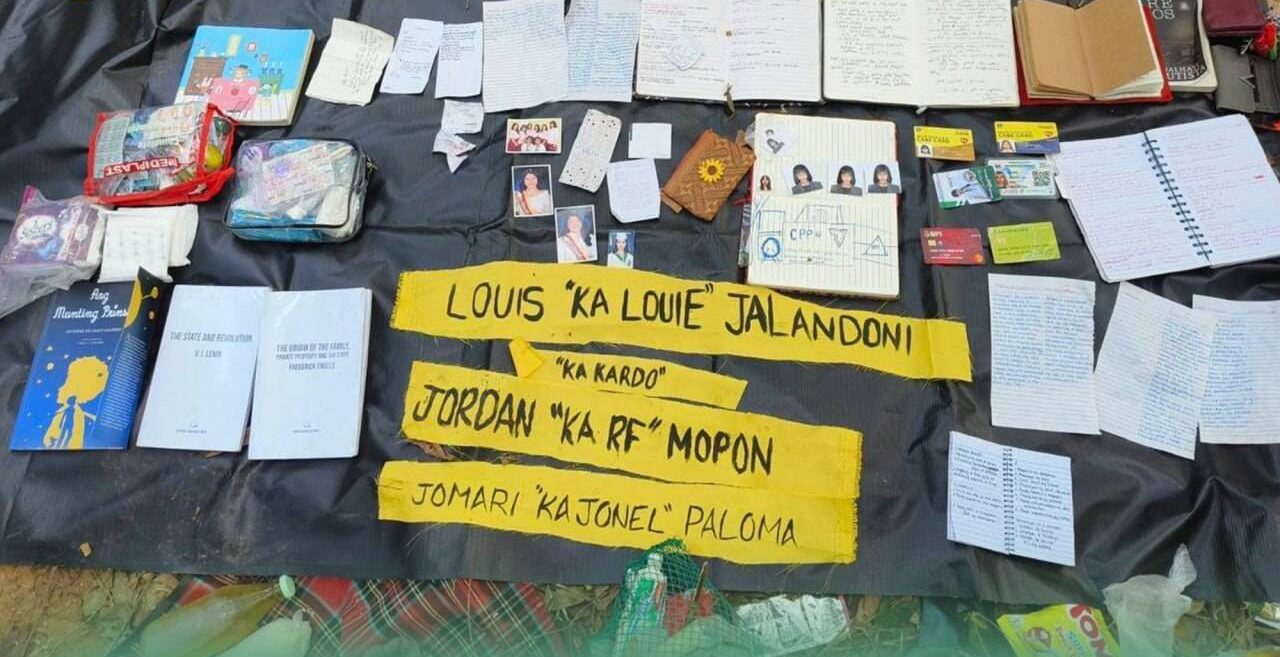
The Army said several identification cards, personal belongings, medical and hygiene kits, food supplies and alleged subversive documents were later recovered at the site.
Photos of the items were shared on the military’s social media accounts.
The CPP, however, said its forces in Mindoro were observing a unilateral ceasefire when the military reported the clash.
In a statement also on Thursday, CPP chief information officer Marco Valbuena said Armed Forces of the Philippines troops attacked an NPA unit that was providing medical and other services to local communities, mostly Mangyan residents.
Community ‘terrorized’
Valbuena said government forces used heavy gunfire and helicopter gunships, causing fear among civilians, and accused the AFP of disrupting the peace in the area.

On Friday, Kabataan Rep. Renee Co issued a statement about the Mindoro encounter, condemning the reported bombing and strafing operations by the military.
“These operations do not protect communities. They terrorize them,” Co said. “Those who ordered and carried out these actions must be held to account. Residents cannot continue to suffer while operations are routinely dismissed as ‘legitimate.’”
Intimidation
Co said such operations frequently followed a pattern of aerial attacks and troop deployments, followed by intimidation of peasant leaders, youth, teachers and humanitarian workers.
“If the government is serious about peace, it must address the roots of armed conflict—landlessness, poverty, lack of basic services and abuse of power—rather than bombing rural communities,” she said. —WITH A REPORT FROM KRIXIA SUBINGSUBING