










Courts join ‘4-day’ setup; labor groups opposed

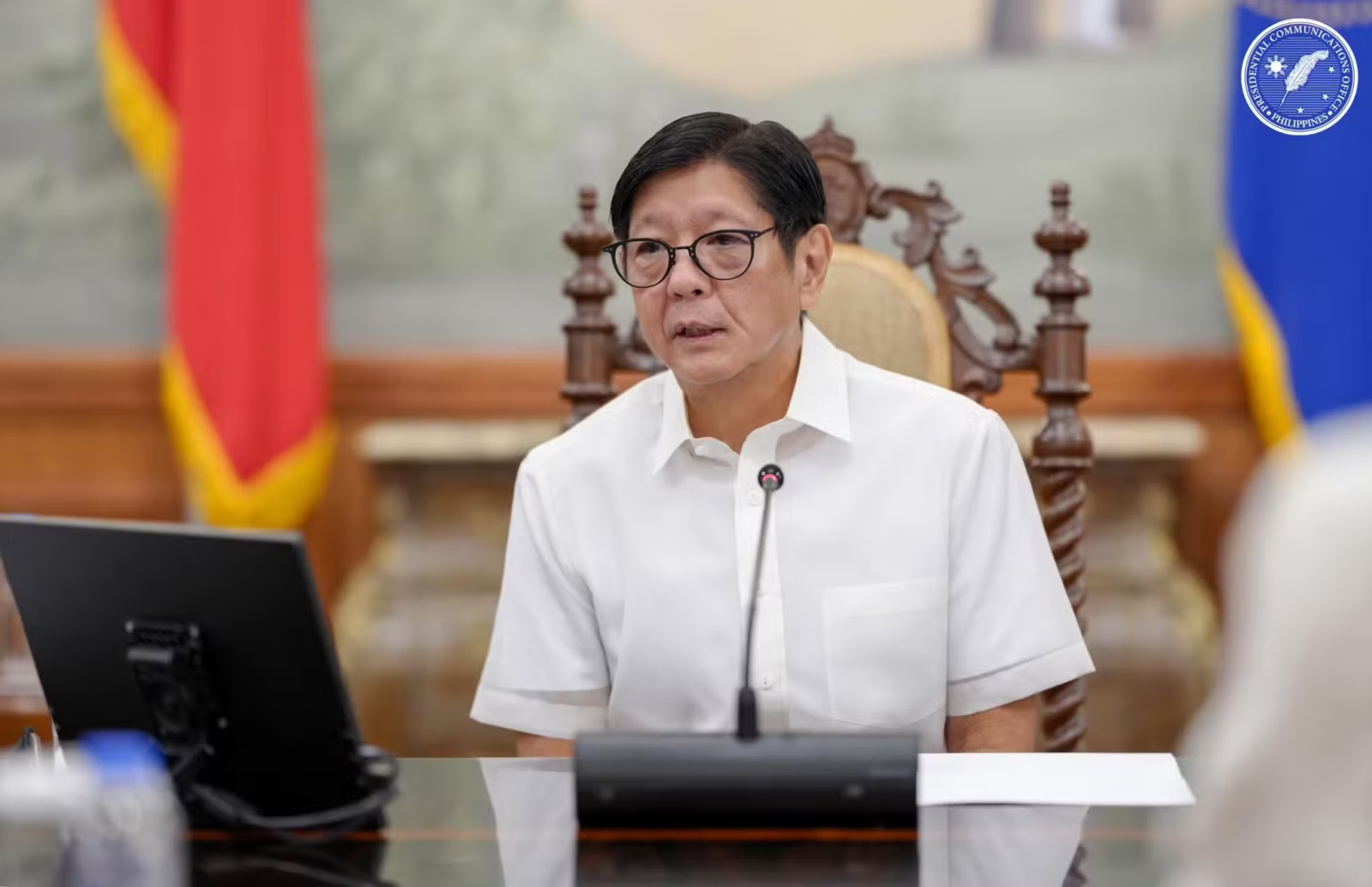
All courts nationwide, except the Sandiganbayan and the Court of Tax Appeals, will implement a four-day on-site work schedule and one day of work-from-home (WFH) starting today, March 9.
This followed President Marcos’ directive adopting a four-day workweek for the executive branch offices to reduce fuel consumption.
Local governments nationwide have also since followed the President’s Memorandum Circular No. 114, which was issued on March 6 amid the impact of the week-old Middle East conflict on fuel prices and the global economy.
Continuity of operations
Under Memorandum Circular No. 02-2026 signed by Chief Justice Alexander Gesmundo, the Supreme Court, Court of Appeals, and all lower courts will observe on-site work from Monday to Thursday, while Friday will be designated as a work from home day.
But the high court clarified that at least 25 percent of employees in each office or division should still report on-site every Friday, as determined by the head of office, to ensure continuity of operations.
The high court also said this new work arrangement “shall not be a ground for the cancellation or postponement of any scheduled hearings, which shall proceed as set by the court.”
Courts were also instructed to adopt conservation practices such as maintaining air-conditioning at 24 degrees Celsius, turning off office equipment when not in use, minimizing elevator use, and conducting meetings online.
Gov’t contractuals
Labor groups were still opposed to the four-day workweek in effect today, March 9, while the country’s biggest business group, the Philippine Chamber of Commerce and Industry, had earlier advised caution, saying that such a policy must be calibrated to suit the needs of individual industries.
“Although some of us may welcome this sudden order, overall we think that it does not respond to the real needs of government workers,” said Santiago Dasmariñas Jr., president of the Confederation for Unity, Recognition and Advancement of Government Employees.
Dasmariñas said Mr. Marcos’ policy failed to consider that there are about a million job order (JO) and contract of service (COS) workers in government, who are under a daily “no work, no pay” policy and who would then unfairly be made to suffer more in these times of crisis.
As of 2025 data from the Civil Service Commission, the government employs 919,868 JO and COS workers nationwide, with 629,862 working as JOs and 290,006 engaged as COS personnel.
“What our workers and our people desperately need now are economic relief and protection,” Dasmariñas said, adding that this can be done by temporarily removing the excise on fuel products and value-added tax on goods and services.

For Kilusang Mayo Uno chair Jerome Adonis, squeezing the workweek into four days will lead to “double or triple” the employees’ exhaustion, as working hours may be extended to as long as 12 hours a day to meet demands.
Meanwhile, the Trade Union Congress of the Philippines called on President Marcos to certify as urgent the legislated P200 wage hike and to direct the regional wage boards to immediately issue an order granting a wage increase or emergency cost-of-living allowance.
For private sector workers, alternative work arrangements are allowed under Republic Act No. 11165, or the Telecommuting Act, passed in 2018. —WITH REPORTS FROM KEITH CLORES AND INQUIRER RESEARCH
******
Get real-time news updates: inqnews.net/inqviber