










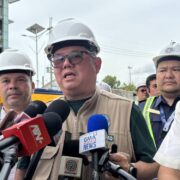
DA vow: Roads to cost 20% less than DPWH version


Roads once built at a cost of P18 million per kilometer may actually be constructed at only P14.5 million per kilometer.
That’s how the chief of the Department of Agriculture (DA) assured taxpayers as the agency takes over the task of building farm-to-market roads (FMRs), projects previously handled by the Department of Public Works and Highways (DPWH)
Based on initial computations, the cost of FMRs may be reduced by about 20 percent, according to Agriculture Secretary Francisco Tiu Laurel Jr.
At a Palace briefing on Thursday, Tiu Laurel also made assurances that FMR projects lined up in the 2026 national budget would be transparent, corruption-free and not overpriced, contrary to warnings coming from a budget watchdog.
Tiu Laurel said a kilometer of paved, two-lane FMR complete with drainage canal would now cost P14.5 million, inclusive of value-added tax, under a new costing schedule prepared by the DA.
That’s down by 19.44 percent from the P18 million-per-kilometer price tag when FMRs were handled mainly by the DPWH.
“I can guarantee that [our FMRs] are properly costed. We have implemented a new costing,” he said.
“I have consulted the private sector on this, and we will be meeting with the most reputable construction companies by next week. We will show them our figures. This is so we can establish the correct costing for [FMRs], where the contractor earns fairly but there is no excess for anyone else,” he added.
President Marcos earlier ordered relevant agencies to cut down the cost of construction materials used in government infrastructure projects by as much as 50 percent.
Tiu Laurel issued the statement in response to an Inquirer report where People’s Budget Coalition (PBC) flagged 820 out of the 870 FMRs under the DA’s budget in 2026 for having “very round numbers.” PBC took this as a sign that the project costings were not properly done.
‘Risky’
According to the report, 549 FMR projects cost exactly P15 million each. Another 121 projects each cost P30 million, and 75 others amounted to P20 million each.
PBC said there were at least P14.9 billion worth of “risky” FMRs.
Tiu Laurel vowed that FMRs, starting with the 2026 national budget, would not face controversies like those that hounded the flood control projects which were implemented also by the DPWH.
“My name and the President’s name is at stake here,” he said. “And the President’s directive to all of us has been very clear: ‘Keep it clean. Do it fast.’ This will be very transparent.”
FMR Watch
In September last year, as the flood control corruption scandal began to unravel, the DA ordered a sweeping audit of FMRs from 2021 to 2025 to check and resolve possible irregularities.
The DA will soon launch “FMR Watch,” where the public can access details and monitor the progress of the projects across the country as part of its transparency initiative.
The website is expected to be launched in February and may be accessed at https://fmrwatch.bafe.gov.ph.

Based on the data available on the portal, the total investment for FMRs from 2021 to 2025 reached P76.52 billion covering 4,810 projects; of this number, 3,135 were completed with a total length of 2,399.85 km.
The public may also submit complaints through the portal, similar to the DPWH’s transparency portal for infrastructure projects that Mr. Marcos launched in December.
According to Tiu Lauel, the DA will be meeting with civil society groups to sign a memorandum of agreement enlisting their help in monitoring the portal.
“It will be very transparent. Every single Filipino can actually go to this portal and see what is happening to every single road being built,” he said.
P33-B budget
Before the 2026 budget, the DPWH was in charge of commissioning, bidding, and constructing the FMRs identified and validated by the DA.
Under the 2026 General Appropriations Act (GAA), the DA gets an allocation of P33 billion to implement FMR projects nationwide—up by 42 percent from last year’s P23 billion.
The allocation would be used to built 1,600 new FMRs spanning 2,750 km to help farmers lower their production and transport costs, and hopefully bring down food prices.
The country needs about 131,000 km of FMRs to spur rural development, according to DA estimates. Of this, some 60,000 km have yet to be built at an estimated cost of P720 billion over at least 21 years.