



Defense doubts records; prosecution cites scheme

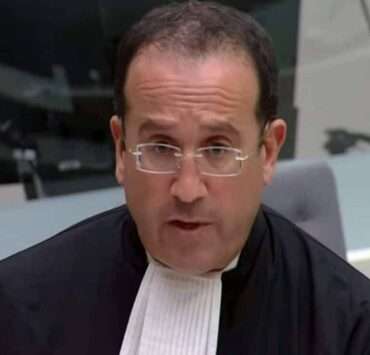
THE HAGUE, the Netherlands—The lead counsel for former President Duterte on Friday sought to discredit the prosecution’s murder charges by questioning records related to the deaths of thousands of drug war victims, including children, citing alleged “fabricated” documents and the lack of birth certificates.
Nicholas Kaufman said the prosecution should rely on actual proof and not bank on emotions in proving the criminal liability of the detained leader.
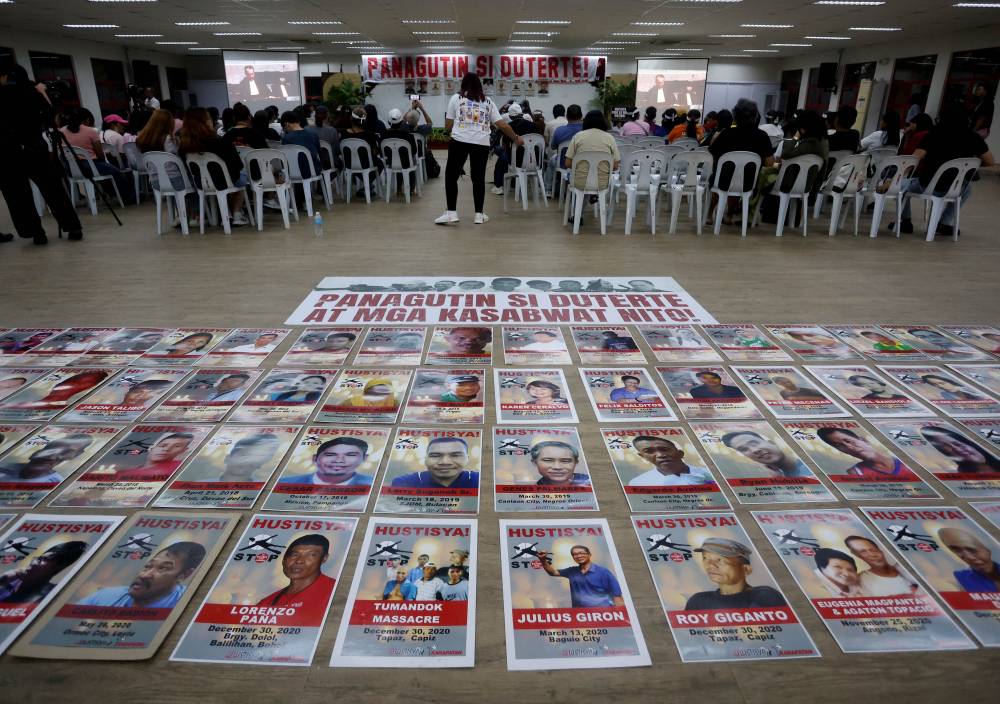
But both the prosecution and the common legal representatives (CLRVs), immediately countered his statements that the killings were merely done at random, saying that those who fell victim to state violence were real people who wanted to emerge from the “shadows” of fake news and online harassment perpetrated by “mini Dutertes.”
On the fourth and last confirmation of charges hearing on Friday, the prosecution, defense and victims’ lawyers had a final chance to tell the court whether the three counts of murder should be confirmed and Duterte brought to trial
Senior prosecution lawyer Julian Nicholls urged the Pre-Trial Chamber (PTC) I of the International Criminal Court (ICC) to rule that Duterte should face a full trial for crimes against humanity for the thousands killed in his brutal drug war.
“Everything he (Kaufman) said, literally this morning, showed why this case should go to trial and that we have met the standard of substantial grounds for confirmation,” he said.
According to Nicholls, the points raised by Kaufman “sounded like a closing argument after a trial.”
He said that Kaufman’s arguments should be resolved at trial.
“The witness that supports our charge is enough for the confirmation of the charges,” he said.
Kaufman called for a scrutiny of the pieces of evidence in the killing incidents in the second and third count of murder as a crime against humanity against Duterte who allegedly formed the “Davao Death Squad” (DDS) whose hierarchical structure became the blueprint for the extrajudicial killings in the national level.
‘Legitimate lethal force’
In refuting the theory that there was “wanton execution” under a “common plan,” Kaufman dismissed the documentary evidence presented by the prosecution as a “fabrication” and doubted the credibility of insider witnesses because they were criminals.
There was also “nothing wrong” with coming up with a drug list, also referred to as “PRRD list,” noted Kaufman, claiming that it was standard procedure.
Those in the list who were eventually targeted and then killed suffered their unfortunate fate because the police had to use “legitimate lethal force” due to the supposed threat presented by suspects to officers’ lives, he said.
Kaufman defended the police operation that resulted in the killing of Benjamin Visda, a suspect from Tondo, Manila, who was on a barangay drug watchlist. Visda was among the five victims whose identities were disclosed in a less redacted version of the document containing charges against Duterte.
He said the police used “permissible force” because Visda, who was handcuffed, allegedly snatched the gun of the police while they were riding on a motorcycle.
These incidents of “nanlaban,” or those who allegedly “fought back,” in drug-related police operations, were the common theme in the so-called war on drugs waged by Duterte at the national level.
Kaufman even went as far as to doubt the legitimacy of those murdered, including children like 17-year-old Kian delos Santos, whose death supposedly could not be corroborated as he had no birth certificate.
Espinosa killing
“Article 61 (of the Rome Statute) requires proof, not emotions,” said Kaufman, citing the ICC’s guiding framework.
Nicholls, who spoke on behalf of the prosecution for the closing statement, immediately refuted Kaufman on using violent force in self-defense by citing the killing of Albuera Mayor Rolando Espinosa Sr. and drug suspect Raul Yap, who were both gunned down in a reported shootout inside a jail cell in Leyte in 2016.
“They were in a jail cell … in a jail cell,” Nicholls stressed.
On Kaufman’s challenge to ICC prosecutors and the CLRVs to investigate the extrajudicial killings that continued under the current Marcos administration, Duterte’s successor, he said: “Well, his client did that by withdrawing from the Rome Statute.”
Duterte withdrew the Philippines from the ICC after learning about a “preliminary examination” of his drug war being conducted by the Office of the Prosecutor led by then ICC Chief Prosecutor Fatou Bensouda.
The CLRVs, represented by human rights lawyer Gilbert Andres, used Kaufman’s argument against him to point out that the public statements of Duterte encouraging the killings and even bragging about them should be taken at face value.
Distancing Duterte
Citing Kaufman’s statement before the chamber on Day 3, Andres said that Duterte was regarded as a man of his word and “will always be a unique phenomenon.
How Duterte’s subordinates interpreted “incendiary” language should also be taken in the Philippine context because “as a head of state, the words of the President must be obeyed.
The police should also bear the burden in proving that the nearly 4,000 deaths in drug-related operations were done lawfully, Andres pointed out.
But “all [of these] deaths had no investigation” he lamented.
Pushing his defense of Duterte further on Friday, Kaufman continued to insist the prosecution had no evidence that he had a hand in the murder, citing specifically the deaths of Espinosa, Ozamiz City Mayor Reynaldo Parojinog and Visda.
Kaufman argued that Duterte explicitly commended Espinosa for surrendering after he gave the late mayor a 24-hour ultimatum to turn himself in.
“So if we look at it from the point of view of Rodrigo Duterte, that is where the incident ended,” Kaufman said.
“What happened thereafter, as awful as it may be, had nothing to do with our client and not one witness can say that,” he added, referring to the killing of Espinosa and a fellow inmate inside the Leyte provincial jail. The two men allegedly fought against police officers sent to check his cell for drugs and weapons.
It was the same thing for Parojinog, Kaufman said, citing police reports. He said that the police tried to implement six judicial warrants to conduct searches in his home and the mayor allegedly resisted.
According to Kaufman, the incident “was hardly consistent with a premeditated murder scheme.”
High-value targets
“After all, if the intention was cold-blooded murder why go through the bother of involving a judge?” he said.
Kaufman cited investigation reports that said the police officers were met with gunfire that struck a patrol vehicle and injured an officer, prompting them to return fire, which resulted in the death of Parojinog.
Both men were listed as “high-value targets,” or HVT, in Duterte’s so-called “PRRD list.” But Kaufman disputed implications that HVT was a code for killing.
According to him, HVT was merely used as an operational classification.
“HVT is not a code for an instruction to kill or a witch hunt. It was a prioritization tool within antidrug operations applied across regions and units on the basis of intelligence assessments, alleged position within drug networks or inclusion on watch lists.” Kaufman said.
‘In self-defense’
“Classification does not imply selection for murder any more than it is proof of unlawful intent,” he added.
In the case of Visda, Kaufman said that the police reported that he attempted to grab the gun of one of the arresting officers. Other officers shot Visda “in self-defense,” he said.
Kaufman pointed out that this police report on this incident “appears to be corroborated” by one of the prosecution’s witnesses.
After the confirmation of charges hearing on Friday, the PTC I will have 60 days to decide whether there is sufficient evidence to bring Duterte to trial for crimes against humanity of murder and attempted murder. —WITH A REPORT FROM ZACARIAN SARAO
******
Get real-time news updates: inqnews.net/inqviber