






Diesel breaches P170/L in fifth fuel price hike


Oil firms have set new double-digit increases for diesel, along with other increases that have become the price movements for five straight weeks since the Middle East conflict broke out on Feb. 28, triggered by the attacks launched by the United States and Israel on Iran.
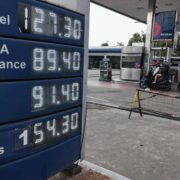
The latest adjustments which take effect on Tuesday have led to diesel now selling at P172.9 per liter, gasoline at P119.9, and kerosene at P178.29.
In its advisory on Monday, Shell Pilipinas said its diesel products would climb by P19.80 a liter, gasoline by P5.90 and by P9.10 for kerosene.
Petron Corp. said diesel would jump by P18.80 per liter, gasoline by P4.90 and kerosene by P8.10.
Seaoil will implement the following increases: P17.95 for diesel, P4.90 for gasoline and P8.10 for kerosene.
Motorists can take advantage and gas up at Jetti Petroleum stations, as the fuel retailer will only implement its price changes on Friday. Diesel and gasoline price hikes at Jetti are at P18.60 and P5.40 per liter, respectively.
“We believe the delayed implementation will help cushion the impact of the significant increase, particularly on diesel,” Jetti Petroleum president Leo Bellas said.
The Department of Energy (DOE) has yet to give its update by Monday regarding the new price surges.
Consumer frustration
The adjustments have sent local prices of diesel alone, the predominant petroleum product among consumers, skyrocketing by as much as P100 a liter since the Middle East conflict began last February.
Diesel products are used by buses, trucks, jeepneys, and fishing boats. Machines used in agriculture also rely on that fuel. Gasoline is used for private cars, motorcycles, tricycles and light utility vehicles.
Albert Dalusung III, energy transition advisor at the Institute for Climate and Sustainable Cities, said the sharp rise in diesel prices would particularly bear down on jeepney and bus drivers.
“It’s not dire, but it’s a very difficult situation because we don’t know where the prices will go,” Dalusung said in a television interview on Monday.
Filipinos online have expressed their frustration over the continuous price increases in petroleum products, on expectations that Iran’s assurance of safe passage for Philippine fuel exports through the Strait of Hormuz could finally drive down pump prices.
In a Facebook post on Saturday night, Energy Secretary Sharon Garin said she hoped to provide “a little more clarity” on the vital waterway.
“This is not a perfect solution, and it does not eliminate all risks. But it is an important step that improves our position in a highly uncertain global environment,” she said.
“We also want to manage expectations: This development will not immediately bring down fuel prices, nor does it resolve our long-term structural challenges in energy,” the energy chief added.
What the assurance from Iran provides is to “help ensure continuity of supply and stability,” Garin said.
De-escalation?
The DOE said earlier that the bulk, or 98 percent, of the country’s crude imports come from the Middle East.
About 97 percent of imports of diesel, gasoline and kerosene are from Asian countries.

Consumers may only see cooling prices once there are signals of de-escalation in the Middle East, according to analysts.
The Iran war begun by the United States and Israel has triggered chaos in the global oil market, prompting other countries to redirect their export operations to conserve supply, especially after Iran took control of the critical Strait of Hormuz, through which one-fifth of the world’s oil supply passes.
In the Philippines, oil firms and the government have been aggressive in securing the country’s stockpile, even via the more expensive process of bidding offers to suppliers.
Fuel price increases took effect two weeks after the Iran war broke out on Feb. 28.
On March 10, prices of regular gasoline were raised from P7 to P13 per liter, and diesel, P17.50 to P24.25.
On March 17, gasoline prices were raised by P16.60, and diesel, P23.90. A further increase took effect on March 24, with gasoline up by about P8, and diesel, P16 to P18.
On March 31, after a month into the Iran war, gasoline had an increase of about P2.50 per liter, and diesel, P12.50. —WITH A REPORT FROM INQUIRER RESEARCH
******
Get real-time news updates: inqnews.net/inqviber