







DOF: Price cuts due to fuel tax law felt by mid-April


The administration could suspend or reduce the excise on fuel as early as April 12, with the Development Budget Coordination Committee (DBCC) set to make this recommendation to President Marcos next week, a Department of Finance (DOF) official said.
Finance Undersecretary Karlo Fermin Adriano on Thursday told a newly formed Senate ad-hoc committee that the President could not legally issue an executive order to cut the fuel excise as the law granting him this emergency power will take effect 15 days after publication. The intervening Holy Week holiday explains the date he cited.
Adriano told members of the Senate committee, which is called Proactive Response and Oversight for Timely and Effective Crisis Strategy (Protect), that the economic team would meet immediately to prepare recommendations for Mr. Marcos.
“The law was signed yesterday and I can confirm there are two triggers. One is that the $80-per-barrel threshold must be breached, which has already happened. Second is that there should be recommendations from the DBCC,” he said.
The DBCC will “definitely” present its recommendation before the Holy Week after its technical working group meets today, Friday, Adriano said. “As soon as the law is in effect, the President can already issue that EO,” he said.
Republic Act No. 12316 allows the president, upon the recommendation of the DBCC and in coordination with the secretary of energy, to suspend or reduce fuel excise if the average Dubai crude oil price reaches or exceeds $80 per barrel for one month.
Crude oil prices have been surging past that threshold since the start of the Middle East war four weeks ago, even reaching beyond $100 per barrel. This has translated into double-digit increases in pump prices, with diesel now seen hitting P130 to P140 per liter.
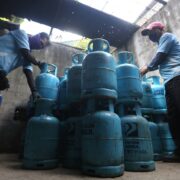
Excises are currently levied at P6 per liter for diesel and P10 per liter for unleaded gasoline, liquefied petroleum gas (LPG), and other petroleum products.
Earlier, Adriano said that temporarily suspending the fuel excise could result in a P121.4-billion revenue shortfall starting in May.
He did not say during Thursday’s hearing whether the DBCC was inclined to suspend or reduce the excise on all or just a few of the various types of fuel.
Not keen on touching VAT
Sen. Bam Aquino asked whether the administration’s economic managers had also discussed the possible suspension of the 12-percent value-added tax (VAT) on oil products.
In response, Adriano gave a less optimistic outlook, noting that exempting VAT on fuel could have counterproductive results.
“The VAT system is relatively complicated. If the output is exempt and you have inputs on which you paid VAT, you cannot claim those inputs,” he said.
For instance, Adriano said, in the oil industry, machinery, trucks, and other capital goods are subject to VAT. Since fuel is the output and is exempt, companies cannot recover the input VAT, which would ultimately be passed on in prices.
But energy industry representatives noted that a VAT exemption at the point of importation would immediately reduce cost, eventually providing more relief to consumers.
Tanya Samillano, representing small oil players, said that removing VAT immediately lower costs, allowing fuel price cuts to be passed on more efficiently to consumers.
Lorelie Quiambao-Osial, president of Shell Pilipinas Corp., supported the proposal, noting that VAT, being a percentage-based tax, increases as global oil prices rise.
“From a technical point of view, the VAT would be faster to implement … and because it is a percentage, the higher the price, the higher the VAT becomes,” Quiambao-Osial said.
Lubin Nepomuceno, general manager of Petron Corp., said the industry supported VAT suspension.
Lawmakers have yet to draft a law on VAT granting the president powers to also suspend or reduce it.
Once the President approves the DBCC’s recommendations on the excise, fuel prices are expected to go down for the rest of April, but equivalent only to the amount of excise that is removed. The overall pump prices may still be higher than what they are today as prices are expected to rise weekly.
How about in May?
As far as prices go, that could still give some measure of relief to the public, including transport operators, drivers, commuters and agricultural producers. But supply is still uncertain as fuel companies admitted that no oil traders have committed deliveries for May.
The Philippine Institute of Petroleum (PIP) and the Independent Philippine Petroleum Companies Association (Ippca) disclosed this to the Senate Protect committee.
“So many of the traders are keeping quiet, especially for deliveries in May. There has been no response for tenders for May,” PIP executive director Rafael Capinpin said.
PIP is composed of Chevron Philippines Inc., Isla LPG Corp., Petron Corp., Shell Pilipinas Corp., and PTT Philippines Corp.
Ippca members—Castrol, Eastern Petroleum, Filpride, Flying V, Liquigaz, Chemrez, Oilink, Seaoil, Filoil, Chemfour, IEPI and Unioil—have the same dilemma.
“Our incoming importations are still arriving, but we haven’t received any confirmation for future deliveries beyond April,” Ippca president Samillano, said.

“Although there are some offers available in the market, the price is very, very high,” Samillano added.
Fresh supply from Russia
Malacañang press officer Claire Castro on Thursday confirmed a wire report that the Sierra Leone-flagged oil tanker Sara Sky, which was carrying 700,000 barrels of high-quality crude from Russia’s Eastern Siberia-Pacific Ocean pipeline, arrived on Monday.
Sources told the French news agency, Agence France-Presse (AFP), that the consignee was supposedly Petron Corp., the Philippines’ sole oil company that operates its own refinery.
Earlier Castro assured the public at a press briefing that the government was doing everything in its power to address the rising prices of fuel and the concern over supply shortage, both caused by the Middle East conflict.
Castro said Energy Secretary Sharon Garin and the Department of Foreign Affairs were working together to find countries that could supply oil to the Philippines, given the blockade of the Strait of Hormuz since the US-Israel war on Iran broke out on Feb. 28.
Gasoline stock
“We saw what the government has done, other countries are also struggling with the situation, but now you have seen how the government acted, how quick was its response, and how much the government has done for its people,” she said.
In the same Senate hearing, the Department of Energy (DOE) said that the country has a gasoline stock of 53 days and 46 days for diesel.
While supplies for April have been contracted, the DOE said it was still looking for traders for future supplies.
Sen. Sherwin Gatchalian, head of the committee, urged the DOE to secure supplies through government-to-government agreements, outside of efforts by private companies.
Aquino criticized the supposed lack of a sense of urgency of some government agencies, noting that both the Senate and House had expedited the passage of the bill granting the President the power to suspend or reduce excise on fuel.
“If the price of diesel and gasoline is going up every week, you should also meet every week so that you can update the people,” he said. “We rushed to pass that law. I hope you will also hurry up with the implementation of the law.” —WITH REPORTS FROM PNA AND AFP
******
Get real-time news updates: inqnews.net/inqviber