





DPWH, Tieza funds sought for Baguio’s wastewater upgrade

BAGUIO CITY—The city government is seeking funding from the Department of Public Works and Highways (DPWH) and the Tourism Infrastructure and Enterprise Zone Authority (Tieza) as the city council revisits a proposed sanitation fee equivalent to 16 percent of the average household’s water consumption to overhaul the city’s wastewater system.
The sanitation fee would be collected by the local water utility through proposed revisions to the Baguio Environment Code (Ordinance No. 18 of 2016) and the Baguio Septage Management Law (Ordinance No. 26 of 2020). The fee is among the preconditions for securing a loan, according to city environment officer Rhenan Diwas, who addressed the council during its Monday session.
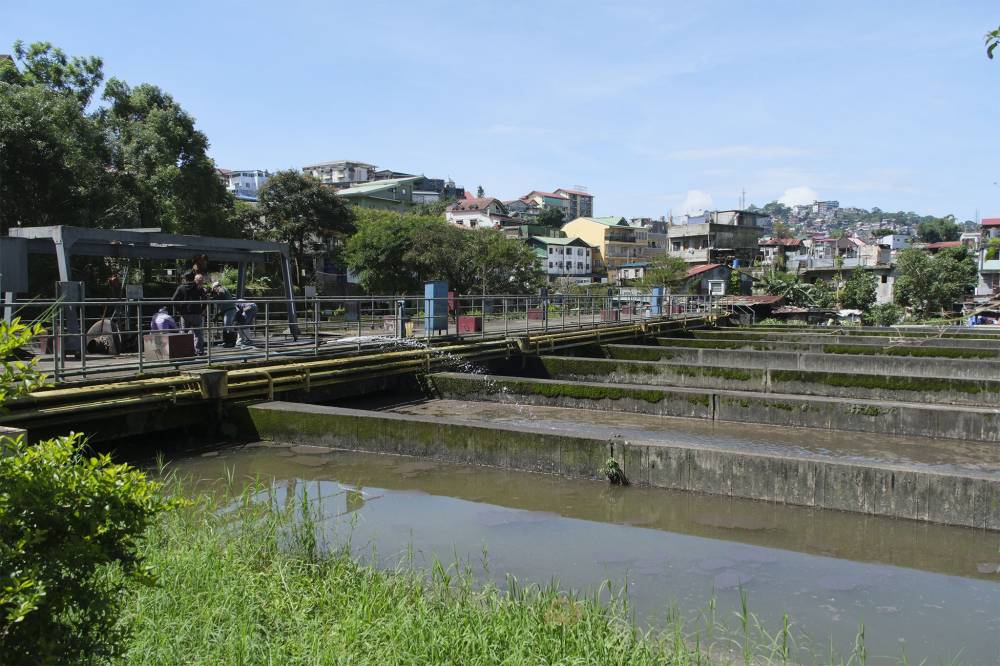
Through Tieza, the city was poised to secure a $45-million loan from the Asian Development Bank (ADB) to fund repairs and improvements to its aging sewage treatment plant (STP) and to expand a 61-kilometer sewer network, parts of which date back to the American-controlled Philippine Commonwealth in the late 1940s.
Baguio was designed and built by the American colonial government at the beginning of the 20th century.
Vice Mayor Faustino Olowan said proceeding with sewage modernization and upgrading Baguio’s only STP is necessary to reduce the discharge of untreated sewage into critical river systems flowing from the city.
Penalties
In 2020, the Balili River—where the city’s STP is located—recorded a fecal coliform count of 160 quadrillion. Studies showed the STP needs advanced filters to process up to 15,000 cubic meters of wastewater. Built in 1986 using a Japanese grant, the 40-year-old facility currently has a capacity of only 8,500 cubic meters.
“The Department of Environment and Natural Resources has warned Baguio that it could impose penalties of as much as P200,000 a day at any time. Where would we get that money? Baguio would be bankrupt,” Olowan said during the session.
However, the wastewater rehabilitation plan known as the Baguio Resilient City Tourism Project was removed from the national government’s list of priorities last year due to delays in passing the required ordinances.
Aside from the proposed sanitation fee, the council is also studying a separate measure that would impose a P150 environmental user’s fee on every visitor to Baguio to help pay for the loan.
“We are not abandoning the ADB loan,” Diwas told the council, noting that it requires a national government guarantee. He said Mayor Benjamin Magalong has directed city officials to resubmit the ADB loan proposal to the Department of Economy, Planning and Development.

Magalong has also asked Tieza and the DPWH to include Baguio in their respective wastewater funding programs, Diwas added.
‘Favorable response’
He said Tieza gave Baguio a “favorable response” but requested an updated feasibility study and details on regulatory fees needed to make the rehabilitation more sustainable. A prototype of the small STP has been installed at the City Engineering Office to provide proof of concept to building owners and potential investors.
The sanitation fee would be based on the volume of water consumed each month by households supplied by the Baguio Water District (BWD), covering families, tenants, or occupants of about 120,000 buildings.
For commercial establishments and accommodation facilities, BWD would collect the equivalent of 18 percent of monthly water consumption.
However, the draft fee ordinance has yet to be approved, as the council still needs a computation matrix for households not served by BWD and those relying on private deep wells for their water supply.