




Du30 at ICC: Day 2 highlights of confirmation of charges hearing

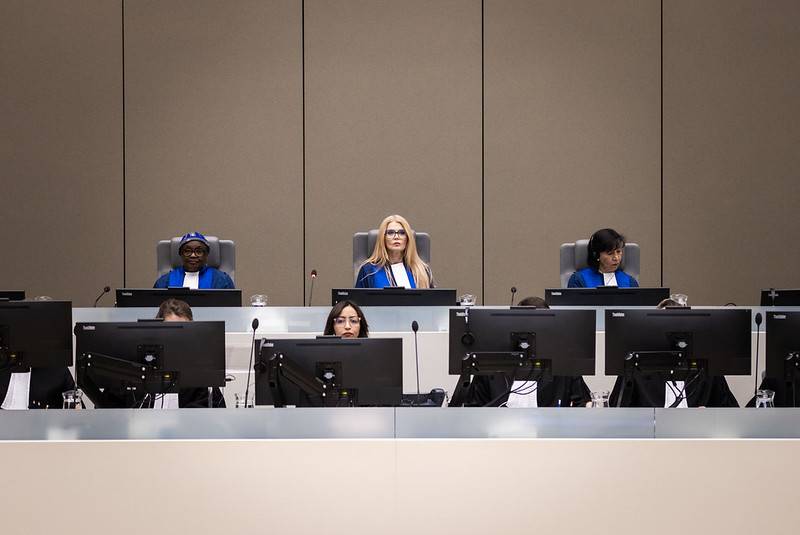
The second day of the confirmation of charges hearing on Feb. 24 against former President Rodrigo Duterte in the International Criminal Court (ICC) covered the prosecution and the victims’ submission on the merits of the case.
Prosecution’s submission:
Former President Rodrigo Duterte campaigned for the presidency on the basis that, if elected, he would implement his Davao model of killing on a national scale, and this is what he did.
Central to Duterte’s plan was the formal national anti-illegal drugs campaign launched via Command Memorandum Circular (CMC) No. 16-2016, which was issued by then newly appointed PNP chief Ronald dela Rosa on the first day of Duterte’s presidency. The document includes a reference to Duterte’s pronouncement to eradicate illegal drugs during the first six months of his term.
Execution of the plan as stated in the document once again refers to “neutralizing” illegal drug personalities as well as the backbone of the illegal drugs network operating in the Philippines. Insider witnesses provided evidence that within law enforcement in the Philippines, to “neutralize” meant to “kill.” One insider witness explained the significance of the word “neutralize” as a means of emphasizing the kill order from Duterte.
Concept of operations referred to Project Tokhang and Project HVT (High-Value Target). The prosecution alleges that 14 victims covered in the ICC case were murdered during Project HVT, and many of the victims were included in charts and lists that Duterte showed in public appearances and speeches.
On Aug. 7, 2016, Duterte held a televised press conference in Davao City, in which he named 150 public officials who he claimed were involved in the drug trade. During this appearance, he stated: “Wherever you go, I will be waiting for you. Even if I’m no longer president, as long as I have a gun.” (translated).
On Nov. 5, 2016, Rolando Espinosa Sr., one of the officials named by Duterte, was murdered. On July 30, 2017, Reynaldo Parojinog, who was also named by Duterte, along with a number of others, were also murdered. A video clip presented showed Duterte saying that he is the “sole person responsible for it all.”
The list was published by the media as Duterte’s “narco-list’”or the “Duterte list.” Mention was made of the PRRD list, at the bottom of which are a series of different tabs listing different regions of the country; within these tabs are names and identifying information of alleged high-value targets. The persons in this list were also assigned different levels ranging from 1 (lowest) to 5 (highest).
A witness stated: “[T]his [list] was used by the police in their operations. And if you are in the list, you will be subject for police operations. And most of the time, the people on the list are killed. […] So basically, the PRRD list is […] a dead list.”
Duterte publicly paraded the PRRD list on multiple occasions. In his speeches in Davao, he would occasionally seek to legitimize his encouragement of state violence by references to human rights and self-defense, and continued to do so as president. A speech shown by the prosecution showed Duterte stating he would protect and even reward security forces who used lethal force against suspects.
Project Tokhang overview was given and witnesses stated that the poor were often targeted because they were the ones least likely to file complaints against the police. Included was a reference to the death of Kian de los Santos and the public outcry that followed, leading to the conviction of three police personnel and prompting a temporary withdrawal of police operations. In announcing the withdrawal, Duterte said he hoped it would satisfy “bleeding hearts” in the media, indicating not a genuine effort to prevent crime but a temporary effort to placate public criticism.
Prosecutor’s presentation:
Contextual elements of crimes against humanity included an attack against the civilian population in the Philippines, targeting civilians alleged to be involved in drugs and other forms of criminality; the attack was widespread and systematic, and these were carried out pursuant to or in the furtherance of state organizational policy to neutralize alleged criminals.
The incidents cited in the ICC case are “representative and emblematic of a larger killing campaign.” During Duterte’s mayoral period, at least 274 extrajudicial killings were recorded in Davao City and the data is corroborated by several DDS witnesses. A witness testified that “our job in Davao … was just to kill […] small criminals … petty criminals. […] Out of the almost 300 people that I have killed … I never actually got to kill a drug lord.” Another DDS witness: “We were eight, tasked by Mayor Duterte to kill suspected criminals in Davao City, including shabu users and pushers.”
Official figures were then cited: 3,967 deaths reported in the Philippine government’s 2017 report and 5,281 deaths reported by the Philippine Drug Enforcement Agency (PDEA).
The killings followed a structural pattern and features of the killings were often markedly similar (informant -> motorcycle (arrived or fled) -> shooting at close range or stabbing -> victims were targeted under allegations of being drug users, pushers, and other criminals -> the DDS received reward money). The killings continued to be systematic during Duterte’s presidency. Targets were “pre-identified, listed, and then subject to operations based on that list.”
Evidence from an expert witness showed data that in the first 25 months of the Duterte presidency, the number of suspects killed by the police increased by 590 percent nationwide.
The co-perpetrators when Duterte became president were identified as Dela Rosa, Vicente Danao, Camilo Cascolan, Oscar Albayalde, Christopher Go, Dante Gierran, Vitaliano Aguirre II, and Isidro Lapeña.
Insider witness: “I felt like I did not have any other choice but to follow their orders…” Evidence from a police insider: “[W]e were told that there should be 5 to 10 deaths […] per month. […] the Regional Director called him and told him that if there were no deaths, or no recorded killings, then he would be relieved of his duty.”
Duterte’s essential contribution:
Designing and disseminating the policy to neutralize alleged criminals; establishing and overseeing the DDS; instructing and authorizing violent acts including murder; providing personnel and logistical resources such as weapons; appointing key personnel to positions which were crucial to the execution of the crimes; offering financial rewards and promotions for killing; creating and maintaining a system of impunity; authorizing, condoning, and encouraging killings through public statements; authorizing state actors in and out of the campaign, and publicly naming targets, including “high-value targets.” Without Duterte’s essential contribution, the crimes would not have been made, or would have been committed in a significantly different way.
A low-level police perpetrator during the presidential period was asked about the impact of Duterte’s public speeches on his team. He responded: “It did have an effect on me because it’s like I was saying to myself, ‘Well, even the President, he himself is ready to do something like this, and who am I?’” A senior officer reportedly stated that the killings started “because of the directive of the president.”
The common legal representative of the victims’ submission on the merits stated that several victims came from impoverished and marginalized communities. They cited a 2022 report by the Human Rights Watch that since 2016, the Philippine police have admitted its involvement in the death of more than 6,200 people in drug raids across the country. In a 2020 report, the UN Office of the High Commissioner for Human Rights reported 8,663 deaths occurred in the drug war. The Human Rights Commission of the Philippines and Domestic Human Rights Group report death tolls that are two to three times higher than the UN figure.
Also presented were testimonies of victims’ families regarding acts of the police during the war on drugs.