








Dutch-based lawyer challenges PH maritime laws

A Netherlands-based maritime law expert has questioned the constitutionality of two laws defining the country’s maritime zones and archipelagic sea lanes and allowing innocent passage to foreign vessels without permission from the government. He alleges that this conflicts with the “archipelagic principle” in the 1987 Constitution.
Peter Payoyo, a former law professor at the University of the Philippines (UP), has filed a petition for certiorari and prohibition in the Supreme Court seeking the nullification of Republic Act No. 12064, or the Philippine Maritime Zones Act (MZA), and RA 12065, or the Philippine Archipelagic Sea Lanes Act (Asla), both enacted on Nov. 8, 2024.
The 157-page petition was filed in August 2025 but made public only recently. The respondents were former Executive Secretary Lucas Bersamin, Foreign Secretary Ma. Theresa Lazaro and National Mapping and Resource Information Authority Administrator Peter Tiangco.
The petition alleged that the two laws violated Article I of the Charter, which provided for the “archipelagic principle” that stated: “The waters around, between, and connecting the islands of the archipelago, regardless of their breadth and dimensions, form part of the internal waters of the Philippines.”
The “plain” language of the Constitution, he noted, meant that the Philippines has exclusive rights and sovereignty over its territorial waters, whether archipelagic or internal, which restrict any access to foreign ships.
‘Aggressive deployments’
Payoyo said that contrary to the Constitution, both the MZA and Asla contain provisions that “establish, recognize or implement the ‘right of archipelagic sea lanes passage’ or the ‘exercise of the right of archipelagic sea lanes passage’ in and through or over Philippine archipelagic waters by foreign ships and vessels.”
As a consequence, the laws “overturned over half a century of Philippine policy and practice requiring prior permission, notification, authorization, clearance for warships to navigate through the country’s territorial waters.”
“In a more stunning result,” Payoyo said in his petition, “the ASLA has annulled the archipelagic principle at a time when its protective security mantle is precisely the need of the hour against the roving threats, intensified hostility, and increasingly aggressive naval deployments of China inside Philippine territorial waters.”
He cited instances when the Philippine Navy or the Philippine Coast Guard (PCG) allowed the passage of Chinese vessels, citing the right to innocent passage.
‘Sovereign discretion’
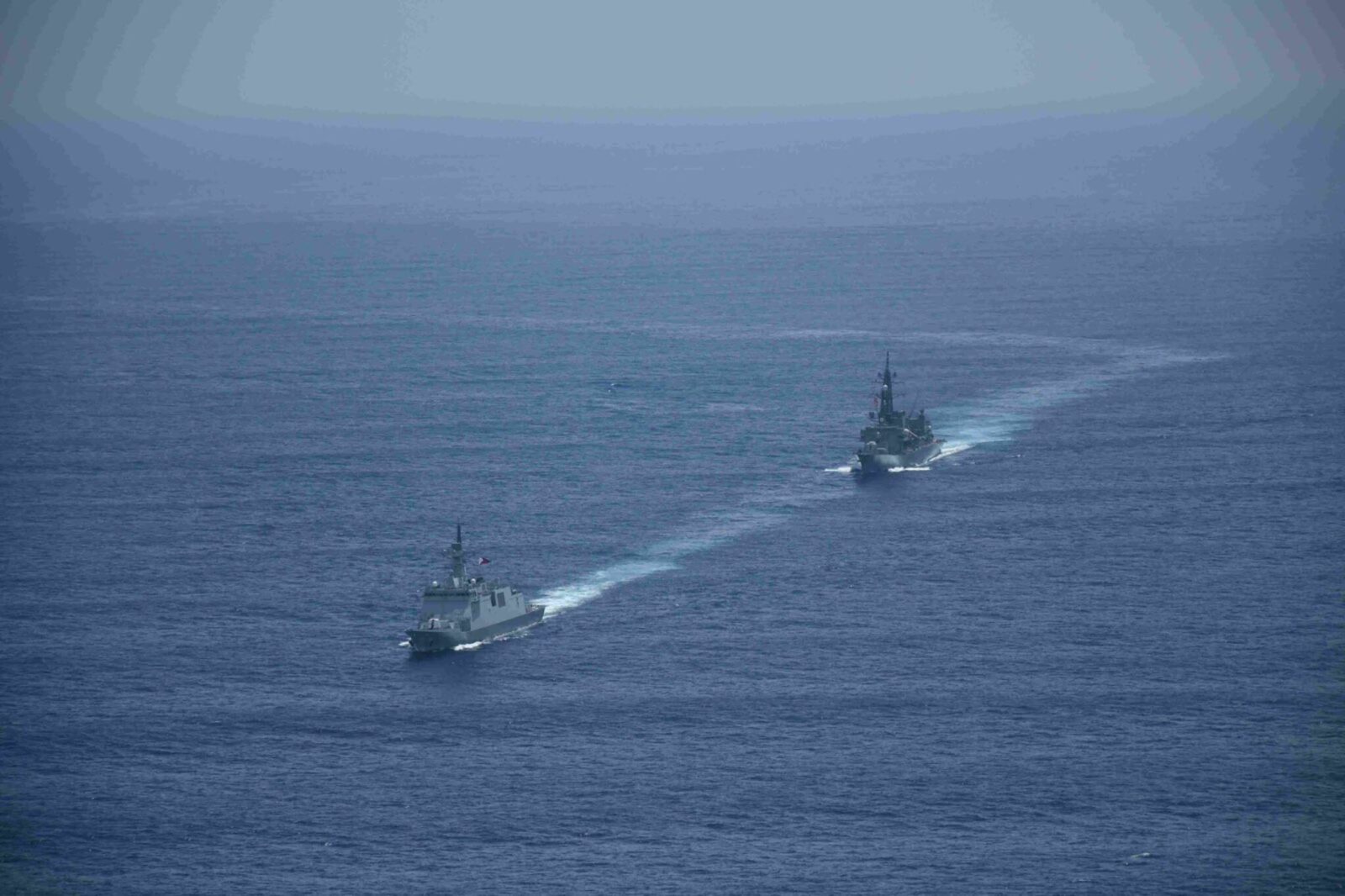
In February 2025, three Chinese warships—a large destroyer, a frigate and a replenishment vessel—entered Philippine waters through the Mindoro Strait and the Sulu Sea before exiting via the Basilan Channel.
Payoyo cited statements by Commodore Roy Vincent Trinidad, the Navy spokesperson for the West Philippine Sea, who described the route as “archipelagic sea lane passage” while other Philippine government officials noted the “disrespectful” transit of the Chinese naval ships for supposedly not following diplomatic protocol.
He cites the resulting “precarious legal position of the Philippines,” noting the country no longer requires and strenuously implements notification authorization for warship passage through its territorial waters.
An April 2025 transit by a Chinese research vessel called “Song Hang” via the Sulu Sea was tracked by the PCG and described by Rear Adm. Jay Tarriela as appearing to have followed “an archipelagic sea lane route identified in the ASLA,” Payoyo said.
“Why the government assumed and/or concluded that the Song Hang was automatically entitled to innocent passage in the first place deserves scrutiny,” he said.
“From the Philippine Constitution’s point of view, Philippine authorities should have asserted sovereign discretion to deny innocent passage to this ship, or else condition its passage to the observance of stringent coastal State security requirements,” he added.

‘Title to our territorial sea’
Payoyo, who once served as chair of the UK-based International Committee on Seafarers’ Welfare, said these “transformation of Philippine internal waters into archipelagic waters” brought about by the new laws “could not come at a worse time in China-Philippine relations, especially for the Philippines.”
“At this juncture of unprecedented tensions between the two countries and deepening geopolitical disputes in the region, the ASLA’s facilitation of unhindered warship access to Philippine territorial and coastal waters bodes ill for Philippine national security,” he added.
The MZA emphasized the Philippines’ exercise of sovereignty over its territorial seas, while also observing the rights of other states, including the right of innocent passage, as stipulated in the United Nations Convention on the Law of the Sea (Unclos).
The Asla, on the other hand, also defined the right of innocent passage, which is accorded to ships of all states under Unclos, as including “stopping and anchoring, but only insofar as the same are incidental to ordinary navigation or are rendered necessary by force majeure, distress, or to render assistance to persons, ships, or aircraft in danger or distress.”
Tiangco had said these laws would be the country’s “title to our territorial sea, our contiguous zone.”
“Although China is not recognizing this, the imprimatur that we will be getting from the international community will strengthen our position,” Tiangco said.
For his part, professor Jay Batongbacal, who heads the Institute for Maritime Affairs and Law of the Sea of the UP College of Law, had described the laws as the “foundational pieces of legislations” that were aligned with the Unclos.