











Edcom 2 to DepEd: End student ‘mass promotion’


The Second Congressional Commission on Education (Edcom 2) is calling for the phaseout of a system that has encouraged what it called the “de facto mass promotion” of public school students despite the lack of skills required to advance to higher grade levels.
In its final report titled “Turning Point: A Decade of Necessary Reforms,” which was released on Monday, the commission noted that learners in public schools are “routinely advanced” to the next level regardless of their demonstrated proficiency.
The government body tasked to oversee the country’s education system found, based on consultations with teachers and parents, that the grades indicated in the students’ report cards “increasingly diverg[ed]” from the skills they actually showed both at home and in school.
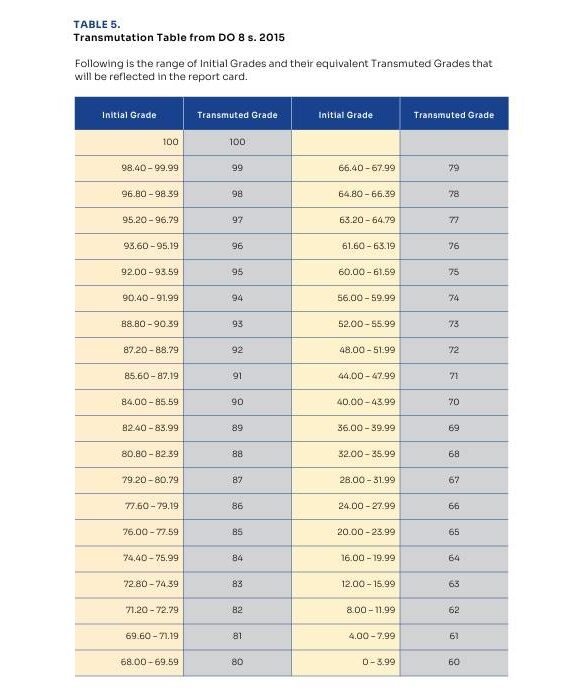
The grading rules set by the Department of Education (DepEd), particularly under Department Order No. 8, series of 2015, also known as the transmutation policy, had diluted the diagnostic value of assessment and “hinder accurate targeting for interventions,” it said.
The DepEd transmutation policy is a standardized grading system that ensures that the passing raw scores averaging 60 to 61.59 correspond to a minimum 75, the passing grade.
Inflated achievements
For example, if a student has an initial grade of 61, their “transmuted” grade would become 75, while those with initial grades of 100 would get the same standing.
For Edcom, this presents a problem since converting very low raw scores into passing or near passing final grades allows learners who perform far below their respective proficiency to appear as if they have met the minimum requirements to move up to the next grade level.
Teachers consulted by Edcom reported that the practice under the transmutation table was “difficult to justify” the additional remediation, such as flagging the failing learners to the Academic Recovery and Accessible Learning Program (Aral) or the Bawat Bata Makakabasa Program.
It was also difficult for teachers to explain to parents why a child would appear to have passed their grade levels despite being unable to read independently or handle basic mathematics, according to the commission.
“For the system as a whole, these grading practices inflate reported achievement, distort school and division level data and weaken the evidence base on which curriculum reform, learning recovery programs and promotion policies are meant to rest,” Edcom said in the final report.
“Without realignment of grading and promotion rules that reported marks correspond[ing] more closely to actual mastery, curriculum improvements and learning recovery investments will continue to operate on an unstable foundation of partial and sometimes misleading information about what learners can do,” it also said.
Domino effect
Teachers, at the same time, lamented that retaining a learner in the same grade level would “trigger” a certain domino effect such as more layers of approval, close scrutiny from school heads and placing them at risk of getting the blame for a “high failure rate” in their classes.
This is mainly because the promotion, completion and dropout indicators are still being used as “headline metrics” in their evaluation forms, as well as in report cards, according to Edcom.
Principals, meanwhile, will then be pressured to maintain the high promotion rates in their schools, with some even “explicitly” discouraging or prohibiting learners from failing despite their nonmastery of lessons, the commission pointed out.
“In this context, accurate grading and honest documentation of learning gaps can be interpreted as poor performance, which creates strong incentives for teachers and school heads to promote learners rather than risk sanctions or negative evaluations,” it said.
Crowded school days
As for the causes of students falling behind their classes, Edcom, citing teachers’ observations, pointed to frequent absenteeism of students, child work, unstable caregiving arrangements and lack of parental support at home.
Some of the teachers would even be confronted, or worse, threatened by parents, when they assign failing marks or require children to attend remedial classes. There were also times when parents would reference the child protection policy “in adversarial ways,” the commission said.
Edcom also reported that teachers were expected to organize home visits, conduct parent conferences and deliver tutorials during the school year and summer, with some using their own time and even resources for transport and communications just to fulfill this responsibility.
In addition, it noted how cocurricular activities, such as the Palarong Pambansa and the National Schools Press Conference (NSPC), have crowded the school year, leaving teachers to compress an “already congested curriculum into fewer learning days.”

Based on Edcom’s review, recent DepEd school calendars indicate that public schools operate with an average of only about 191 actual class days per year due to more than 120 legislated activities, celebrations and observances. These activities often require participating students and teachers to be excused from their classes, displacing core instructions.
This “directly contradicts” the intention under an existing DepEd policy wherein the prescribed 205 school days be strictly devoted to the “engaged time-on-task,” and that class suspensions for celebrations or national programs be avoided in favor of simple integration into regular classroom discussions.
While the commission acknowledged that the NSPC and the Palarong Pambansa are meant to showcase excellence and guide learners to creative and technical career paths, these are still largely organized during the school year, eating up the time when students and teachers are supposed to be in classrooms.
It recommended that DepEd rationalizes legislated activities, celebrations, and large-scale cocurricular events through a system-wide review that protects instructional time while preserving high-value learning opportunities.
Recommendations
In ending mass promotion, Edcom said DepEd should “fully implement” the Aral program which was created by Republic Act No. 12028. It sees the program’s full implementation from 2028 until 2035 as helping learners excel in reading, math and science.
The commission also urged the amendment of the teachers’ Results-based Performance Management System, particularly the Office Performance Commitment and Review Form, which measures a teacher’s performance, by 2027. This is to provide safeguards for teachers and protect their autonomy and ensure that targets or incentives within these systems are not linked, directly or indirectly, to student promotion or dropout rates.
“A streamlined, outcomes-focused performance management system, centered on improving student learning rather than compliance or promotion rates, will help ensure that all promotion decisions genuinely reflect students’ actual performance,” the commission said.
******
Get real-time news updates: inqnews.net/inqviber