



EJK victims’ kin struggle with language at ICC watch

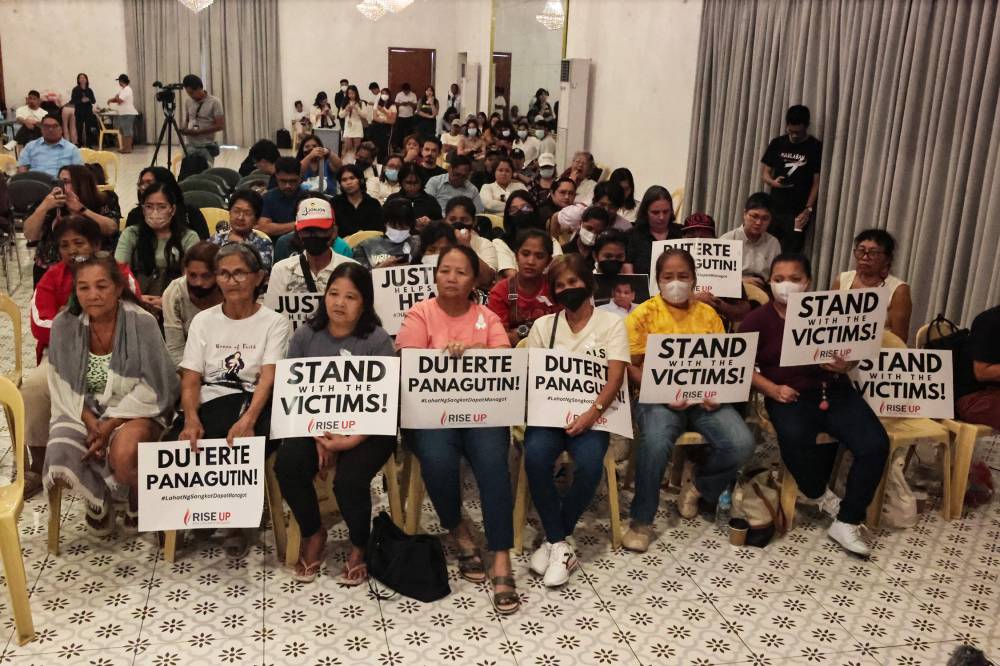
Apart from loudspeakers airing the livestreamed International Criminal Court’s (ICC) confirmation of charges hearing for the crimes against humanity case against former President Rodrigo Duterte on Monday, only sporadic murmurs could be heard from the audience in the capacious all-white interior of Atencio-Libunao Hall at the University of the Philippines in Diliman, Quezon City.
Reporters kept waiting for reactions that would have made good soundbites from several dozen watch party viewers—mostly family members of victims of extrajudicial killings (EJK) under Duterte.
“If you were waiting for an immediate reaction earlier, the mothers were still processing the information,” human rights lawyer Maria Sol Taule told the Inquirer during a break in the hearing.
“The proceedings we watched earlier were in English,” Taule said, “so of course, the mothers who are not very proficient in this language could not immediately absorb what’s happening in the proceedings.”
“So, our volunteers presented themselves and sat beside the mothers to explain what’s happening. It was touching,” she added.
Norma Dollaga, a deaconess of the United Methodist Church and co-founder of Rise Up, a support group for families of EJK victims, was one of the several volunteers who stepped in.
“[The proceedings are] in English, and the victims were having a hard time understanding the intricacies of the legal system,” Dollaga told the Inquirer.
She provided a blow-by-blow translation to a mother whose sons were among the thousands slain in the war on drugs waged by the Duterte administration. The woman now earns a living from collecting scrap metal.
“I understand it a little bit … ” the woman, who asked that she not be identified in this story, said during the second part of the proceedings, with Dollaga by her side.
At one point, Dollaga had been translating the opening statement of Nicholas Kaufman, Duterte’s lead counsel.
Only when Dollaga was translating Kaufmann’s remarks, phrase-by-phrase, into Filipino could she understand what the former president’s lawyer was saying, prompting her to hurl expletives at him.
When asked, Dollaga believed her translation helped “because [the woman] reacted. I can feel her reaction.”
“I’m not a language expert, but I annotate, and the intricacies of the translation should befit her experience,” she added.
At least 6,000 people were killed during the war on drugs under Duterte, according to the official government data released during his term. However, human rights watchdogs estimate the death toll to range from 12,000 to 30,000 from 2016 to 2019 alone.
The ICC’s Pre-Trial Chamber I is conducting the four-day confirmation of charges hearing in the crimes against humanity case against Duterte, who is facing two counts of murder and one count of murder and attempted murder for the killings of 78 individuals in his crackdown on illegal drugs. The proceedings, which started on Monday, would determine whether there is sufficient evidence to establish substantial grounds to elevate Duterte’s case to a full trial.
Taule said it would be “ideal” for the ICC to provide the proceeding’s translation in Filipino and other local languages.
But for the meantime, she said: “Hopefully, once this gets rolling, when the charges are confirmed and the trial proceeds, we can come up with a device on how they (families of EJK victims) could better understand because this is for them.”