







Flood of scandals: Journos have their hands full under Marcos 2.0


Every administration post-Edsa has been dogged by at least one major, potentially regime-ending scandal that lays bare the corrupt inner trappings of power.
In Corazon Aquino’s time, for example, there was the notorious “Kamag-anak Inc.,” a reference to relatives who reportedly took advantage of their closeness to the president to enrich themselves.
For Fidel Ramos, it was the backlash over his administration’s white elephant Clark Centennial Expo project, to name just one of many.
Who can forget, too, the “jueteng” scandal that eventually unseated Joseph Estrada, or the sundry controversies— from “Hello Garci” to the controversial NBN-ZTE deal—that hounded Gloria Macapagal-Arroyo in her 10 years?
Or the pork barrel scam that unraveled under the Noynoy Aquino administration and saw the unprecedented prosecution of three senators—an instance of accountability that was later undercut by their eventual acquittal?
Rodrigo Duterte also had his fair share of corruption scandals that almost overshadowed his bloody war on drugs, such as ghost payments and illicit schemes under the Philippine Health Insurance Corp., and the overpriced pandemic supplies awarded to Pharmally, a small, undercapitalized company linked to his associates.
Distinct texture
Every such generational scandal had its own distinct texture, and the Inquirer always sought to make sense of it for the public. The paper identified the key players, exposed backroom deals, followed the paper trail. With every interview, every story, every issue, it chipped away at the walls of power and secrecy to try to bring stories of public interest to the citizenry.
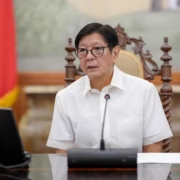
It’s the same with President Marcos, whose defining controversy at this point appears to be the ongoing flood control scandal that he himself triggered in his fourth State of the Nation Address delivered in July. He had set out, at first, to cast a dragnet on those who profited off from “ghost” and substandard infrastructure projects that failed to mitigate flooding across the country. But like a serpent eating its own tail, all the testimonies and documents are now eventually leading back to Malacañang.
The President’s battle cry in July, “Mahiya naman kayo,” once earned roaring applause, but now provides schadenfreude for his administration’s detractors. Never has an anticorruption crusade so badly backfired that it now threatens the very survival of its instigator.
But one silver lining in all this tumult is the renewed public appetite for stories on flooding, or flood management, or its various purported remedies. Because often in journalism, when issues like flooding become too chronic, the less they are treated with urgency, the more they are relegated to some seasonal thing to cover.
It’s also precisely why flood control projects have become a favorite vehicle for corruption. Unlike multipurpose buildings or barangay basketball courts, it’s not as easy to identify flood control projects (what is a revetment? who dares look for drainage systems?), or understand how they’re supposed to work. So when contractors underdeliver, they need only a strong enough typhoon to wash away their fraud.
Ironically, by revealing the Top 15 contractors who had cornered a big chunk of the country’s flood control projects, and by opening his “Sumbong sa Pangulo” website, Mr. Marcos lifted the veil that allowed this entire scheme to escape meaningful scrutiny. He forced into daylight the networks of contractors, officials, and lawmakers who treated infrastructure projects like a bottomless trough.
Critical lens
Now, our readers look for—demand—more stories on flooding, though with a more critical lens. Who conjured these flood control projects, and how much did they cost in taxpayer money? Were they completed on time and within their specifications? Were they built where they were supposed to be?
For individual reporters, the call of the times is to learn and practice data journalism. We do not have the benefit of another Benhur Luy handing us a damning ledger this time—but we’ve seen how simply typing “site: dpwh.gov.ph” on Google can open the floodgates to information waiting all this time to be parsed and pursued.
I, for one, now personally keep multiple databases of flood control and infrastructure projects obtained from the Sumbong site and the Department of Public Works and Highways’ (DPWH) infrastructure portal. I keep pivot tables of certain contractors I have flagged to be suspect or have links to politicians, as well as how many projects they have (and how much they cost).
I have folders and folders of DPWH contracts and Securities and Exchange Commission (SEC) general information sheets and articles of incorporation. I’ve looked at them so many times that I know by heart which are the big or biggest contractors in certain provinces or regions. Some of this data I have been able to use in stories and in scoops about certain ‘congtractors’; others need context for related stories.
The information has also helped me look at the scale and breadth of the nine-company Discaya empire; or the projects in flood-prone Bicol (where my home province is).

Clear memory
Perhaps it’s fortunate that this entire exercise—reporting on floods, or even just thinking about flood management—is not new to me. I was never assigned to the environmental beat where such stories usually go, but I kept returning to them anyway if only to tend to scars left by Tropical Storm “Ondoy” when I was 13.
That was my first clear memory of what a truly devastating flood looked like: my parents wading through neck-deep water, shouting instructions to me and my siblings to flee to our neighbors’ two-story house while they salvaged what they could from our own sunken home. Everything was gone the next day.
Every story I’ve ever written on flooding hoped to make sense of that memory. Last year, I also wrote about the long-overdue Metro Manila Flood Management Project (MMFMP) that was supposed to alleviate flooding in the metropolis, but which was beset by procurement delays and underfunding by Congress. That story bagged best investigative report at the 47th Catholic Mass Media Awards last month.
That it was published 10 months before the current flood control scandal broke out was just fortuitous. But there was an element in that story whose significance wasn’t obvious at the time, but is now being revealed as a critical factor behind the flood mess. At the time, Public Works Undersecretary Emil Sadain lamented that since 2023, the MMFMP, along with other foreign-assisted projects, were not getting the needed government-counterpart funding and had been pushed to unprogrammed appropriations (UA) in the national budget. This meant it could only get funded if the government exceeded its target revenue and generated savings, making such projects perpetually uncertain.
Peak time
Today, public works officials and contractors implicated in the scandal point to the same UA as both a convenient entry point for inserting anomalous projects awaiting funding, and as a dumping ground for legitimate items removed from the regular budget to create space for these anomalies.
Also noteworthy: the UA is released at the discretion of the President. At the start of Mr. Marcos’ crusade, back when he still seemed above the fray, the President lamented: “Are there really no more investigative journalists?”
It was an apparent attempt to disparage the press for supposedly failing to uncover the schemes his administration now claimed to be exposing.
But those critical remarks have only sharpened journalism—compelled us to look at records, create databases, acquire SEC documents, request SALNs, in a way and scale not seen since the PDAF scam. As we’re witnessing once again, such a grave period for the nation calls for critical journalism.