







From Church people, a wellspring of stories

It should be personal, I was told.
One day years ago, after some digging into my personal archives, I realized that I had written so many Church-related stories, mostly magazine features about Church persons—living, killed, martyred, fighting, suppressed, hunted, tortured, celebrated.
So, I came up with a collection titled “You Can’t Interview God: Church Women and Men in the News” (Anvil Publishing, 2013), the fourth of my seven books. I borrowed the title from my own lecture on reporting on matters related to religion before Southeast Asian journalists more than a decade ago.
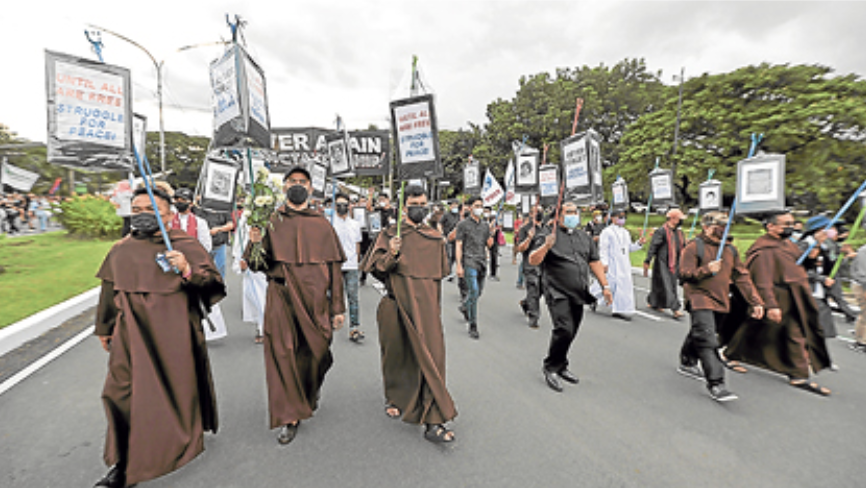
While writing this piece, I looked at my book’s table of contents and the bibliography-like list of my articles at the end, and was struck by the richness and diversity of the lives of those in the Church sector: clerics, consecrated religious, lay persons, members of the hierarchy, activists. How fortunate I have been to be a witness to their lives and to tell their stories. Lives in service of the poor and suffering, confronting sexual abuses, laying one’s life for the beloved country, seeking the lost, least and forgotten, crossing into dangerous terrain, speaking truth to power, fighting for justice, advocating peace and justice in a troubled land. And, in certain cases, paying the price for doing so.
There were many other stories that could not be accommodated in the book.
One standout beat
Standout stories in my mind: A bishop who was gunned down. A fully professed nun in the rebel underground. Religious sisters immersed in an indigenous community or in the urban slums. A German sister (a Ramon Magsaysay awardee) who had spent her life among lepers in Pakistan. A priest who braved the raging waters and tried to save lives during a typhoon and lost his in the process.
Priests with healing hands. A Protestant woman pastor. Church workers and a priest taken hostage. The surreal Black Nazarene “traslacion.” Nuns advocating for human rights and women’s rights. Servant shepherds. Religious cults. Blockbuster papal visits.
Long after the publication of the book, stories continued to cry out to be written.
During these past 40 years that I have been writing for the Inquirer, with close to 3,000 articles of varying lengths and subject matter—feature stories, serialized investigative reports, opinion pieces, etc.—in print and online, I could say that I have crisscrossed different beats—health, environment, politics, women, crime, culture and the arts, name it.
One of the beats that I have felt strongly drawn to is the Church beat. That is, after human rights.
‘Digital missionaries’
A footnote: a French Church group sponsored my trip to Paris in 1998 for me to attend, with other Filipino human rights activists, the 50th anniversary of the Universal Declaration of Human Rights, where among the speakers were some of the framers of the Declaration. It was at the same historic Palais de Chaillot where it was signed 77 years ago this year.
Religion, the Churches and people of all faiths are part of Philippine culture, society and history. Media practitioners need to familiarize themselves with Church affairs, structures, dynamics and personalities, even while Church persons are themselves getting more adept at media technology, their blogs and websites not be scoffed at. Yes, Pope Leo XIV did put a good word for “digital missionaries.”

In Philippine media, specifically in the Inquirer, there is a so-called religious or Church beat. This probably dates back to that time when Church officials spoke openly against the tyrannical regime of the Marcos martial law era. I know of priests who were heavily tortured. On ordinary days, this beat may not be a major one like defense, justice, foreign affairs, sports, the legislative or the presidency, but it is a good source of news stories. Because human beings in the Church sector also wade into the secular, not necessarily to directly evangelize but because they are also citizens with voices, or because it is a biblical imperative.
So, in writing about religious affairs that impact the secular and vice versa, I have made it a point not to be confined to the parochial. Many issues are interconnected. At times, the issue of religious affiliation is played out in the larger and secular arena. It is played out in elections and politics, ethnic conflicts, military operations and attacks on sacred places.
Complexity, color
The so-called separation of church and state is easier said than done. There is a time when it is imperative for those in the Church sector to speak out and speak truth to power.
What do religious authorities or members of a religious group have to say on the government’s policy on abortion, sex education for the young, divorce and gay marriage? On health and AIDS? These may not make stand-alone “religious” stories in themselves, but these may make their way into stories in other beats like, say, health, the environment and women’s rights.
There are fine lines to tread that are not as obvious as, say, the death penalty or workers’ rights. Matters of faith add to the complexity and color of social issues. Journalists may get so focused on the secular issues at hand that they might miss out on the lives of the Church persons involved.
Up close, these persons can be an interesting lot. They add perspective and depth to the hard news. My thanks to those who trusted me with their stories (some unprintable) and shared with me the essence of their personal lives, thus enriching mine.