









Gov’t urged to run oil industry as prices soar

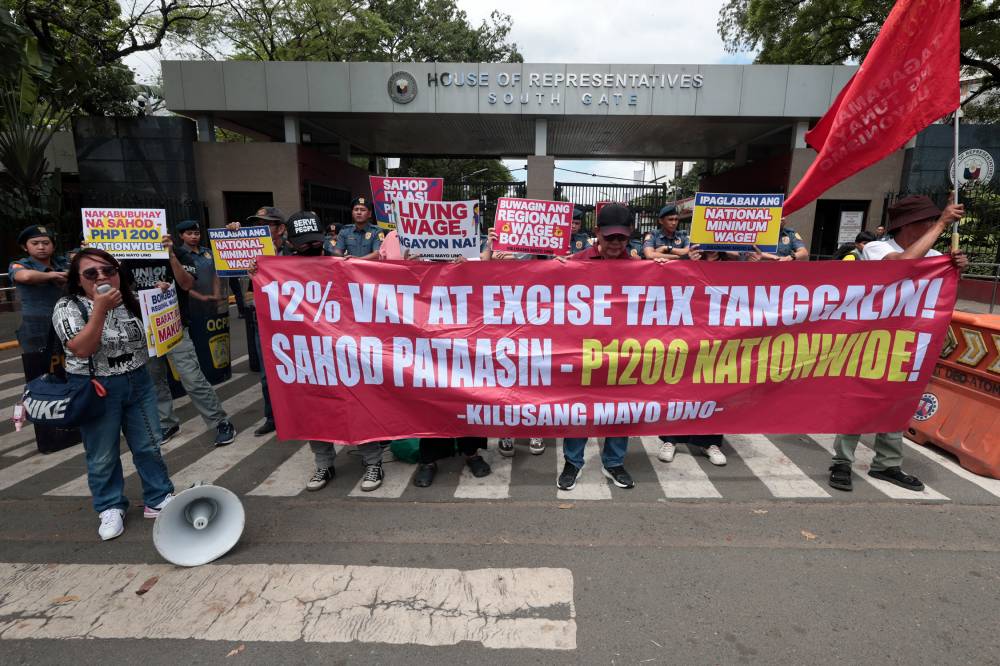
Ahead of another round of double-digit fuel price hikes on Tuesday, the largest trade union in the country has called on President Marcos to enforce emergency powers under the oil deregulation law, to temporarily take over the industry in a bid to stabilize oil prices.
Also on Monday, the House of Representatives approved on third and final reading the President’s earlier proposal to suspend the fuel excise, as Mr. Marcos also certified as urgent that day a measure to temporarily allow the unhampered importation of biofuel components.
House Deputy Speaker and party list Rep. Raymond Democrito Mendoza of the Trade Union Congress of the Philippines (TUCP) said the President may invoke Section 14(e) of Republic Act No. 8479, or the Downstream Oil Industry Deregulation Act of 1998.
“In times of national emergency, when the public interest so requires, the DOE (Department of Energy) may, during the emergency and under reasonable terms prescribed by it, temporarily take over or direct the operation of any person or entity engaged in the Industry,” the provision states.
Mendoza said, “When a conflict thousands of kilometers away suddenly dictates how much a Filipino family eats, rides, and pays for their needs, that is no longer just a global crisis, it becomes a national emergency at home.”
“The government need not be powerless and helpless under the oil deregulation law as it already gives the [DOE] the authority to act during a national emergency. But how long will it take before we use those powers to protect people over profit?” he added.
Mendoza said once the President declares a state of national emergency, oil companies, especially the biggest players, are mandated to fully disclose to the DOE, under confidentiality, their actual supply inventories and acquisition costs.
“Let us be clear: this is not about punishing oil companies but sharing the burden of a national emergency,” Mendoza said, as he noted further that “the government is already stretching its limited fiscal space through fuel subsidies and possible excise tax suspensions.”
“But are the oil companies willing to sacrifice a portion of their double-digit earnings growth and even record-high net income [which] they boasted just weeks ago?” he asked.
State of national calamity
Apart from Mendoza’s recommendation, the country remains in a yearlong state of national calamity until November under Proclamation No. 155, which the President issued last year.
This allows the government to impose a price freeze on basic commodities, and prevent the overpricing, profiteering or hoarding of prime commodities, medicines and petroleum products.
The government, however, cannot set price caps on fuel prices due to the oil deregulation law. Petroleum companies set their own prices based on global crude prices, foreign exchange, and shipping and refining costs.
The TUCP also urged the President to convene a National Emergency Summit, bringing together representatives from labor, transport groups, agriculture, business, consumer organizations, and the academe, among other sectors.
The Inquirer reached out to Palace press officer Claire Castro for comment but she had yet to respond as of Monday night.
Excise, biofuels
Meanwhile, the House voted 247-3 to approve House Bill (HB) No. 8418, which seeks to add to Section 148 of the National Internal Revenue Code a provision that would allow the President to suspend the fuel excise, upon the recommendation of the Development Budget Coordination Committee and the DOE.
This amendment goes with certain conditions: the average Dubai crude price must be based on the Mean of Platts Singapore reaching or exceeding $80 per barrel for one month; and a state of national emergency or calamity must have been declared by the President.
Mr. Marcos on Monday also sought the expedited passage of Senate Bill No. 1965, which seeks to amend Republic Act No. 9367 or the Biofuels Act of 2006.
In his letter to Senate President Vicente Sotto III, the President said the Senate measure, if enacted, will “mitigate the impact of rising fuel prices amid escalating geopolitical tensions and volatility in global oil markers, as well as strengthen the country’s resilience against future disruptions to energy supply.”
The bill, authored by Senators Jinggoy Estrada and Pia Cayetano, was filed on March 12, and is pending first reading as of Monday. A House counterpart bill, HB 8469, is also pending first reading.
The government aims to scale up the use of biofuels in the country’s energy mix, amid the disruption to fuel exports since the Iran war broke out on Feb. 28.
The existing law mandates the use of locally sourced biofuels components in all liquid fuels for motors and engines sold across the country, with the current blending set at 3 percent of bioethanol by volume (B3).
SB 1965 proposes to give the President the authority, alongside the recommendation of the National Biofuels Board (NBB) and the DOE, to import, for a period not exceeding a year, biofuel components such as bioethanol and biodiesel, “regardless of the supply level of locally produced biofuel components.”

This shall be done if the price of blended gasoline and/or diesel engine fuels is higher by at least 5 percent compared to their pure fuel counterparts.
Higher blend
A total of 14 biodiesel facilities in the country currently utilize 100-percent locally sourced coconut oil to produce coconut methyl ester (CME), used as an alternative to fossil fuel-based diesel.
CME is a fatty acid ester produced from coconut oil and when blended with diesel, turns into coco-biodiesel. It has a high cetane number and better lubricating properties.
The DOE issued an advisory last year suspending the 4-percent and the 5-percent biodiesel blend scheduled for implementation in October 2025 and this year, respectively.
It acted on the NBB’s recommendation to defer the higher biodiesel blend, as global coconut oil prices soared by more than 300 percent per metric ton.
In a statement over the weekend, The Philippine Biodiesel Association said it is ready to pump up the biodiesel blend to 7 percent to help shield Filipinos from further spikes in imported fuel prices.
Although the current blending rates are set at 3 percent, it said operators have invested in capacity building, allowing them to supply up to a 7-percent biodiesel mix.
The group previously said coco-biodiesel remains cost-efficient, noting that blended diesel is often at parity with, or even cheaper than, pure diesel.
******
Get real-time news updates: inqnews.net/inqviber