









House dismissal of impeach raps vs Marcos seen affecting Sara’s case

The reasons presented by the House justice committee to dismiss the two impeachment cases against President Marcos could affect the outcome of the new complaints against Vice President Sara Duterte, which are expected to be deliberated in the coming weeks.
Legal experts and minority lawmakers said on Thursday that the committee majority, who are part of the proadministration bloc, “lawyered” for the President and wrongly and prematurely applied a strict standard of evidence in deciding that the impeachment complaints against Mr. Marcos did not meet the “sufficiency in substance” requirement for the process to continue.
The two complaints were filed separately by lawyer Andre de Jesus, endorsed by Pusong Pinoy Rep. Jett Nisay, and by Bagong Alyansang Makabayan (Bayan), endorsed by the Makabayan bloc of ACT Teachers Rep. Antonio Tinio, Gabriela Rep. Sarah Elago and Kabataan Rep. Renee Co.
After finding that the two complaints were sufficient in form on Monday, the more than 40 members of the justice committee voted overwhelmingly on Wednesday to declare that these were lacking in substance.
This effectively killed the complaints before they could reach the hearing stage where evidence could be presented to back the allegations against the President.
“We have repeatedly heard representatives of the majority say that there is no evidence and that the offenses contained in the complaint are not impeachable. It is not their job to lawyer for the President, but that seems to be what is happening,” the Makabayan lawmakers said in a statement.
“Clearly, the majority would not like the President to face the charges against him at the proper forum. That is what this is about—an attempt to shield the President, to prevent him from answering the allegations against him.”
Mamamayang Liberal Rep. Leila de Lima, who voted in favor of the Bayan complaint, said that determining sufficiency of substance required only a recital of facts, not yet to establish that the allegations were true.
‘Same standard’ for Sara
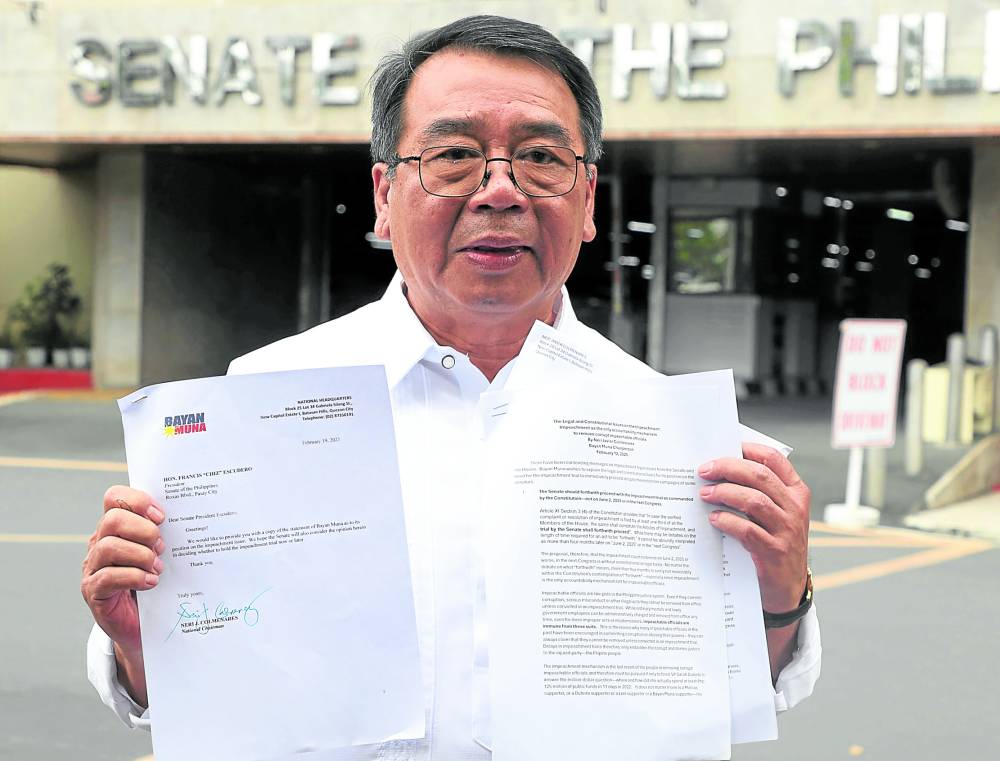
Lawyer and former Bayan Muna Rep. Neri Colmenares said that if the facts alleged were proven during subsequent hearings, they would constitute an impeachable offense, but the majority was already demanding proof at that early stage of the impeachment process.
“If that’s the case, then we should have already brought witnesses, right?” Colmenares told the Inquirer. “But that was not the proper stage to have done that. That comes at the next stage, at the determination of probable cause during the hearings.”
Constitutional law expert and University of the Philippines law professor Paolo Tamase shared this view, saying that the determination of sufficiency in substance “is supposed to be a low bar.”
At this stage, the justice committee “normally doesn’t go into evidentiary matters” like whether the complainants had personal knowledge or enough proof.
“Those are settled after sufficiency in substance and once the (impeachable) officer replies and the parties present their evidence,” he said in an interview.
Tamase warned that this could affect the new impeachment complaints against Duterte as the House “must apply the same high standard in assessing the sufficiency in substance.”
“While impeachment is political and thus, in the final analysis, a numbers game, it has moral undertones that requires the House to act fairly. It needs to do that if it wants the public to take its proceedings seriously,” Tamase said.
It’s also why Colmenares urged the House to walk back this standard, at the very least, “or else impeachment is going to be impossible.”
“They need to set the right precedent in impeachments in a way that makes it an accessible (venue for accountability),” he said. “Because if this is going to be the standard from now on, then all future complaints will die at this stage if the committee will always say these are mere allegations and hearsay.”
Colmenares joined Bayan in filing one of the two impeachment complaints against Duterte, which repeated among other allegations, that she betrayed public trust in misusing P612.5 million in confidential funds.
The Supreme Court last week affirmed its July 2025 ruling that Duterte’s impeachment was unconstitutional for violating the one-year bar on filing more than one impeachment case against the same official.
Strongest ground
In criticizing the House justice committee’s decision, Colmenares said it threw out their strongest ground against Mr. Marcos—former Ako Bicol Rep. Elizaldy Co’s allegations that the President, his Cabinet secretaries and former Speaker Martin Romualdez maneuvered P100 billion into the 2025 General Appropriations Act in exchange for kickbacks.
He said the committee dismissed Co’s allegations, made through a series of Facebook posts from abroad, because they were not “authenticated documents.”
“How sure are they that Co would not have come home and issue an affidavit had the complaints gone to hearing?” Colmenares said. “How sure was the committee that there was no evidence to back the allegations?”
But one thing going for the Bayan complaint against Duterte was that it cited so many transcripts from hearings in both the House and the Senate, according to the former lawmaker.
“So I imagine they would be hard-pressed to say these are not authenticated documents,” he said. “But remember, we also did the same for the Marcos complaint. The sauce for the goose is sauce for the gander.”

Leaders of the House justice committee denied allegations that they “lawyered” for Mr. Marcos or that they railroaded the dismissal of the impeachment complaints.
“What happened was not lawyering for the President but the giving of opinions by each member,” Manila Rep. Joel Chua said at a press conference after Wednesday’s vote, adding that committee members who are lawyers explained how to look at evidence.
Luistro: Rules are rules
Committee Chair Batangas Rep. Gerville Luistro said that rules were meant to be followed.
“It is very clear … that the impeachment complaint must be coupled with a verification which says that the allegations must be based on personal knowledge and authentic records,” she said.
“If the allegations are not based on (these), that will fail the standard of sufficiency in substance and even in form.”
San Juan Rep. Isabel Zamora said the committee allowed everyone to speak on each of the charges against the President.
“If we wanted to stop this at the earliest opportunity, we could have done so at the level of form,” according to Bicol Saro Rep. Terry Ridon.
The committee opted to proceed with deeper deliberations to avoid allegations of haste or bad faith, Ridon said.
Luistro said they had “painstakingly engaged in the deliberation.”
“We cannot please everyone but in as far as I am concerned as the Justice Chair, I am very much convinced and I stand that the members of the Justice Committee acted independently and impartially,” she said.
******
Get real-time news updates: inqnews.net/inqviber