










How national agencies will decide Pangasinan’s nuke fate

(Last of three parts)
LABRADOR, PANGASINAN— Emerging as a proposed site for a nuclear power plant, this coastal town draws increasing public scrutiny and opposition.
The planned project carries an estimated cost of P225 billion, with Pangasinan Rep. Mark Cojuangco citing Labrador’s geographical features as making it a suitable candidate.
Conflicting claims over public support for the proposed nuclear power plant surfaced after information circulated stating that residents of Labrador had signed in favor of the project. Labrador is home to roughly 30,000 people on less than 10,000 hectares.
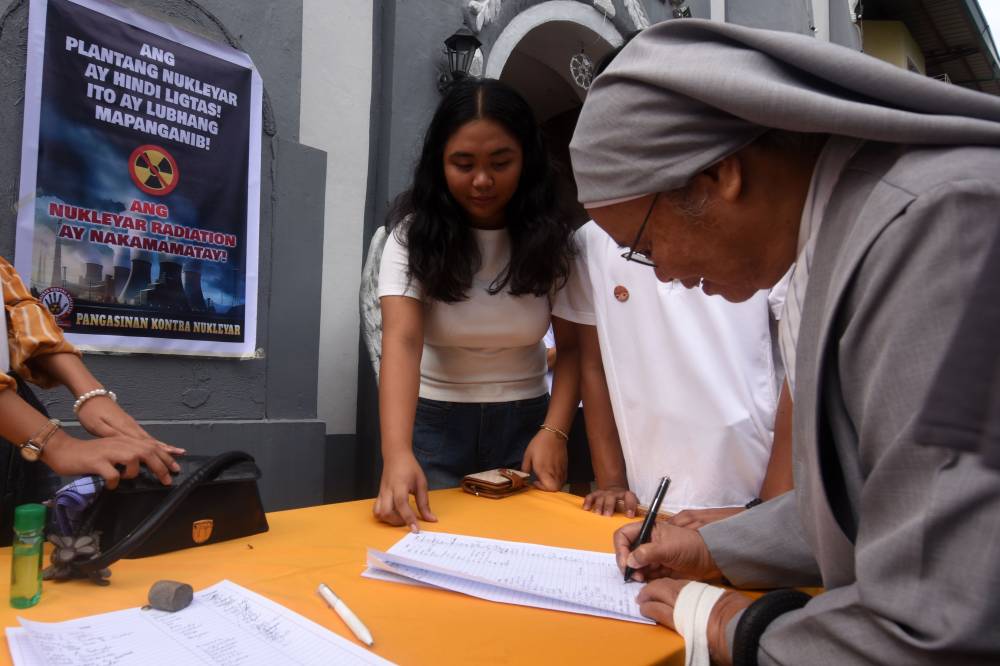
Church leaders question the validity of the signatures, saying many residents are unaware of what they are signing.
In response, the Catholic Church organizes its own signature campaign to formally register opposition to the proposal—a move later criticized as allegedly influencing Mass attendees. Church leaders deny the claim, saying participants are fully informed that the Jan. 4 Mass, led by Alaminos Bishop Napoleon Sipalay, is explicitly held to oppose the nuclear power plant.
With pronuclear groups claiming that 66 percent of Labrador residents have signed in favor of the project, and opposition groups reporting 500 signatories, the town appears divided.
However, the decision to establish a nuclear power plant does not depend solely on the approval or disapproval of town residents.
It involves national government agencies, independent regulatory bodies and specialized technical institutions.
The authority to license and authorize the construction of a nuclear power plant lies with the country’s nuclear regulator—the Philippine Atomic Energy Regulatory Authority (PhilATOM).
During a hearing on Senate Bill No. 1206 (Philippine Nuclear Liability Act), filed by Sen. Bam Aquino on Jan. 22, Alex de Guzman of the Environmental Management Bureau (EMB) under the Department of Environment and Natural Resources (DENR) says an environmental compliance certificate (ECC) is required for the project to proceed.
Before an ECC can be granted, the project proponent must undergo a lengthy process that requires public participation at various stages, with the EMB providing oversight and checks and balances.
Ultimately, the decision lies beyond Labrador.
Final warning
Nuclear power projects require approval from national regulators, including PhilATOM, as well as an ECC from the DENR.

According to Carlo Arcilla, director of the Department of Science and Technology-Philippine Nuclear Research Institute, the fastest way for the country to adopt nuclear power is to revive Bataan Nuclear Power Plant.
Farmer-leader Hipolito Mislang, 93, fears what he sees as the most dangerous scenario: war, in which nuclear facilities become targets.
“What would happen to us? A drone is enough to carry a bomb. So what do you think will be destroyed in Labrador? Labrador—everything. The whole of Labrador,” he tells the Inquirer.
Church leaders are more emphatic in their declaration: “Pangasinan is not ours. We owe future generations the responsibility to keep Pangasinan safe from the disaster of a nuclear catastrophe.”
They add: “The risks are greater than the benefits. Buhay muna bago ang kuwarta! Tao muna bago ang lahat! Aanhin ang benepisyo kung mas malagim ang perwisyo? (Life comes before money. People before everything else. What good are the benefits if the damage is far more devastating?)”
“Choose life, that you and your children may live,” the church leaders assert.