






ICC prosecutor: Fear of Du30 led to slays

THE HAGUE, THE NETHERLANDS—The prosecution and the counsel for the victims on Monday told judges at the International Criminal Court (ICC) that former President Rodrigo Duterte had created “mini-Dutertes,” or clones of himself, who became blood-thirsty under a cloud of fear he instilled so that suspected criminals would be killed under a ruthless pattern of attack while he was a city mayor and the country’s leader.
But Duterte’s lead counsel dismissed the Davao Death Squad (DDS), composed of hired goons and policemen who pulled the trigger in the name of Duterte’s bloody war on drugs, as a “fictitious construct” that the prosecution has focused on despite lacking in substantial grounds.
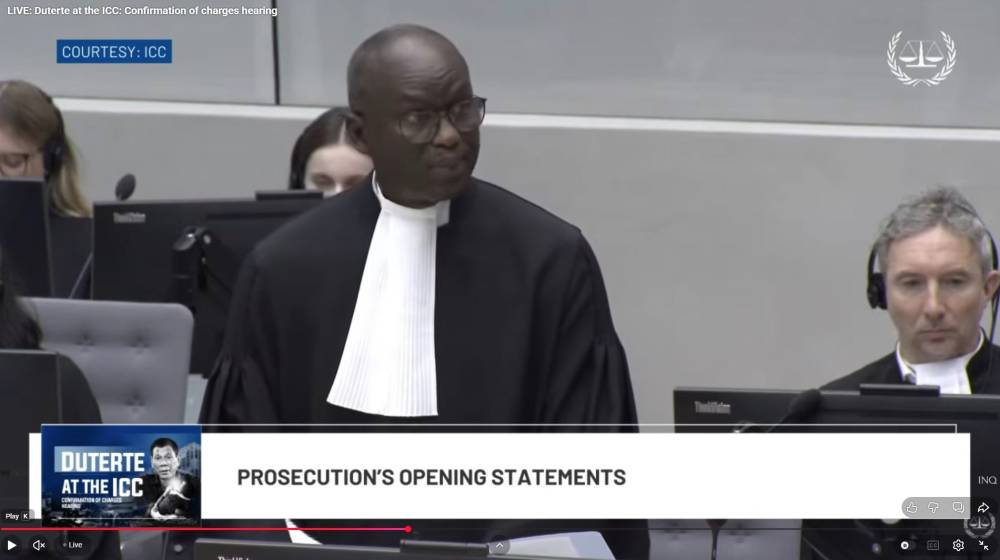
It was the day of opening remarks for the prosecution, defense and the victims’ lawyer, the start of the much-anticipated confirmation of charges hearing in the crimes against humanity case against Duterte, who is facing two counts of murder and one count of murder and attempted murder for the killings of 78 individuals in his crackdown on illegal drugs.
These include the murder of 19 victims in Davao City from 2013 to 2016 by the DDS, while Duterte was still mayor; the murder of 14 “high-value targets” from 2016 to 2017 by a national network of state actors; and the murder and attempted murder of 45 victims during a barangay clearance operation from 2016 to 2018, during which three children were also killed.
‘Blind loyalty’
Deputy Prosecutor Mame Mandiaye Niang went first, with a reminder about the gravity of the hearing to the victims, the Filipinos and the ICC to prosecute individuals accused of being behind the thousands of drug war killings in the Philippines.
“[This is] a reminder that those in power are not above the law,” Niang told the court.
According to Niang, the police and gunmen of the so-called DDS were emboldened by the cloud of “fear” that the former president and Davao City mayor created as a “de facto authority.”
He cited the testimony of an unnamed “insider” witness, who told the prosecution that compliance to the killings was “impossible not to obey” due to “blind loyalty,” a system of rewards and incentives and a form of competition that also brought purpose to Duterte’s followers.
“Others felt no other choice but to comply, [it was] simply impossible to not obey Duterte’s command,” Niang told the three-member Pre-Trial Chamber (PTC) I, quoting testimonies mentioned in the prosecutor’s list of materials submitted to the court.
It was “no secret,” Niang pointed out, as Duterte repeatedly threatened drug users and pushers who would be killed in his incendiary public statements while he was mayor, was gunning for the presidency, and eventually as Philippine president.
It was a “program” he promised even during his presidential campaign, the deputy prosecutor noted.
Citing Duterte’s speeches, Niang told the chamber that Duterte bragged about doing the deed himself to “personally show … that if I can do it, so can you.”
Reward system
The prosecution said the insider witnesses have detailed a rigid hierarchy where a “major” hit can only be carried out upon direct signal from the top.
Niang said an insider told him that the “clearance” from Duterte as the mayor was the final step in any execution.
When Duterte became president, insider witnesses said an incentive structure was put in place to ensure compliance within the ranks of the Philippine National Police.
The prosecution, quoting insider witnesses, said the police were given weapons and logistics, cash rewards “per head,” and publicly naming individuals on the “watch lists” were subsequently killed.
Niang said insiders described a “cash per head” system where financial rewards and rapid-track promotions were the primary currency for those who met killing targets.
Conversely, those who hesitated, the witnesses alleged, faced a culture of fear, adding that one insider explained that it was “simply not possible” to disobey a command originating from the then President Duterte.
Lingering fear
Human rights lawyer Joel Butuyan, who spoke on behalf of the victims, expressed the lingering fear of the families of the drug war killings if the charges against Duterte are not confirmed.
“This case symbolically represents the last boat the victims can board to go on a journey in search of justice for their loved ones who were brutally killed upon the orders of Mr. Duterte. If this Chamber prevents the boat from sailing by not confirming the charges, the victims will forever be moored in an island where the nights are filled with the screams and cries of their massacred loved ones,” Butuyan told the chamber. “There is absolutely no other recourse for the victims.”
A scenario the victims fear will happen if the charges are dropped is that Duterte would be heralded instead as a “conquering hero,” who preaches “his gospel of impunity.”
“It is a very serious concern of the victims that Mr. Duterte will be portrayed in history by his multitude of followers as the leader who vanquished the ICC and who cleansed his country of 30,000 rapists, murderers and dangerous criminals, which were the scornful words he sweepingly used against all those who were killed in his murderous spree,” Butuyan added.

‘Silent partner’
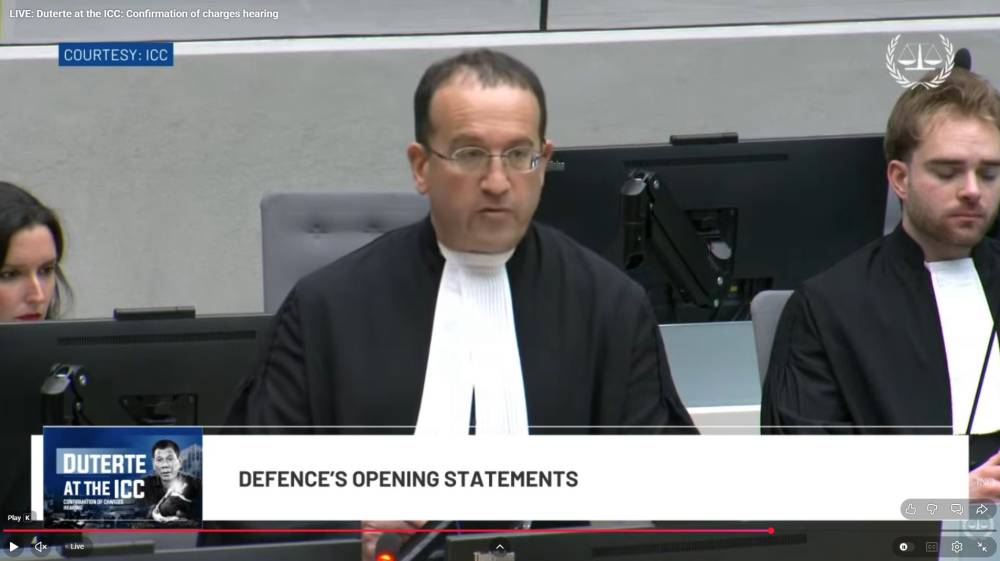
Defense counsel Nicholas Kaufman followed Butuyan’s remarks, and before starting his opening statements, went straight to dismissing the Filipino lawyer’s arguments: “This is a court of law…. not political demagoguery.”
Kaufman also accused President Marcos of seeking to “neutralize” the former chief executive, citing a document that supposedly contained a transcript of a telephone call among four parties, including a “silent partner” for Mr. Marcos.
While Kaufman did not identify who these parties were, he claimed that Mr. Marcos’ “silent partner” was “boasting about managing a scheme” to influence the ICC case versus Duterte.
This, he said, proved that Mr. Marcos intended to “neutralize” Duterte and his legacy.
This was quickly belied by the Palace, which accused Kaufman of suffering from “cognitive impairment.”
Presidential Communications Office Undersecretary Claire Castro reminded Kaufman that the cases against Duterte at the ICC were filed in 2017, back when Mr. Marcos was still a private citizen.
“He seems to be the one suffering from severe cognitive impairment, and not his client, because he tremendously forgets the timeline,” she added.
Castro noted that Kaufman does not seem to offer a clear defense for his client, Duterte, particularly on the alleged extrajudicial killings that occurred during his time as a mayor.
“In addition, one of the counsels, Silvestre Bello III, admitted that Duterte killed someone by throwing him out of a helicopter,” Castro said. —WITH REPORTS FROM TETCH TORRES-TUPAS AND ZACARIAN SARAO
******
Get real-time news updates: inqnews.net/inqviber